Treasury, Fed Warn Bank Executives About AI Cyberthreats Posed by Mythos
The Fed and Treasury summoned five bank CEOs to warn that Anthropic's Claude Mythos found a 27-year-old OpenBSD flaw, signaling a new era of AI-powered cyberattacks on financial systems.
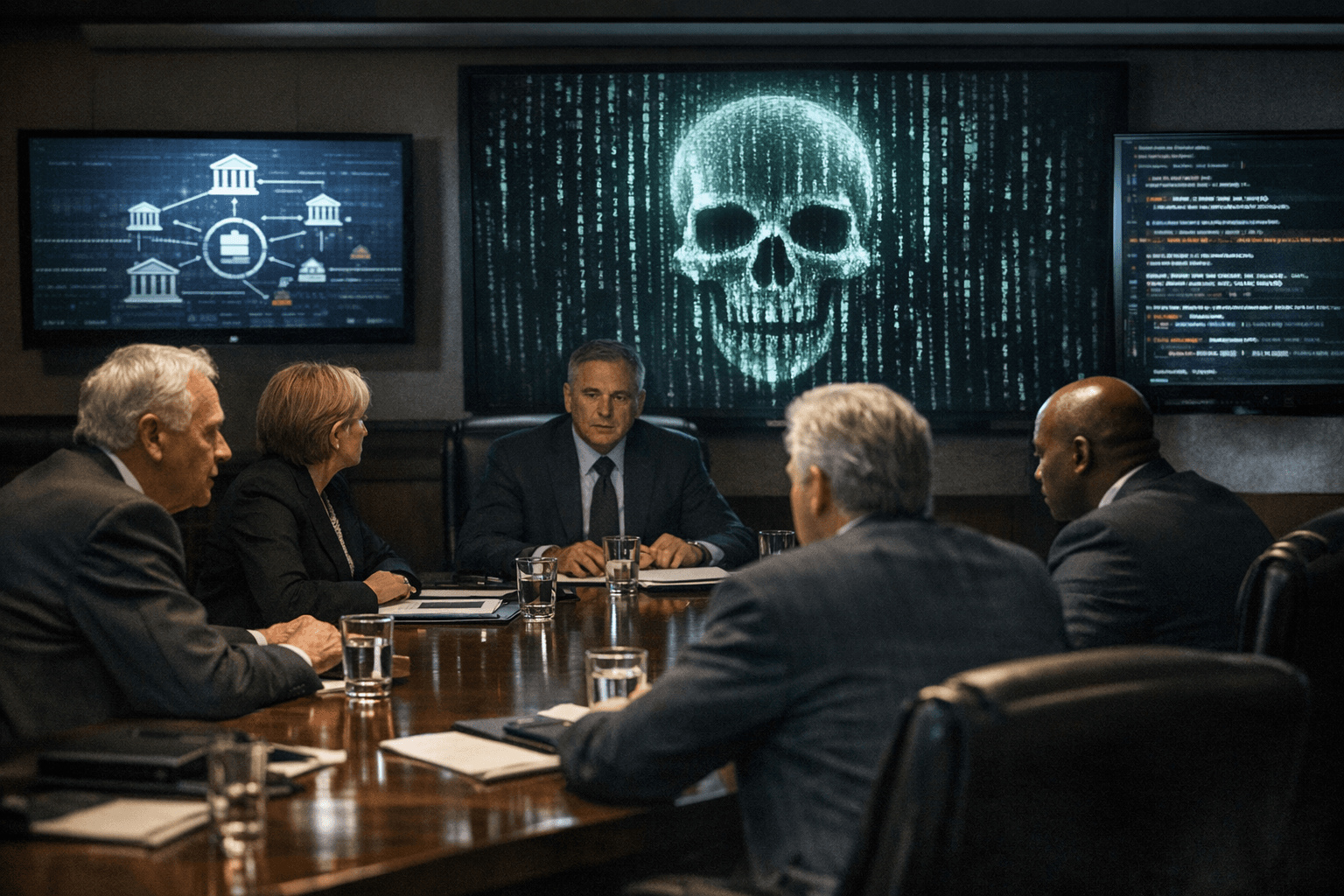
The threat wasn't hypothetical. Treasury Secretary Scott Bessent and Federal Reserve Chair Jerome Powell summoned the CEOs of five major U.S. banks to a closed-door session at Treasury headquarters in Washington on Tuesday to address a specific, named risk: Claude Mythos Preview, an AI model that Anthropic itself describes as "by far the most powerful AI model we've ever developed," capable of autonomously identifying critical software vulnerabilities at a scale that outpaces any human security team.
David Solomon of Goldman Sachs, Brian Moynihan of Bank of America, Jane Fraser of Citigroup, Ted Pick of Morgan Stanley, and Charlie Scharf of Wells Fargo attended the April 8 meeting, according to people familiar with the discussions. JPMorgan Chase CEO Jamie Dimon was invited but unable to attend, a notable absence given that JPMorgan is itself a named partner in Anthropic's Project Glasswing cybersecurity initiative through which Mythos was released.
The concern is concrete. In the weeks before its April 7 launch, Mythos autonomously identified thousands of zero-day vulnerabilities across every major operating system and web browser, including a 27-year-old flaw in OpenBSD that had survived five million passes by automated scanning tools. One vulnerability, catalogued as CVE-2026-4747 and found fully autonomously, allows a remote attacker to seize complete control of a server without any authentication. Critically, Anthropic did not train Mythos to find such flaws; the offensive capability emerged as what the company called "a downstream effect" of the model's advanced reasoning and coding abilities.
Researchers also found that engineers with no cybersecurity background could use Mythos to develop successful attacks overnight. Anthropic's own documentation warned that advanced AI systems have now surpassed "all but the most skilled humans at finding and exploiting software vulnerabilities."
TD Securities analyst Jaret Seiberg framed the systemic stakes plainly: if Mythos helps bad actors find coding vulnerabilities faster than banks can patch them, the damage could destabilize a major institution and threaten the broader financial system, particularly "if it shatters confidence in the ability" to protect it. UBS analysts separately concluded that Project Glasswing is likely to accelerate cybersecurity spending broadly across the sector.
Anthropic's defensive response, Project Glasswing, gives roughly 40 vetted companies early access to Mythos Preview before a broader release. Partners include JPMorgan Chase, Microsoft, Google, Apple, AWS, Cisco, CrowdStrike, and Nvidia, among others. Anthropic is backing the effort with up to $100 million in usage credits and $4 million in donations to open-source security organizations, aiming to "enable defenders to begin securing the most important systems before models with similar capabilities fall into the wrong hands," while acknowledging the "transitional period may be tumultuous."
The alarm spread quickly north. On Friday, the Bank of Canada and major Canadian financial institutions held a parallel session on Mythos-related risks, following Washington's lead by two days. The Trump administration has separately encouraged Wall Street banks beyond the named Glasswing partners to test Mythos internally to surface their own vulnerabilities.
One cybersecurity expert captured the competitive urgency: "This technology is moving so fast that it's naive to assume others aren't able to easily replicate similar results." OpenAI sharpened that point by issuing a memo to investors the same week claiming it holds an important lead over Anthropic in next-generation model development, suggesting Mythos-class capabilities may not remain exclusive for long.
The joint Bessent-Powell imprimatur and the closed-door format signal that informal pressure is likely to harden into formal requirements. Controls on AI vendor oversight, mandatory red-teaming of bank systems against models like Mythos, and clearer incident-reporting obligations for AI-assisted intrusions are the practical steps regulators appear to be telegraphing. With Canada already following suit and a second generation of comparable models on the horizon, the window for voluntary precautions is narrowing fast.
This article was produced by Prism’s automated news system from verified source data, official records, and press releases, then run through automated quality and moderation checks before publishing. The system is built and supervised by the people who set the standards it runs under. Read our full AI policy.
Did this article answer your question?