Truecaller pivots to subscriptions and business services as ad revenues fall
Ad pressure hit Truecaller’s biggest revenue engine, even as subscriptions and business services surged past a 750 million-krona annualized run-rate.

Truecaller’s ad slump has forced the caller-ID app to lean harder on paid subscriptions and business services as it tries to reduce its dependence on India and on a volatile advertising market. The shift comes after the company said a change in an algorithm by its largest demand partner, starting on August 13, 2025, cut ad revenues beginning in mid-August and left fourth-quarter ad sales expected at SEK 210 million to SEK 230 million, about 30% lower in constant currencies.
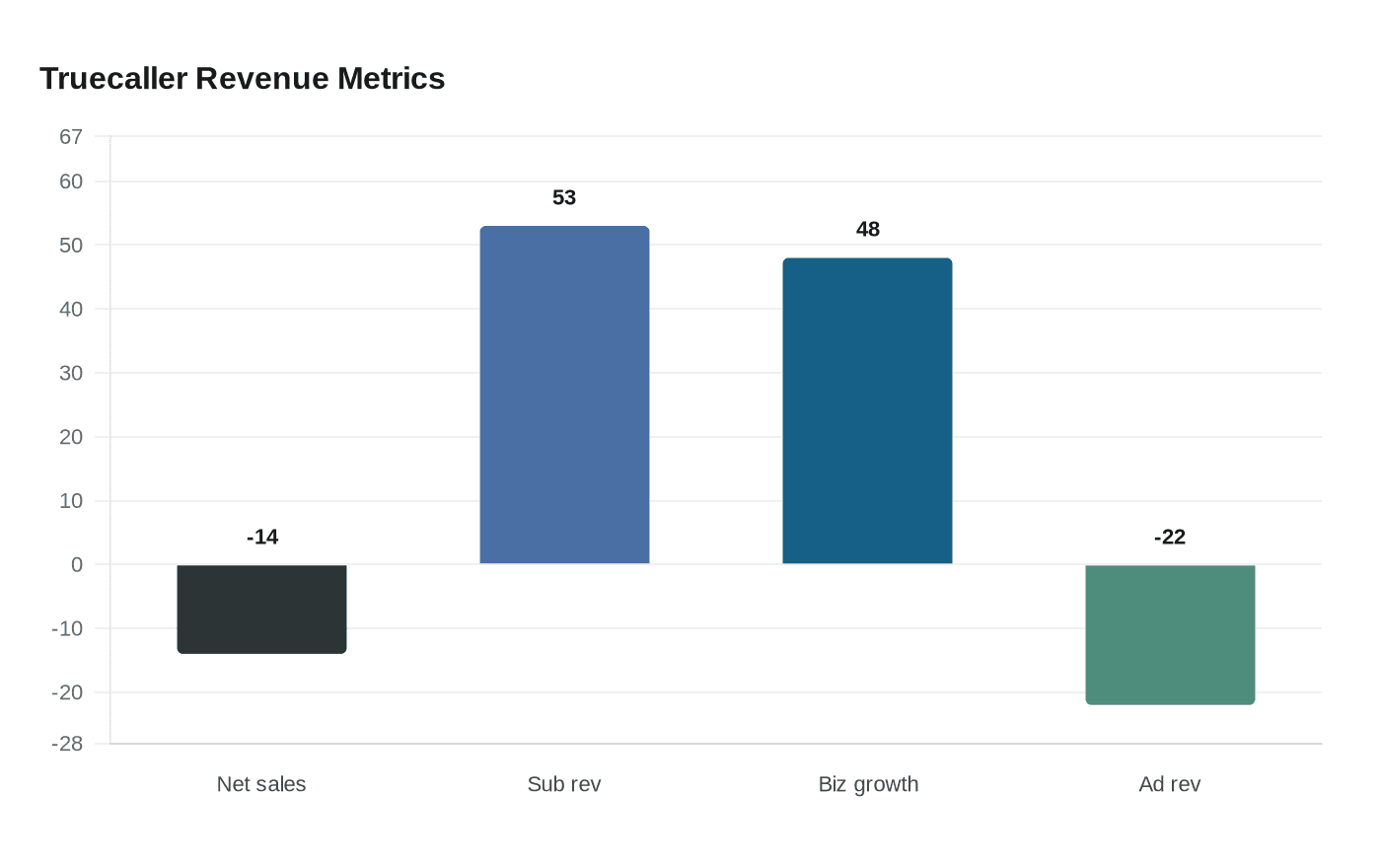
The damage showed up in Truecaller’s year-end 2025 numbers. Net sales fell 14% to SEK 450.9 million, though the decline was only 1% in constant currencies, while the underlying mix moved sharply toward recurring revenue. Subscription revenue rose 53% in constant currencies, Truecaller for Business grew 48%, and ad revenue dropped 22%. Truecaller said recurring revenues excluding one-off items reached an annualized run-rate of about SEK 750 million, a sign that the company is trying to build a more durable base than advertising alone can provide.
That pivot is happening while the user base is still expanding. By late March 2026, Truecaller said it had more than 500 million users globally, including 350 million in India and 150 million outside India. The company also said it crossed 4 million premium subscribers in March 2026, and that it added more than 50 million users in 2025. In India, where Truecaller remains dominant, its 2025 India Insights report said users blocked 1,189 crore unwanted calls during the year.
Even so, the market Truecaller built itself around is becoming more contested. India’s Department of Telecommunications has been moving toward a Calling Name Presentation system, or CNAP, that could function as a network-level caller ID alternative backed by verified subscriber records. That raises the possibility of a government-supported substitute in Truecaller’s most important market just as the company is also facing more competition and a loss of exclusivity in business messaging, which it expects will slow growth in Truecaller for Business in 2026.
For Truecaller, the next phase is less about raw user expansion than about monetization discipline. The company is pushing subscriptions, direct sales and reseller partnerships while trying to widen growth beyond India, a strategy that reflects a broader problem across consumer tech: once a platform matures, every new source of revenue risks changing the product that made it valuable in the first place.
This article was produced by Prism’s automated news system from verified source data, official records, and press releases, then run through automated quality and moderation checks before publishing. The system is built and supervised by the people who set the standards it runs under. Read our full AI policy.
Did this article answer your question?