Trump administration moves to force many green card applicants overseas
A May 21 USCIS memo and a May 23 policy shift could send many in-country green card applicants abroad, while health and housing rules tighten too.
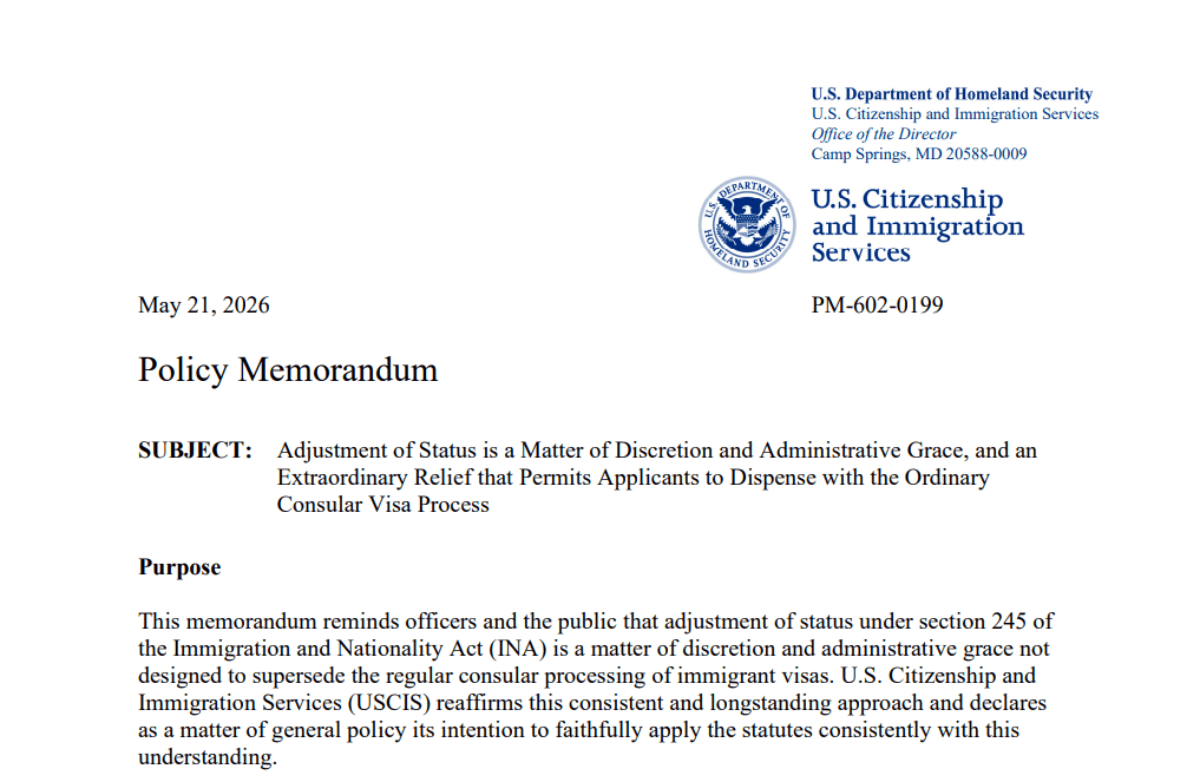
Green card applicants already living in the United States are being pushed toward a far harder route to permanent residency. U.S. Citizenship and Immigration Services issued policy memorandum PM-602-0199 on May 21, 2026, and the Trump administration said two days later that most immigrants seeking green cards must leave and apply from abroad, turning consular processing outside the country into the default with only limited exceptions.
The change reaches well beyond a narrow class of applicants. More than half a million people rely each year on the ability to apply for a green card from within the United States, and The Washington Post reported that about 54 percent, or 608,260, of the 1.17 million new lawful permanent residents in fiscal year 2023 received their green cards without leaving the country. Immigration lawyers and advocates say the new posture could disrupt students, workers and other temporary visa holders who have built their lives around the existing process.
The pressure campaign does not stop at immigration paperwork. Separate federal changes are set to tighten access to health coverage for lawfully present immigrants beginning in 2026. The Commonwealth Fund projects that more than 1 million lawfully present immigrants will lose access to marketplace coverage, Medicaid or Medicare under H.R. 1 and a new federal rule. The Department of Health and Human Services has also rescinded a 1998 interpretation that had extended certain federal public benefits to undocumented immigrants, including Head Start and mental health programs.
Housing has become another front. In Port Isabel, a South Texas community of about 5,000 people, the Port Isabel Housing Authority sent residents a Feb. 3, 2026 letter saying households had 30 days to prove legal status or face eviction. The episode triggered confusion and warnings, and it showed how quickly a federal signal can ripple through local housing offices and leave mixed-status families scrambling. HUD has separately been pressing public housing agencies to verify citizenship or eligible immigration status, prorate aid for mixed-status households and report some cases to the Department of Homeland Security.
All of this lands inside a broader second-term immigration drive that has already generated hundreds of lawsuits. Courts have blocked the administration in a number of cases, and the final reach of this campaign will depend on those challenges, along with the limited exceptions agencies choose to recognize.
This article was produced by Prism’s automated news system from verified source data, official records, and press releases, then run through automated quality and moderation checks before publishing. The system is built and supervised by the people who set the standards it runs under. Read our full AI policy.
Know something we missed? Have a correction or additional information?
Submit a Tip