Trump Cites Europe's Iran Stance, Greenland Ambitions to Threaten NATO Exit
Trump blasted NATO as a failed alliance that "wasn't there when we needed them," renewing his Greenland threat hours after a tense White House meeting with Secretary-General Mark Rutte.
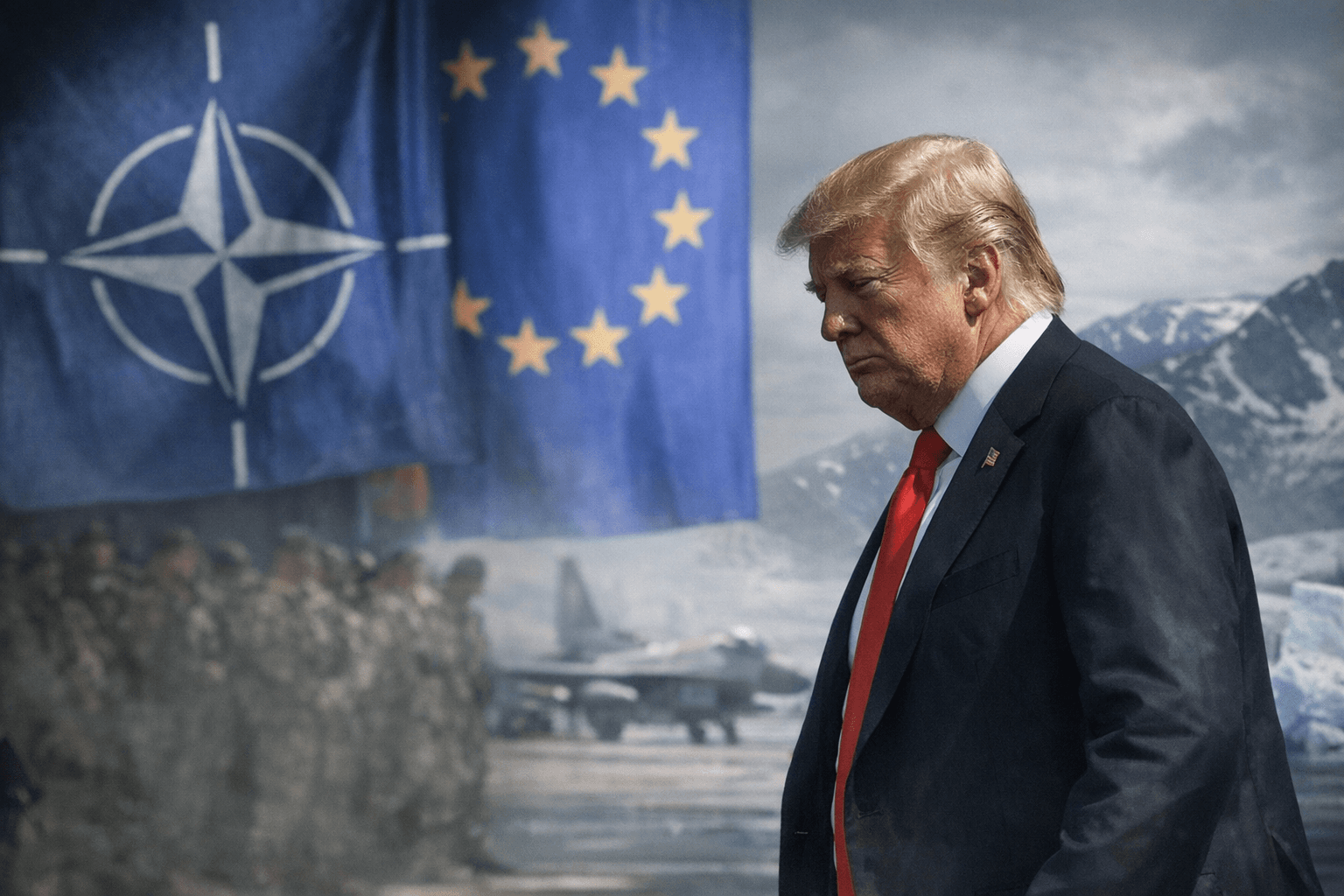
A two-hour closed-door meeting between President Donald Trump and NATO Secretary-General Mark Rutte at the White House on Wednesday ended not with reassurance but with a TruthSocial broadside that shook the transatlantic alliance to its foundations. In all capital letters, Trump posted: "NATO WASN'T THERE WHEN WE NEEDED THEM, AND THEY WON'T BE THERE IF WE NEED THEM AGAIN. REMEMBER GREENLAND, THAT BIG, POORLY RUN, PIECE OF ICE!!!" The message arrived one day after the United States and Iran agreed to a ceasefire, turning the fury of Washington's war-making apparatus squarely back onto its closest allies.
The Iran war exposed a structural fault line that burden-sharing arguments had long obscured: NATO's collective defense architecture, built around Article 5 commitments in Europe, showed no mechanism to compel allies to join offensive operations beyond the continent. European governments declined to contribute military forces to the U.S.-Israeli campaign against Iran, restricting their participation to defensive maneuvers. Bases in the United Kingdom, France, Germany, Greece, Italy, and Portugal were made available for what analysts described as "one of the most logistically complex operations the U.S. military has been involved in for decades," but no ally sent troops or aircraft into combat. Spain went further, refusing Washington access to its bases entirely. Spanish Prime Minister Pedro Sánchez publicly condemned the war as illegal.
The United Kingdom's position illustrated the fine line European governments tried to walk. Prime Minister Keir Starmer told the British public: "This is not our war." London allowed U.S. bombers to operate from British territory, but only for defensive strikes against Iranian sites targeting British interests, a carve-out that satisfied neither Washington nor domestic critics of the war.
Before Trump sat down with Rutte, White House Press Secretary Karoline Leavitt framed the alliance's conduct as a referendum it had failed. She said NATO member states had "turned their backs on the American people," who fund their nations' defense, and quoted Trump directly: "They were tested, and they failed." That framing elevated the Iran dispute from a policy disagreement into an existential charge against the alliance's reciprocity.
Secretary of State Marco Rubio amplified the threat a day earlier, telling reporters that if NATO was "just about defending Europe" and not the other way around, that is "not a very good arrangement" and one that is "going to have to be re-examined." Trump, in an interview with The Daily Telegraph published the same week, was blunter still, calling European allies "a paper tiger" and saying he was strongly considering pulling out of the alliance.
Rutte, for his part, pushed back against the narrative that Europe had simply abandoned Washington. He argued there was widespread European support for degrading Iran's nuclear and ballistic missile capabilities and warned that prolonged diplomacy risked what he called a "North Korean moment," where negotiations drag on until a country achieves nuclear capacity and the window to act closes. He declined to answer directly when asked repeatedly whether Trump had told him he intended to leave NATO.
Any formal withdrawal faces a significant legal obstacle. The National Defense Authorization Act of 2024 bars a president from pulling the United States out of NATO without either a two-thirds Senate supermajority or an act of Congress. Legal scholars have noted, however, that Trump could attempt to invoke presidential authority over foreign policy to circumvent that statutory constraint, an approach with no clear court precedent.
Rutte was also scheduled to meet with Defense Secretary Pete Hegseth during his Washington visit, underscoring that the rift was not merely rhetorical. Trump's revival of the Greenland threat, aimed at NATO member Denmark, signaled that the president sees the alliance's vulnerabilities as leverage on multiple fronts simultaneously. The question facing European capitals is no longer whether Trump will pressure NATO, but whether the alliance can survive a second term in which the United States treats collective defense as a conditional arrangement rather than an unconditional commitment.
Sources:
Know something we missed? Have a correction or additional information?
Submit a Tip