Trump Declares Iran War Objectives Nearly Complete, Vows Weeks More Strikes
Trump called the Iran war 'nearing completion' while vowing weeks more strikes, sending Brent crude up 6% and erasing a 1,125-point pre-speech Dow rally overnight.

Brent crude surged more than 6% overnight as President Trump declared his Iran campaign "nearing completion" while vowing to strike the country "extremely hard" for another two to three weeks, a combination that snapped a historic pre-speech market rally and pushed American gasoline prices past $4 per gallon.
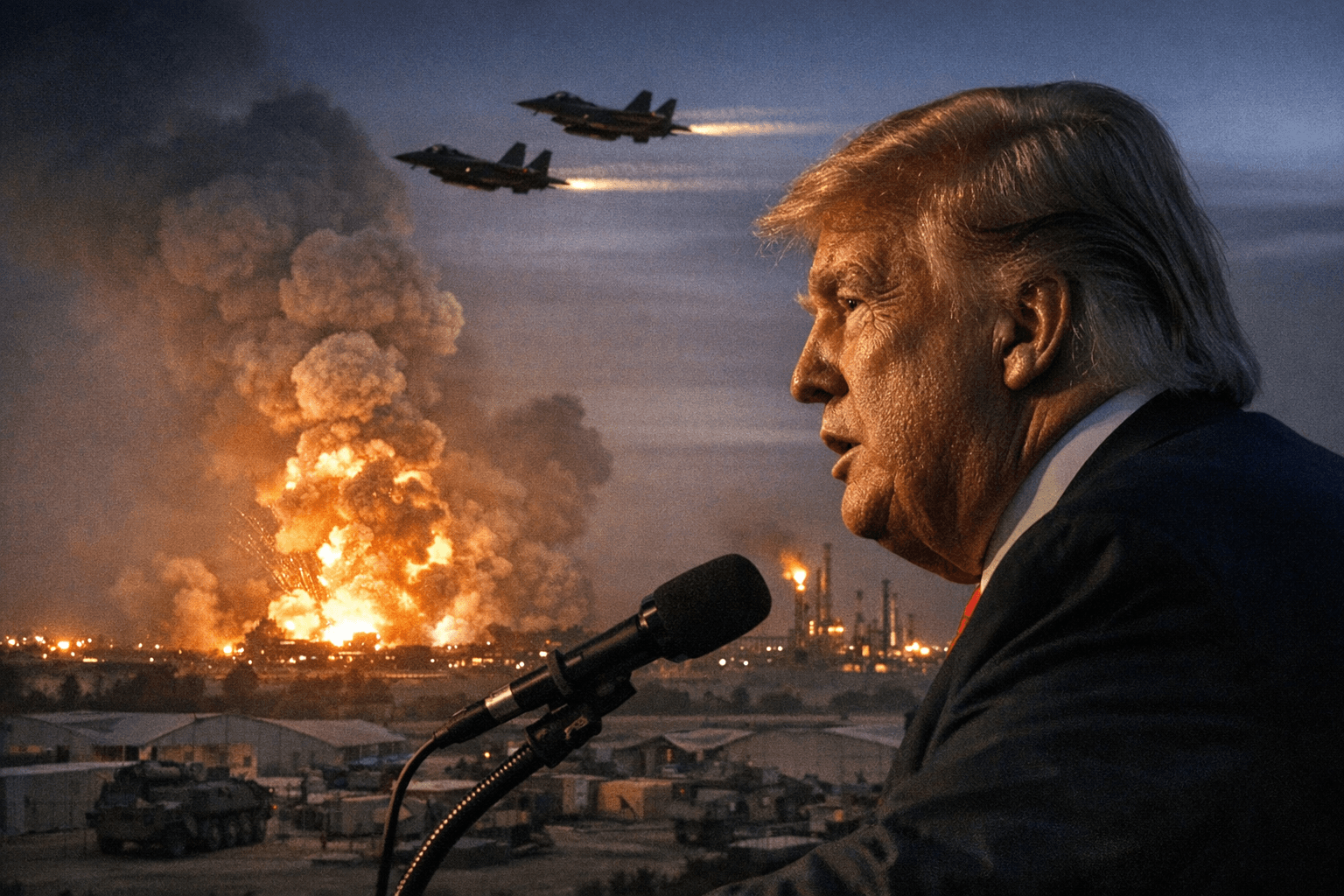
Trump delivered the 19-minute prime-time address from the White House on April 1, his first national address since Operation Epic Fury began 33 days earlier on February 28, 2026, with joint U.S.-Israeli airstrikes that killed Iranian Supreme Leader Ali Khamenei. Trump said the operation's "core strategic objectives are nearing completion," citing the degradation of Iran's ballistic missiles, drones, and navy. He invoked the war's human cost, saying: "We think especially of the 13 American warriors who have laid down their lives in this fight to prevent our children from ever having to face a nuclear Iran."
The address immediately reversed what had been an extraordinary day for equity markets. Dow Jones futures had soared 1,125 points before the speech, fueled by investor speculation of a swift war exit. After Trump spoke, S&P 500 futures declined 1.29%, Nasdaq 100 futures lost 1.59%, and Dow futures shed 543 points, roughly 1.16%. Asian markets extended the selloff, with Japan's Nikkei 225 falling 2.1% and South Korea's Kospi sliding 3.9%.
The central risk markets are pricing is Iran's effective closure of the Strait of Hormuz, through which roughly 20% of the world's oil supply transits. Crude oil futures spiked more than 5% after the speech, with Brent crude reversing sharply after having dipped below $100 per barrel earlier in the day on hopes for a quick exit. Energy market experts warned that ending the military campaign without reopening the strait is unlikely to resolve the energy crisis, and that elevated transport costs will persist, feeding inflation expectations across supply chains that run through the Persian Gulf.
Trump attributed rising fuel costs to Iranian attacks on commercial oil tankers and called the impact "short-term," but his address offered no exit condition tied to the strait's status. Russell Chesler, an investor tracking the conflict, described the market reaction as a "buy-the-rumour, sell-the-fact type reaction" and warned of "another two to three weeks of uncertainty hanging overhead for markets." Kazunori Tatebe, chief strategist at Daiwa Asset Management in Tokyo, put it more plainly: "There was no mention in Trump's speech about de-escalation."
Sen. Mark Warner of Virginia said the speech "did little to answer the most basic questions the American people deserve when our nation is engaged in a costly and dangerous conflict."
On the diplomatic front, Trump said discussions with Tehran "are ongoing" even as he promised weeks more bombardment. UK Prime Minister Keir Starmer announced that 35 countries had signed a statement committing to restore maritime security in the strait, and that the UK would host an international conference on reopening it. Iran's Ebrahim Azizi, head of the Iranian Parliament's National Security Committee, offered a terse response: the strait would reopen, he said, "but not for you."
Financial analysts also raised concerns about insider trading after an unusual spike in crude oil futures occurred minutes before a prior Trump announcement about Iran talks, a pattern that has drawn scrutiny from market observers.
Sources:
Know something we missed? Have a correction or additional information?
Submit a Tip