Trump Fields Reporter Questions on Iran War at White House News Conference
Trump warned Iran "the entire country can be taken out in one night" at his first press conference since the U.S.-Israel war began more than a month ago.

President Trump used his first White House news conference since the United States and Israel launched strikes against Iran to set a hard Tuesday deadline for Tehran: reopen the Strait of Hormuz or face devastating military strikes on the country's power plants and bridges.
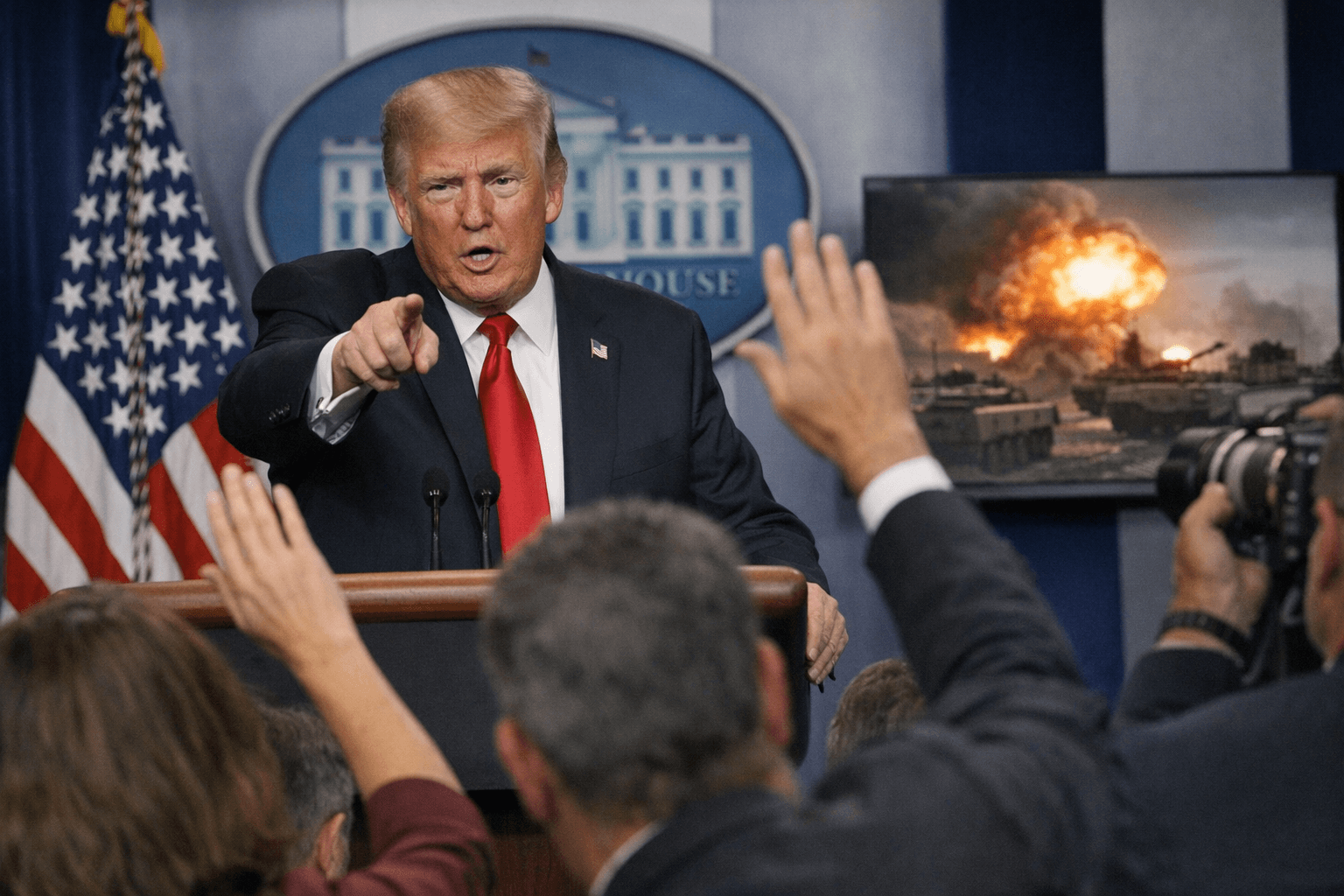
Standing at the podium in the James S. Brady Press Briefing Room alongside Defense Secretary Pete Hegseth, CIA Director John Ratcliffe, and Chairman of the Joint Chiefs of Staff Gen. Dan Caine, Trump fielded a wide range of reporter questions Monday afternoon about the conflict, which has now stretched more than a month. Trump held firm on his threat to launch massive attacks on critical Iranian infrastructure if Tehran doesn't make a peace deal that includes reopening the Strait of Hormuz.
Trump warned that "the entire country can be taken out in one night, and that night might be tomorrow night," citing a deadline of 8 p.m. ET Tuesday. "We have a plan, because of the power of our military, where every bridge in Iran will be decimated by 12 o'clock tomorrow night," Trump told reporters. Power plants, he added, would be "burning and exploding, never to be used again." When asked by reporters whether those threats amounted to potential war crimes, the president said he was "not at all" concerned.
Trump opened the conference by discussing the "historic" rescue of a U.S. airman in Iran over the weekend. He described the decision to authorize the mission as "risky," saying the U.S. could have ended up with "100 dead as opposed to one or two." Ratcliffe said the search and rescue operation was "comparable to hunting for a single grain of sand in the middle of a desert." Hegseth provided the most precise accounting of the effort: "For 45 hours and 56 minutes, we held that call open for coordination," the defense secretary said, describing a secure call that ran nearly two days straight. Caine told reporters that "the United States of America will recover our war fighters anywhere in the world, under any conditions, when we want to. We will always bring overwhelming skill and firepower."
Iran's state-run IRNA news agency said Monday that Tehran had rejected the latest cease-fire proposal and wants a permanent end to the war, complicating any path to a deal before Trump's Tuesday night cutoff. Iran's closure of the Strait of Hormuz, the route through which 20% of the world's oil is transported, has led to a jump in gas prices globally, hitting around $4 per gallon last week in the United States.
Asked whether Iran opening the strait was the specific condition that had to be met by his Tuesday deadline, Trump said "a deal that's acceptable to me" more broadly had to be secured by 8 p.m., but added that part of the deal needs to be "free traffic of oil." He also said he did not know whether the war would end soon, and told reporters he did not favor assistance from Kurdish forces in targeting Iran, saying they "bring with them some problems."
Tony Dokoupil anchored CBS News' special report coverage of the news conference, which was Trump's first since the U.S. and Israel launched strikes against Iran. The briefing came one day after Trump posted a profanity-laced online warning to Iran and threatened to bomb the country back to the "stone ages" if no deal was reached.
This article was produced by Prism’s automated news system from verified source data, official records, and press releases, then run through automated quality and moderation checks before publishing. The system is built and supervised by the people who set the standards it runs under. Read our full AI policy.
Did this article answer your question?


