Trump offers no clear Iran policy in State of the Union address
President Trump repeated recent talking points on Iran but provided no detailed threshold or plan, leaving lawmakers, allies and markets confronting strategic uncertainty.
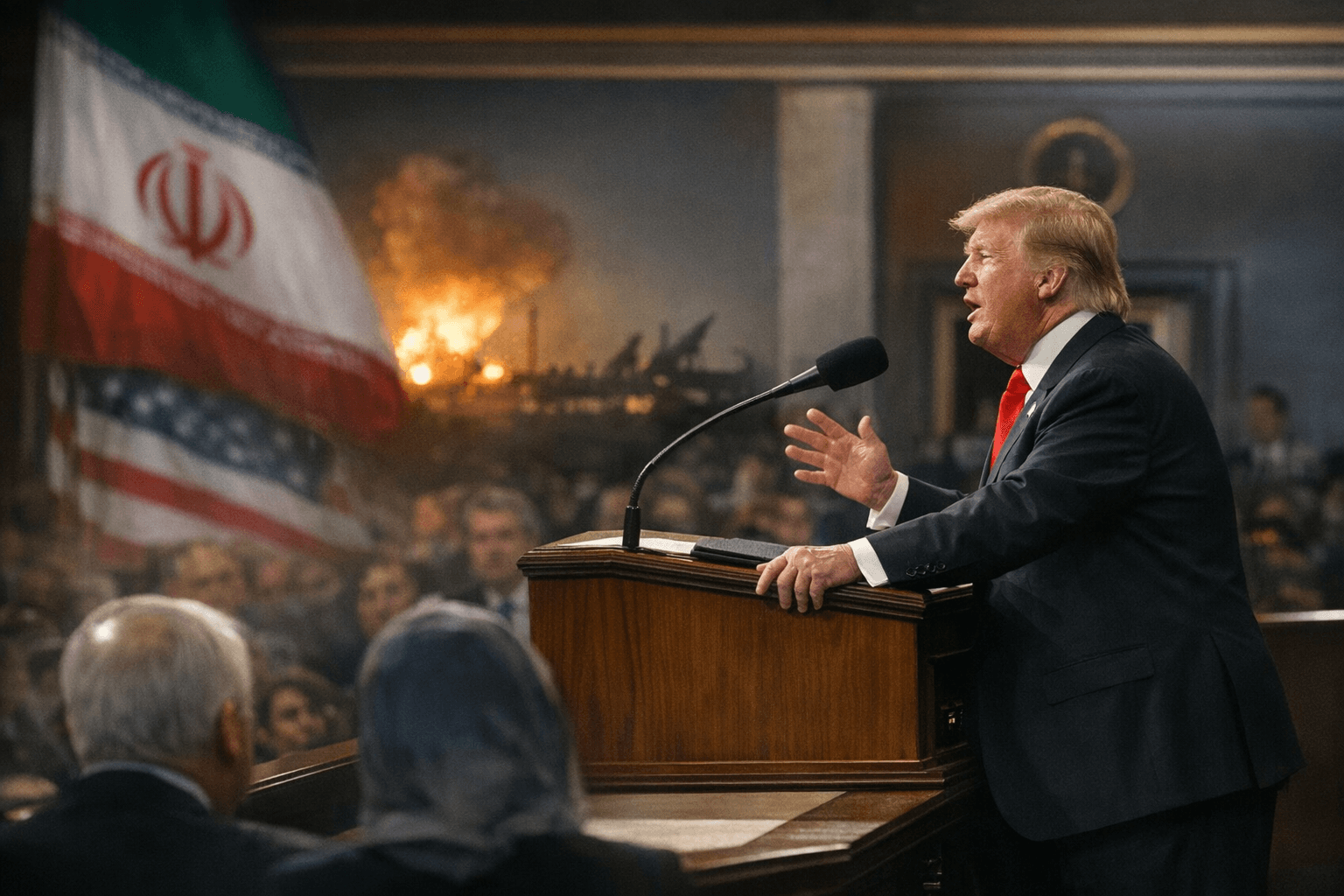
President Trump used his State of the Union address to reiterate recent criticisms of Iran and to defend his record on national security, but he stopped short of articulating a clear policy or setting conditions for military action even as the White House weighs the option. The omission leaves a vacuum of authority and information at a moment when Congress, U.S. partners and military commanders say they need specificity to assess risk and legal authority.
The speech returned to familiar lines, assertions of strength abroad and warnings about Tehran, without resolving key questions: what specific red lines would trigger a strike, what objectives any military action would pursue, how long the campaign would last, and what constraints would govern civilian casualties or escalation. Administration statements in recent days had signaled the possibility of kinetic options; the president’s address did not translate that posture into a public strategy or legal rationale.
That absence sharpens institutional pressure. Under the War Powers Resolution and longstanding constitutional practice, Congress claims a central role before U.S. forces are committed to hostilities. Lawmakers in both parties have repeatedly demanded briefings and a clear explanation of the administration’s legal basis for force, yet the State of the Union provided no new guidance that would frame forthcoming votes or oversight hearings. The lack of a public standard raises the prospect of heightened congressional scrutiny and partisan clashes if military action proceeds without explicit congressional authorization.
Allied capitals and regional partners also confronted the silence. Governments that would be affected by a campaign in the Middle East seek clarity on objectives, expected duration and coordination mechanisms. Without public signals from the president, diplomatic channels bear the burden of translating vague U.S. posture into operational cooperation, increasing the risk of miscommunication and unintended escalation.
The military faces its own dilemma. Commanders require precise political guidance to plan operations that limit unintended consequences and ensure compliance with international law. When the national leadership offers rhetoric instead of thresholds, the armed services must prepare for a wider range of contingencies, which can stretch logistics and increase the risk of errors during execution.
Financial markets registered the broader uncertainty. Investors and energy traders price geopolitical risk into portfolios and oil supply expectations; ambiguity around U.S. policy toward Iran typically produces volatility in defense stocks, currency markets and commodity prices. That economic ripple adds to domestic pressure on elected officials to clarify objectives and limits.
The political calculus for the White House is also evident. A narrowly framed, publicly articulated threshold could rally support among skeptical lawmakers and reassure allies, but it would also expose the administration to criticism if the stated objectives appear unattainable. By delivering a speech that emphasized strength without specifics, the president preserved flexibility while ceding the public debate over legitimacy and oversight to other institutions.
Absent clearer direction, the next steps will play out behind closed doors: classified briefings on legal and operational options, diplomatic consultations, and internal deliberations about timing and targets. Those private decisions will have public consequences. Democratic accountability and institutional norms hinge on translating that deliberation into the information Congress, allies and the public require to evaluate whether the use of force is necessary, proportional and constrained.
This article was produced by Prism’s automated news system from verified source data, official records, and press releases, then run through automated quality and moderation checks before publishing. The system is built and supervised by the people who set the standards it runs under. Read our full AI policy.
Did this article answer your question?

