Supreme Court Weighs Birthright Citizenship, Could Leave Door Open for Congress
Justices across the ideological spectrum signaled deep skepticism of Trump's birthright order, but a statutory ruling could still hand Congress a way to act.
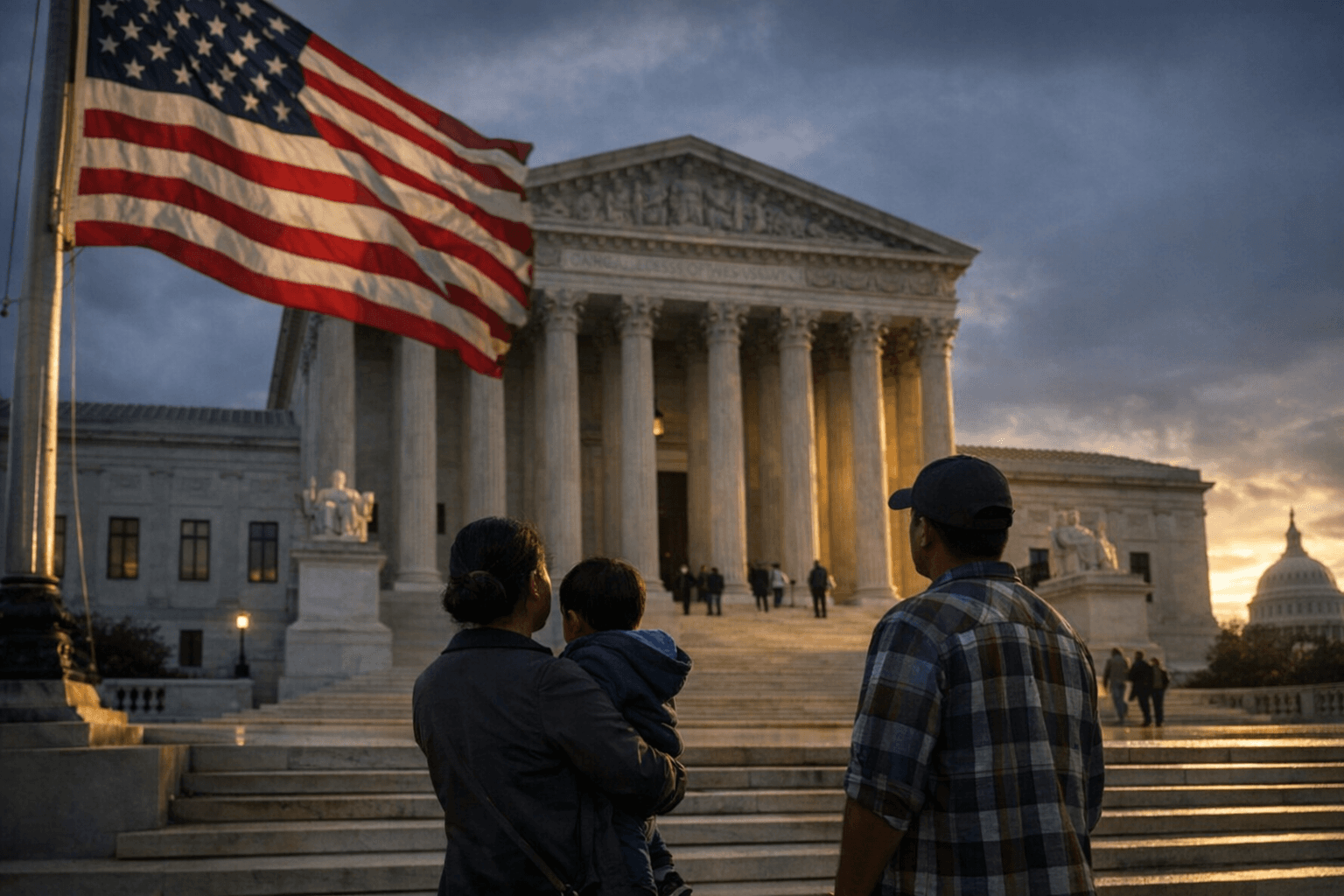
Justice Brett Kavanaugh's question during oral arguments on April 1 may have revealed as much about where the Supreme Court is headed as any of the sharp exchanges that followed. Kavanaugh asked why the Court needed to resolve whether Trump's executive order violated the 14th Amendment if the case could be decided under the Immigration and Nationality Act alone. That distinction is the difference between settled constitutional law and a statute Congress can rewrite with a simple majority.
The case, Trump v. Barbara, centers on President Donald Trump's January 20, 2025 executive order seeking to deny birthright citizenship to children born in the United States unless at least one parent is a citizen or lawful permanent resident. More than 250,000 babies born in the U.S. each year would be affected, according to the Migration Policy Institute and Pennsylvania State University's Population Research Institute. Every federal court that has considered a challenge has struck it down.
A majority of justices appeared skeptical across the ideological spectrum. Chief Justice John Roberts told Solicitor General D. John Sauer, "It's a new world. It's the same Constitution," and reportedly described the administration's theory as "quirky." He pressed Sauer on how common birth tourism actually is; Sauer acknowledged "no one knows for sure." Justice Ketanji Brown Jackson asked whether the administration was "bringing pregnant women in for depositions."
Sauer argued the 14th Amendment was meant to cover only formerly enslaved people and that children of "temporarily present aliens" are not fully subject to U.S. jurisdiction. ACLU National Legal Director Cecillia Wang countered that under the order, "what will immediately happen is that every month, tens of thousands of U.S.-born babies will be stripped of their citizenship. They may be stateless."
The constitutional record weighs against the administration. The 14th Amendment, ratified in 1868 to overrule the 1857 Dred Scott decision, received its defining modern interpretation in United States v. Wong Kim Ark, an 1898 case in which the Supreme Court ruled 6-2 that a child born in San Francisco to Chinese parents legally barred from citizenship was nonetheless a citizen by birth. Congress reinforced that understanding in a 1940 nationality statute and again in the INA in 1952, which uses the same "subject to the jurisdiction thereof" language as the amendment itself.
That shared phrase is precisely where Kavanaugh's statutory off-ramp would operate. A ruling grounded in the INA rather than the Constitution would leave the 14th Amendment untouched while placing the fight squarely before Congress. A constitutional amendment requires a two-thirds vote in both chambers and ratification by three-quarters of states; the INA demands only a legislative majority. University of Virginia law professor Amanda Frost warned that accepting the administration's full reading would effectively declare the amendment has been misread for generations, casting doubt on the citizenship of anyone whose ancestor arrived as a temporary immigrant.
Trump attended the April 1 arguments in person, the first sitting president on record to do so, per the Supreme Court Historical Society. He left before arguments concluded, then posted on Truth Social that the U.S. is "the only Country in the World STUPID enough to allow 'Birthright' Citizenship." Nearly 33 countries, primarily in the Americas, including Canada, Mexico, Brazil, and Argentina, have the same policy.
A ruling is expected by late June or early July 2026. If the Court settles on a statutory decision rather than a constitutional one, it may hand Trump a legal loss while keeping this fight very much alive on Capitol Hill.
This article was produced by Prism’s automated news system from verified source data, official records, and press releases, then run through automated quality and moderation checks before publishing. The system is built and supervised by the people who set the standards it runs under. Read our full AI policy.
Did this article answer your question?

