Roberts Rejects "New World" Claim in Trump Birthright Citizenship Case
Roberts shut down Trump's solicitor general with a four-word rebuke: "It's the same Constitution," as the president watched from inside the courtroom.
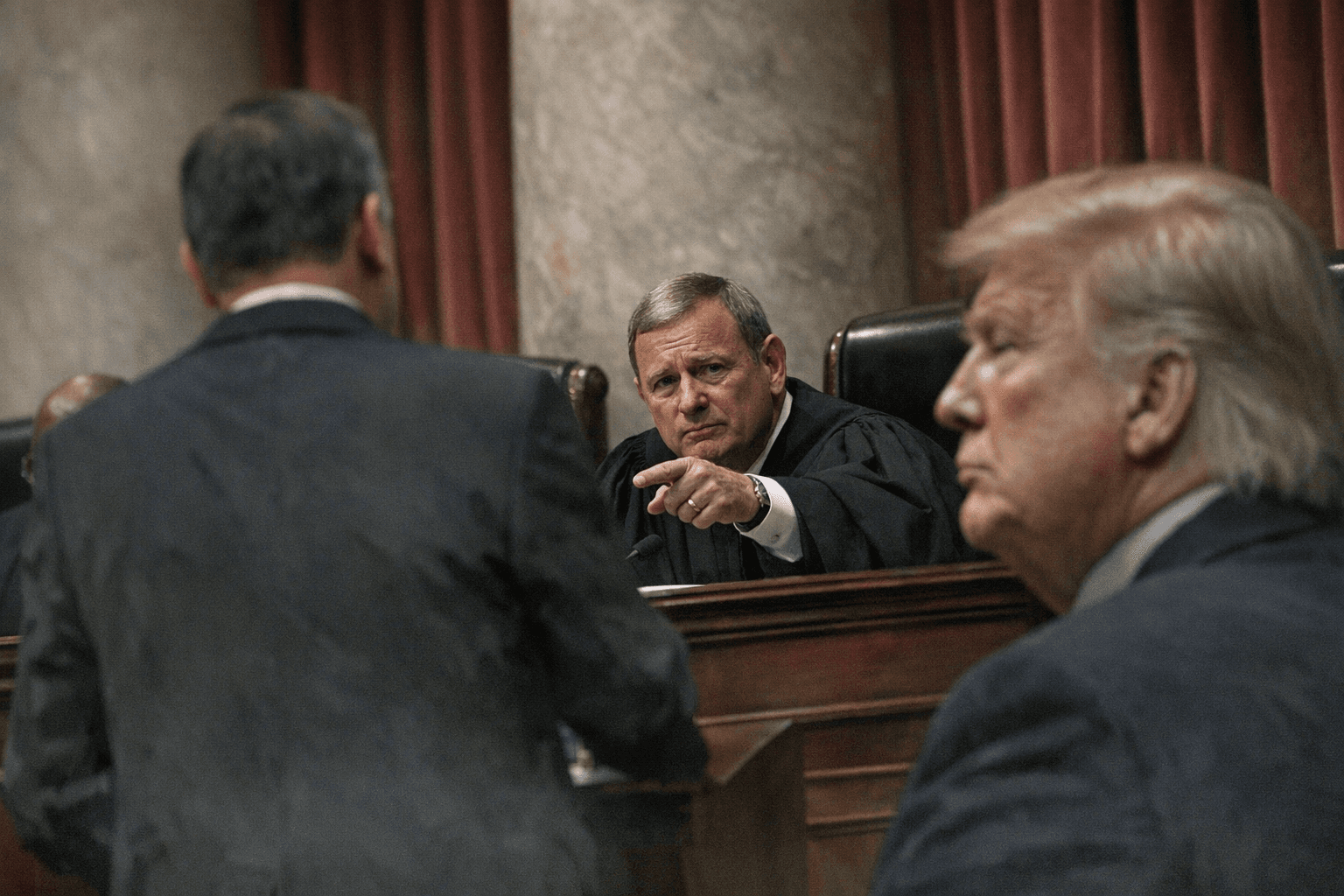
When Solicitor General D. John Sauer told the Supreme Court that the United States was in "a new world" compared to when the 14th Amendment was ratified, Chief Justice John Roberts offered four words in reply: "It's the same Constitution."
That blunt exchange, during oral arguments Tuesday in Barbara v. Trump, defined the tenor of a hearing that was already unlike any in American history. President Donald Trump became the first sitting president known to attend Supreme Court oral arguments in person, arriving at the court building on April 1, 2026 as justices prepared to weigh whether his executive order eliminating automatic birthright citizenship was constitutional. He stayed for approximately an hour before making an early exit midway through the proceedings. Within minutes, he was posting on Truth Social: "We are the only Country in the World STUPID enough to allow 'Birthright' Citizenship!"
The executive order at the center of Barbara v. Trump seeks to reinterpret the 14th Amendment's citizenship clause, which grants citizenship to "all persons born or naturalized in the United States, and subject to the jurisdiction thereof." Ratified in 1868 following the Civil War, the amendment has long been understood to guarantee citizenship by birth on American soil. Sauer's argument centers on the "subject to the jurisdiction thereof" language, contending that children of undocumented or temporarily present parents do not qualify. The Supreme Court accepted the case on December 5, 2025.
Roberts' skepticism was not the only friction the administration faced. The court's questions throughout the session indicated that even members of its 6-3 conservative majority were unconvinced by the administration's constitutional theory. That majority has ruled repeatedly in Trump's favor, including allowing him to fire federal workers in 2025. But in February 2026, it handed him a significant defeat by striking down his broad use of tariffs as unlawful. Trump's response was to call members of the majority "disloyal to the Constitution" and "unpatriotic," targeting by name two justices he himself appointed, Neil Gorsuch and Amy Coney Barrett. Days before Tuesday's birthright hearing, he was already warning about "dumb judges" in the case.
Trump's physical presence at oral arguments in a case in which he is a named party drew immediate scrutiny. While no statute explicitly prohibits a sitting president from attending, the visit raised distinct separation-of-powers concerns. Federal law, specifically 18 U.S.C. § 1507, enacted in 1950, does make it a federal crime punishable by up to one year in prison to picket or parade near a courthouse or a judge's residence with the intent of influencing a judge. That statute drew renewed attention in May 2022, when protests outside conservative justices' homes followed the leak of the Dobbs draft opinion; the Biden-era Justice Department declined to bring charges, with internal U.S. Marshals Service materials noting potential First Amendment conflicts.
Trump's verbal broadsides against the court, calling justices "disloyal" or "unpatriotic," fall short of the legal standard for "true threats" established in Counterman v. Colorado, where the Supreme Court held in 2023 that prosecution requires proving the speaker subjectively understood their words would be perceived as threatening. Political attacks, however harsh, remain protected speech. Presidential attendance at arguments in one's own case occupies murkier constitutional territory.
Tension between the executive and judicial branches had been building well before Tuesday. In September 2025, ten federal judges spoke to NBC News expressing frustration that the Supreme Court was not adequately explaining its rulings on Trump-era emergency orders. Some of those judges urged Roberts directly to do more to defend the judiciary from external pressure.
Across the street from the courtroom, demonstrators rallied in support of birthright citizenship as Trump sat inside. Roslyne Shiao, who came with her family to protest, put the moment plainly: "I'm surprised he was coming, but at the same time he's such a bully so in a sense I'm not surprised at all."
The court is expected to issue its ruling before the end of its current term. Whatever the outcome, Roberts' swift retort to Sauer's "new world" framing may prove the most durable line of the entire proceeding: the Constitution, ratified or reinterpreted, remains the document it was.
This article was produced by Prism’s automated news system from verified source data, official records, and press releases, then run through automated quality and moderation checks before publishing. The system is built and supervised by the people who set the standards it runs under. Read our full AI policy.
Did this article answer your question?

