Georgia Must Replace Voting System Before November After Deadline Extension Fails
Georgia's legislature adjourned without resolving a July 1 QR-code ban, leaving counties legally trapped and a $70M+ replacement scramble before November 3.

Georgia's 159 counties woke up Friday morning legally prohibited from using their current voting equipment by July 1 and with no funded plan, no replacement system procured, and a November 3 general election bearing down on them, after the state legislature adjourned without resolving a crisis it created two years ago.
The session ended without finalizing any plan to remove QR codes from Georgia's ballots, which a 2024 state law requires by July 1, 2026, a deadline the legislature itself set but never funded. County election officials are now legally prohibited from using QR codes after that date but have been given no money or direction from the state on how to comply, a tab that could exceed $70 million according to Secretary of State Brad Raffensperger.
Sen. Greg Dolezal, a Cumming Republican who co-sponsored the 2024 mandate and sponsored Senate Bill 568 this session, had been warning colleagues all year: "We're on a collision course with our November election in a law that we passed here two years ago, Senate Bill 189, that requires the removal of the QR codes from the ballots." His bill died on Crossover Day in early March. Senate Bill 568 fell two votes short of the 29 needed in the 56-member Senate, with seven senators skipping the vote entirely amid warnings of election "chaos" if the bill passed.
The legislature then attempted two divergent rescue plans that ultimately canceled each other out. The Senate passed House Bill 960, which would have instituted hand-marked paper ballots statewide ahead of the November general election, in a 32-21 party-line vote. The House, meanwhile, was pushing Senate Bill 214, which would have postponed the QR-code removal deadline to 2028 and directed the state to begin procuring a new election system in February 2027, but never brought it to the floor for a vote. With neither chamber willing to adopt the other's approach, both proposals expired when the session gaveled out.
The timing problem is acute regardless of which path Georgia ultimately pursues. The Georgia Association of Voter Registration and Election Officials, which opposed HB 960, warned that the implementation window contemplated by that bill ran from mid-June to early September, precisely when counties are ramping up for the November general election. "This is not as easy as flipping a light switch," said the association's representative. "It takes time... everything tested that we need to test, everything written that we need to write to make this successful statewide."
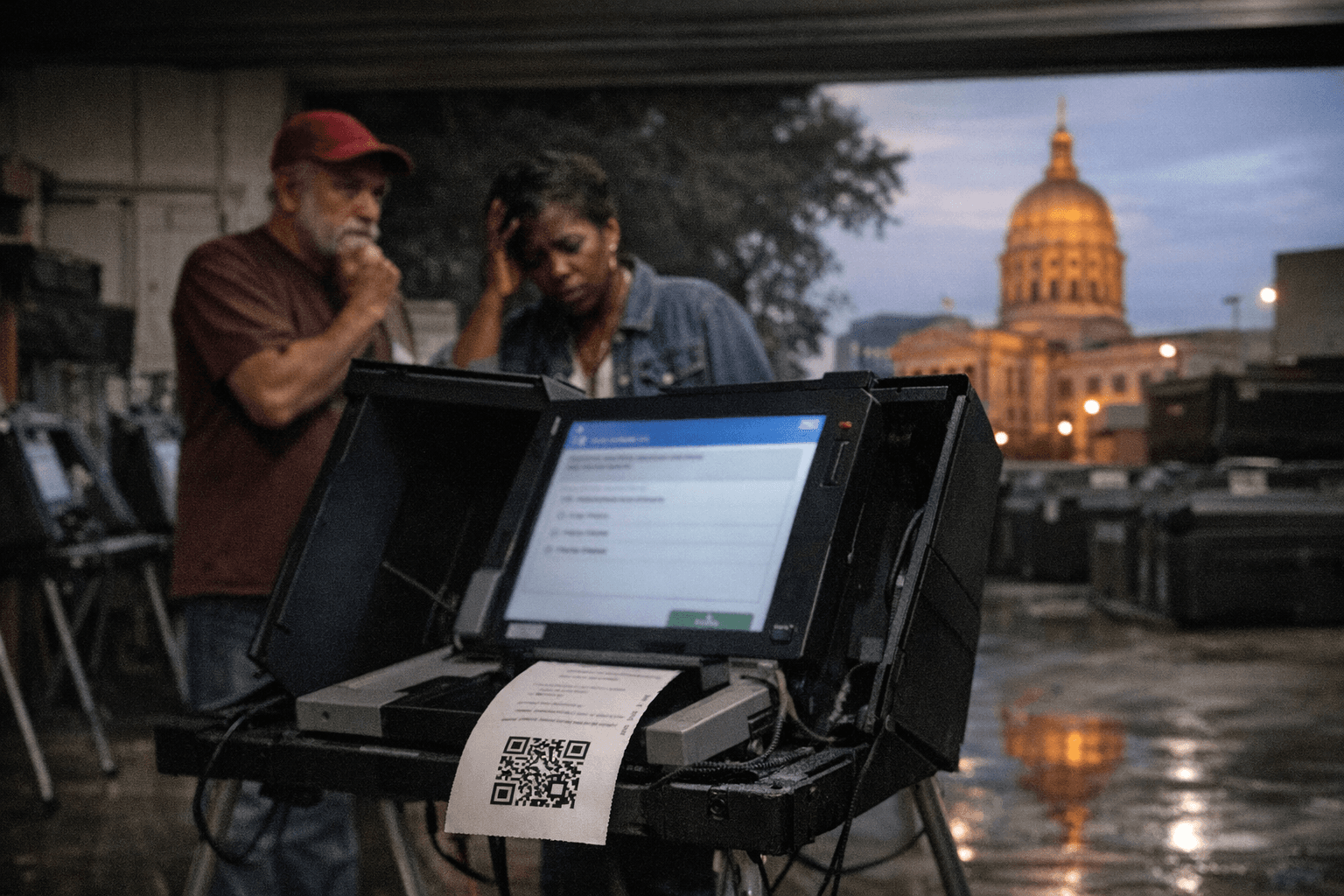
Christopher Channell, elections director of Glynn County, said the prospect of having to make major changes to Georgia's election system halfway through the midterm election cycle left him feeling uneasy. The November election features statewide races for governor, U.S. Senate, and attorney general, as well as all 236 state legislative seats.
Georgia's current touchscreen voting system, built on Dominion Voting equipment, was purchased for over $100 million before the 2020 election. Critics argue the QR codes those machines print on paper ballots are unreadable by voters, making independent verification of ballot choices impossible. Hand-marked paper ballots are the primary election-day voting method in two-thirds of the United States, according to the election technology organization Verified Voting.
Marilyn Marks, executive director of the Coalition for Good Governance, put the counties' predicament starkly: "County election officials are now trapped. They are legally prohibited from using QR codes after July 1, 2026 — but given no money or direction from the state on how to comply."
Sen. Max Burns of Sylvania, assessing the legislature's failure on the final day of the session, offered an epitaph that may define the coming months: "We're at an impasse. If we ignore it again, we're just going to kick the can." With the session over and July closing in, Georgia has no legal path to run its November election on the system it currently owns and no funded contract for what replaces it.
This article was produced by Prism’s automated news system from verified source data, official records, and press releases, then run through automated quality and moderation checks before publishing. The system is built and supervised by the people who set the standards it runs under. Read our full AI policy.
Did this article answer your question?

