Trump Orders Back Pay for All DHS Workers After Six-Week Partial Shutdown
Trump signed an emergency memo Friday ordering back pay for all DHS workers, about 234,000 people who have gone without wages for nearly seven weeks.
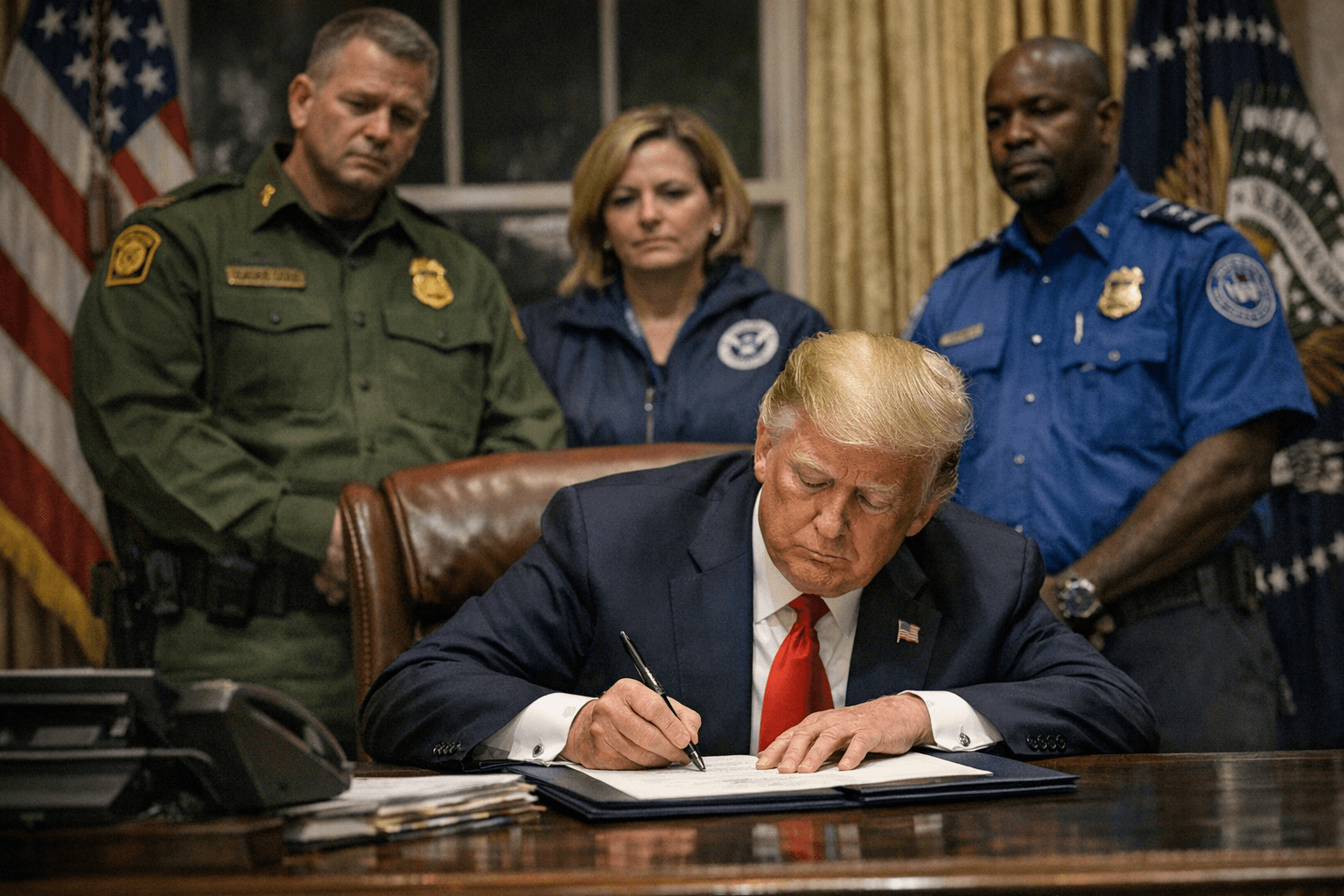
Some 234,000 federal workers who have screened passengers at airports, guarded the southern border, responded to disasters, and protected national cyber infrastructure have gone nearly seven weeks without a paycheck. President Donald Trump signed a memo Friday ordering the Department of Homeland Security to restore full back pay and benefits to all of its employees, extending a directive he had issued the prior week covering only Transportation Security Administration workers.
The April 3 order specifically instructs DHS Secretary Markwayne Mullin and OMB Director Russell Vought to "use funds that have a reasonable and logical nexus to the functions of DHS" to cover wages and benefits for workers who have gone without pay since the agency's funding lapsed on February 14. About 90 percent of DHS's workforce of more than 260,000 employees have been working unpaid during that stretch, according to Federal News Network.
Before Friday's order, agencies still receiving no compensation included FEMA, the Cybersecurity and Infrastructure Security Agency, the Coast Guard, and civilian employees at ICE and CBP. TSA workers had already received retroactive paychecks following Trump's earlier memo, though weeks of understaffing caused by unpaid screeners had already contributed to documented travel disruptions at airports nationwide.
The DHS funding lapse traces directly to a congressional standoff over immigration enforcement. Lawmakers extended the department's funding in January 2026 after shootings involving ICE and CBP agents in Minnesota triggered demands for enforcement reforms, setting a February 13 deadline for negotiations. No agreement was reached. Bloomberg described the resulting partial shutdown as "record-long" by the time Trump signed Friday's order.
The Senate unanimously passed a bill to fund all of DHS except ICE and Border Patrol, but House Republicans rejected it. Republican leaders have since coalesced around a party-line bill to fund ICE and Border Patrol directly, a plan Trump has endorsed, leaving the appropriations standoff unresolved on Capitol Hill.
The legal foundation of Friday's order carries significant uncertainty. The White House's "nexus" language is designed to address whether funds Congress appropriated for specific DHS operations can be redirected to cover wages during a shutdown, but executive actions of this kind provide short-term relief without resolving the underlying appropriation authority that only Congress can confer.
The order also intersects with a running dispute over the Government Employee Fair Treatment Act of 2019, a law passed after the 35-day 2018-2019 shutdown to guarantee automatic back pay to all federal workers when a lapse ends. Vought has argued the law is not self-executing and quietly removed all references to it from official shutdown guidance during the fall 2025 full government shutdown. Labor attorney Nekeisha Campbell of Alan Lescht & Associates challenged that position directly: "There is no legal authority to support that interpretation of the statute."
DHS workers told CNN they had "never seen the morale so low" during the prolonged funding lapse. The partial shutdown follows what the Committee for a Responsible Federal Budget documented as the longest full government shutdown in modern history, which ran from October 1 through November 12, 2025, a span of 43 days, before Congress reopened the rest of the federal government.
Whether the executive order survives legal scrutiny, or whether Congress acts before any challenge materializes, will determine if Friday's memo translates into lasting relief or simply the latest improvisation in a year of budget impasses that has left hundreds of thousands of federal workers bearing the cost of Washington's fiscal gridlock.
This article was produced by Prism’s automated news system from verified source data, official records, and press releases, then run through automated quality and moderation checks before publishing. The system is built and supervised by the people who set the standards it runs under. Read our full AI policy.
Did this article answer your question?