Trump Touts Shrinking Deficit, but His Plans Could Worsen It Long Term
Trump claimed tariffs cut the federal deficit by 25%, but the actual fiscal 2025 deficit shrank just 2.3% — and independent projections show far worse ahead.
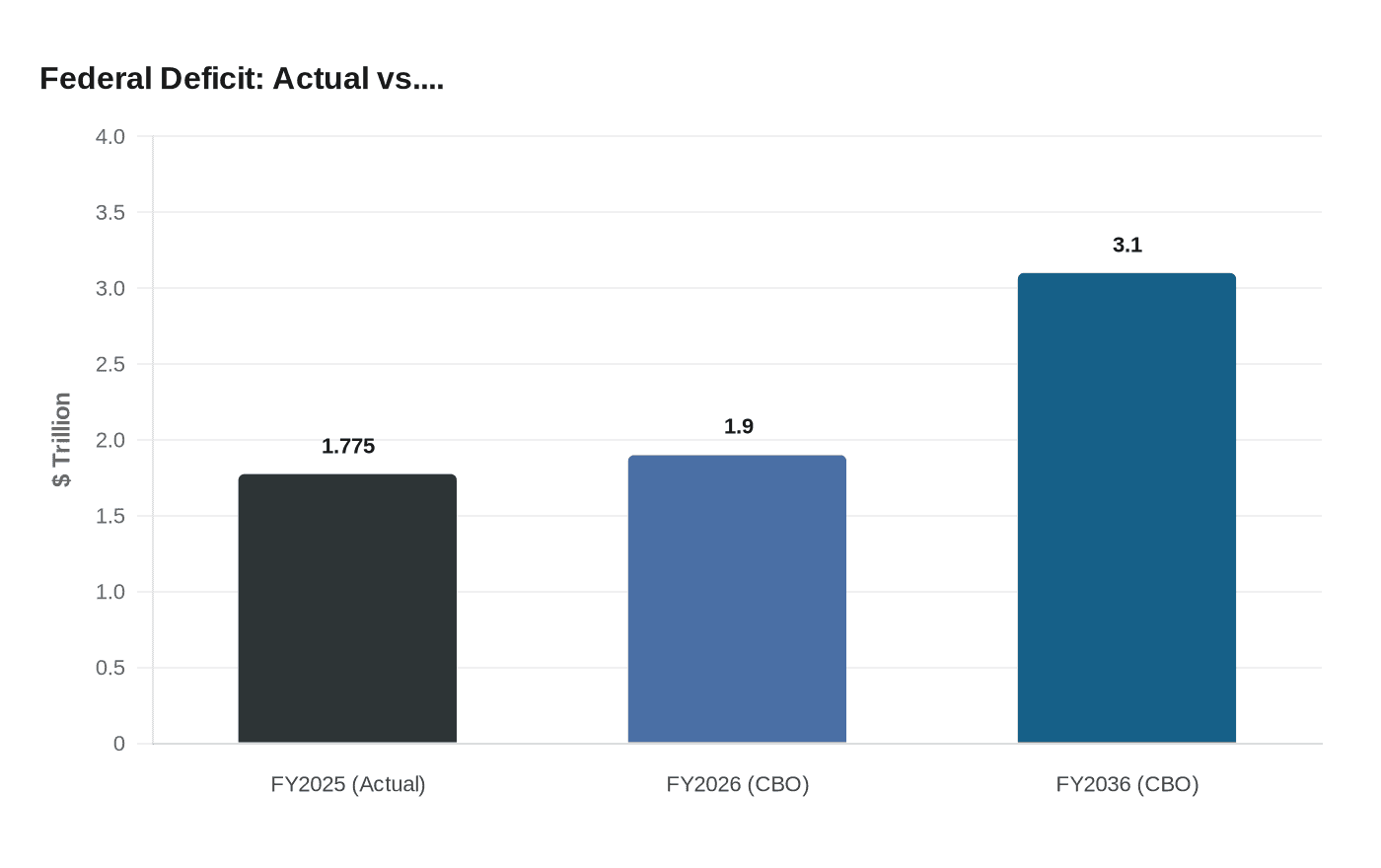
The numbers President Trump has been citing about the federal deficit bear little resemblance to what budget analysts are actually recording. Trump claimed in November 2025 that his tariffs were "helping to slash the deficit this year by more than 25%." The actual fiscal year 2025 deficit, at $1.775 trillion, was only 2.3% smaller than the 2024 figure — and PolitiFact rated the 25% claim as false, noting that during the months Trump was president in fiscal year 2025, the deficit was actually higher than during the same period under President Joe Biden.
The Congressional Budget Office's February 2026 baseline now projects the federal deficit will reach $1.9 trillion in fiscal year 2026 and swell to $3.1 trillion by 2036 under current law. Debt held by the public, already at 101% of GDP, is projected to surge to 120% of GDP by that same year, eclipsing the previous all-time record.
The gap between the administration's optimism and independent forecasts is stark. Trump's Council of Economic Advisers projected that deficits would decline to 3.2% of GDP by 2034 and that real GDP would grow around 4% annually through 2028. The CBO, by contrast, pegs 2026 real GDP growth at 2.2%, fading to an average of roughly 1.8% through the rest of the decade. The CBO further projects that mounting debt would itself slow economic growth, undermining the administration's core argument that expansion will eventually stabilize the fiscal picture.
The administration's signature domestic policy legislation, the One Big Beautiful Bill Act, deepens those concerns. The CBO estimated the bill will add $500 billion to the deficit in 2026 alone, $635 billion in 2027, and a cumulative $4.1 trillion from 2025 to 2034. Tax cut extensions — a centerpiece of the bill — were already projected in January 2025 to add more than $4 trillion to the deficit over a decade if not offset by spending reductions.
The Department of Government Efficiency, which Elon Musk had framed as a vehicle for cutting $2 trillion in federal waste, fraud, and abuse, has also delivered far less than advertised. Budget analysts estimated DOGE's actual savings landed somewhere between $1.4 billion and $7 billion, primarily from workforce firings.
Trump pushed back hard on the CBO's scoring, arguing that tariff revenues vindicate his approach. The White House pointed to a CBO analysis projecting tariffs could reduce total deficits by up to $4 trillion over the next decade if maintained. But the same analysis showed the fiscal year 2026 deficit is roughly $100 billion higher than it was in CBO's January 2025 projections, and cumulative deficits over the 2026 to 2035 period are $1.4 trillion larger than previously forecast.
Michael Peterson, CEO of the Peterson Foundation, called the CBO's latest outlook "an urgent warning to our leaders about America's costly fiscal path." The national debt crossed $39 trillion as those projections circulated, having grown by roughly $2.25 trillion in Trump's first year back in the White House. With the administration's own FY2027 budget acknowledging that returning to fiscal stability would require $6.7 trillion in combined policy savings and economic growth gains over a decade, the distance between the president's rhetoric and the fiscal ledger continues to widen.
This article was produced by Prism’s automated news system from verified source data, official records, and press releases, then run through automated quality and moderation checks before publishing. The system is built and supervised by the people who set the standards it runs under. Read our full AI policy.
Did this article answer your question?

