Trump orders major strikes on Iran as Gulf attacks escalate
Iranian drones and missiles hit Bahrain and Kuwait after Trump’s strikes, tightening the risk to U.S. forces at the 5th Fleet and the Strait of Hormuz.

President Donald Trump ordered major combat operations against Iran on Feb. 28, unleashing massive joint U.S.-Israeli strikes on military, government and infrastructure sites. The campaign was framed as an effort to wipe out imminent threats from Tehran and stop Iran’s nuclear ambitions, but the regional response quickly broadened the fight far beyond Iranian borders.
Iran retaliated across the Gulf, with attacks reported in Bahrain, Kuwait, Qatar and the United Arab Emirates, including strikes aimed at U.S.-linked military sites and civilian infrastructure. Kuwait said its air defenses intercepted Iranian drones and two missiles. Bahrain said a missile attack damaged a residential building near the airport, placing the front line close to the island kingdom’s densely populated capital and to the U.S. Navy’s 5th Fleet headquarters.
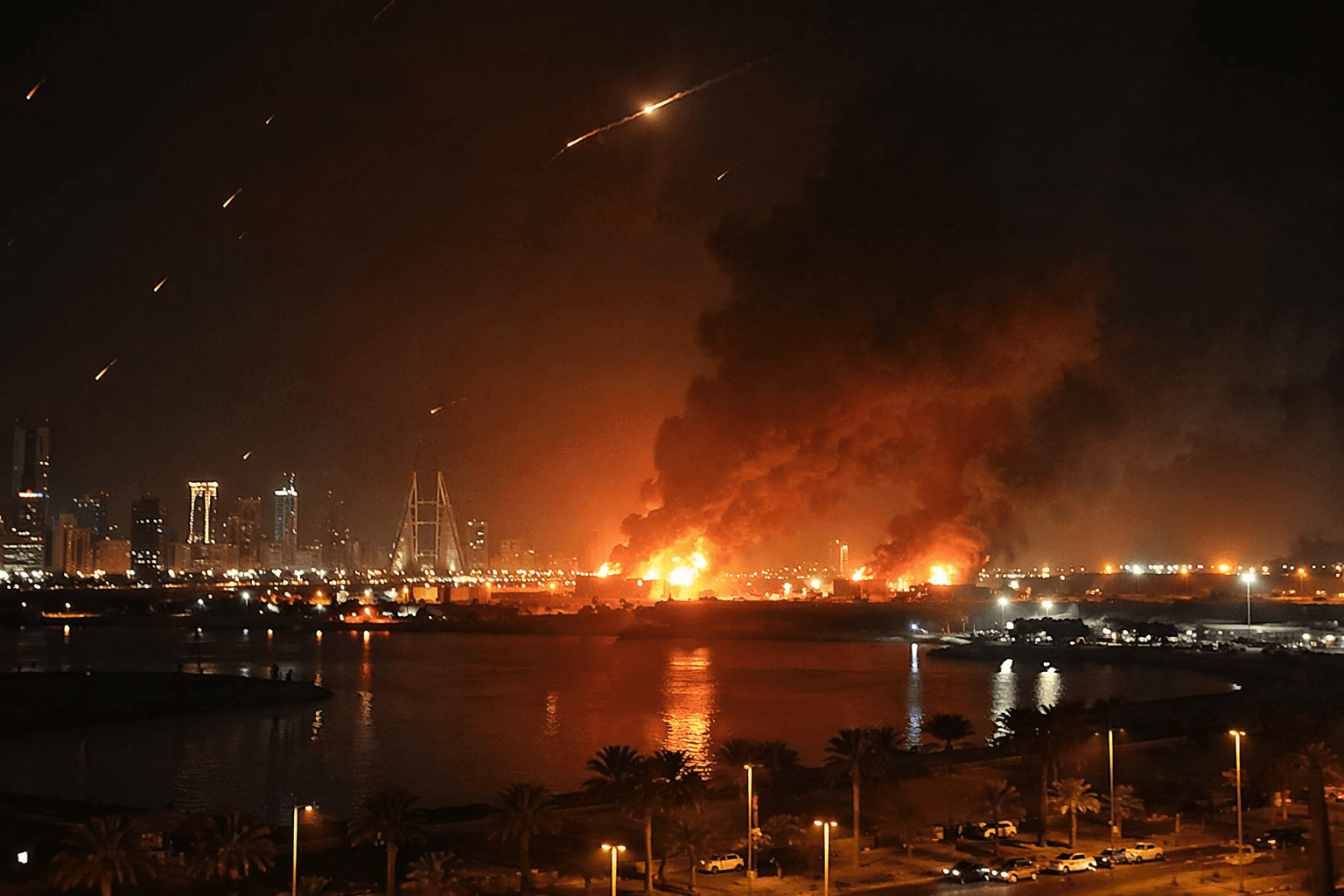
The escalation sharpened the danger to the region’s shipping network. U.S. Central Command said later strikes were aimed at keeping the Strait of Hormuz open to shipping, after attacks on cargo vessels had already turned the waterway into a pressure point. Before the war, a fifth of global oil supplies passed through the strait, making every threat to its traffic a direct risk to energy markets and to governments that depend on uninterrupted maritime flow.
The latest phase also exposed how quickly the conflict has begun to pull in civilian airspace and neighboring capitals. Qatar briefly issued an elevated security threat alert before later giving the all-clear. In Bahrain and Kuwait, the pattern was more severe: repeated drone and missile activity signaled that Iran was willing to answer U.S. strikes by reaching into the Gulf states that host American forces and infrastructure.
Tehran has hardened its line even as the casualty toll climbs. Iranian health officials said U.S. airstrikes over two days killed at least 14 people and wounded 78 in one phase of the fighting, while U.S. strikes in a later wave were said to have hit about 90 targets inside Iran, including missile and drone storage sites and air defense systems. Mohammad Baqer Qalibaf said the Strait of Hormuz would be reopened only under Iranian arrangements, not through U.S. threats, a warning that leaves diplomacy tied to the battlefield. Trump at one point said an interim ceasefire with Iran was “over,” underscoring how quickly the dispute over Iran’s program has widened into a test of U.S. resolve, Gulf security and the safety of one of the world’s most important sea lanes.
This article was produced by Prism’s automated news system from verified source data, official records, and press releases, then run through automated quality and moderation checks before publishing. The system is built and supervised by the people who set the standards it runs under. Read our full AI policy.
Did this article answer your question?