Trump orders massive U.S.-Israeli strikes on Iran, launching combat operations
U.S. Marines boarded the Iran-flagged M/V Touska after disabling its propulsion, extending a campaign that began with Operation Epic Fury and now reaches the Strait of Hormuz.
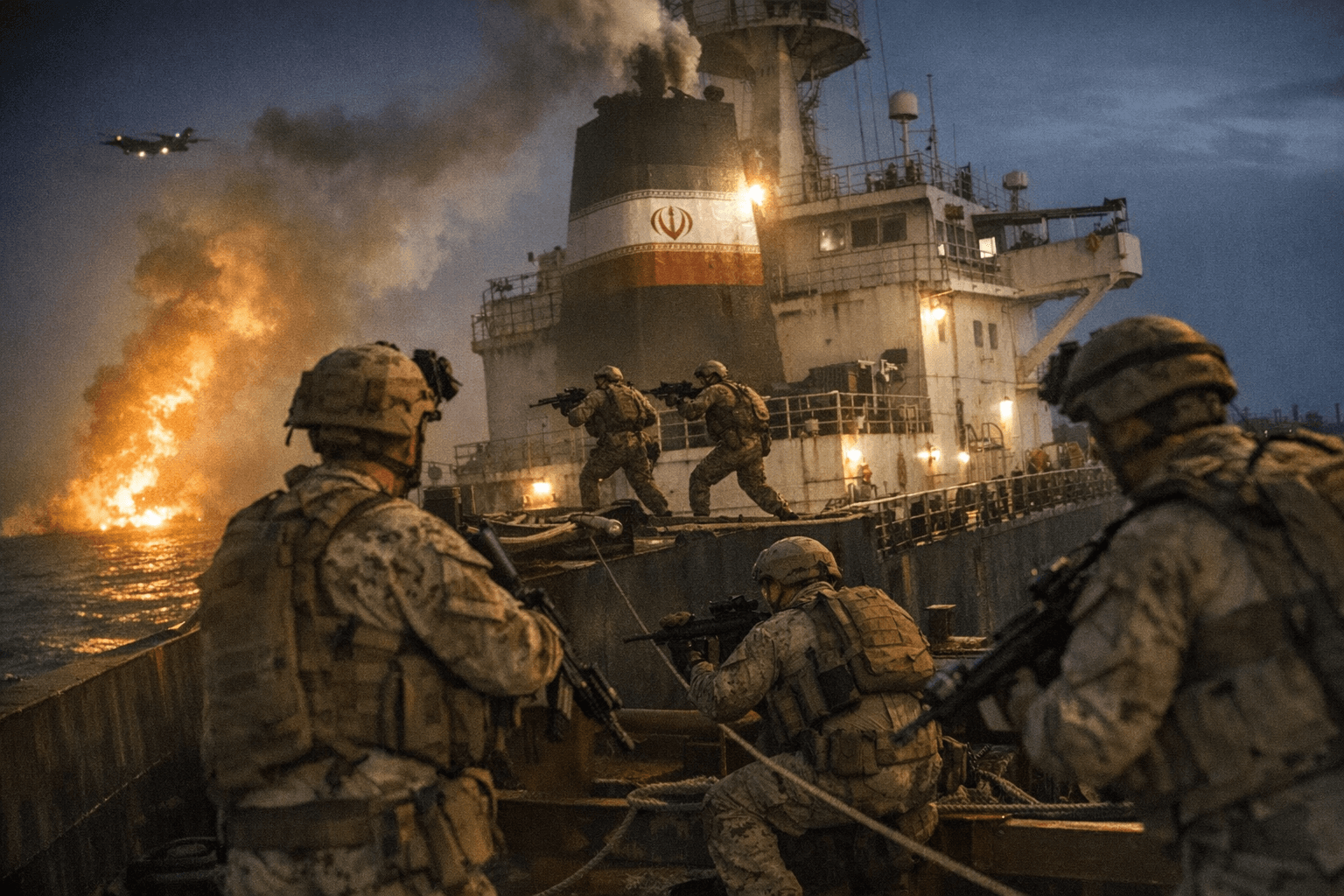
U.S. Marines from the amphibious assault ship USS Tripoli boarded the Iran-flagged M/V Touska after the guided-missile destroyer USS Spruance disabled the vessel’s propulsion, turning a shipping encounter in the Strait of Hormuz into the latest test of how far the U.S.-Iran conflict has widened.
The seizure came after repeated warnings over six hours, and ABC News said Marines reached the ship by helicopter and rappelled onto the deck. Iranian military officials condemned the action as maritime piracy and vowed retaliation, underscoring how quickly the maritime front has become a flashpoint in a campaign that began as a series of strikes on Iranian military targets.
That campaign started Feb. 28 at 1:15 a.m. ET, when U.S. Central Command said Operation Epic Fury began at the direction of President Donald Trump. CENTCOM said U.S. and partner forces hit Islamic Revolutionary Guard Corps command and control sites, air defenses, missile and drone launch sites, and military airfields, then defended against hundreds of Iranian missile and drone attacks in the opening phase. The command described the operation as the largest regional concentration of American military firepower in a generation.
The fighting did not end with the opening salvo. CENTCOM said major combat operations continued into March, and its statements page later listed U.S. service members killed and wounded. It also said Task Force Scorpion Strike used low-cost one-way attack drones for the first time in combat, a sign that the conflict was not only expanding geographically but also changing in method.
By April, the pressure had shifted to the water. On April 11, CENTCOM said it had begun setting conditions for clearing mines in the Strait of Hormuz. On April 12, it said it would begin a blockade of maritime traffic entering and exiting Iranian ports at 10 a.m. ET on April 13, while promising not to impede vessels transiting the strait to and from non-Iranian ports. CENTCOM said roughly 100 merchant vessels move through the strait on a typical day, making the chokepoint central to global shipping and to any confrontation with Tehran.
The Touska boarding suggests the U.S. is moving from air and missile strikes into direct maritime enforcement, a sign of either a deliberate pressure campaign or a further step toward mission creep. That ambiguity now sits at the center of the crisis, alongside talks Trump said would resume in Islamabad with JD Vance, Steve Witkoff and Jared Kushner after earlier negotiations failed to produce a peace deal.
This article was produced by Prism’s automated news system from verified source data, official records, and press releases, then run through automated quality and moderation checks before publishing. The system is built and supervised by the people who set the standards it runs under. Read our full AI policy.
Did this article answer your question?


