Trump says Iran war ended, argues he needs no Congress approval
Trump told Congress the Iran war had “terminated,” arguing a ceasefire erased the need for approval. The move set up a direct test of war powers that could shape future conflicts.

Can a president declare a war effectively over through a ceasefire and then argue Congress no longer gets a vote? Donald Trump pressed that theory on May 1, telling lawmakers the Iran conflict had “terminated” because he ordered a ceasefire and that the military campaign no longer required congressional approval.
Trump’s letters to the House and Senate said hostilities that began on February 28 had ended, and that there had been no exchange of fire between U.S. forces and Iran since April 7. The administration’s legal posture rests on a disputed timeline: it says the 60-day War Powers clock started when Congress was notified on March 2, not when strikes began two days earlier, and Trump did not invoke the War Powers Resolution’s 30-day extension for safe withdrawal.
That interpretation is now colliding with a constitutional fight on Capitol Hill. The 1973 War Powers Resolution requires presidents to seek authorization after 60 days of military action unless Congress approves the operation or the president uses a short extension to pull forces out safely. Tim Kaine has led Senate efforts to force a vote limiting Trump’s ability to continue military action without explicit approval, arguing lawmakers must assert their Article I authority before the White House makes unilateral war a habit.

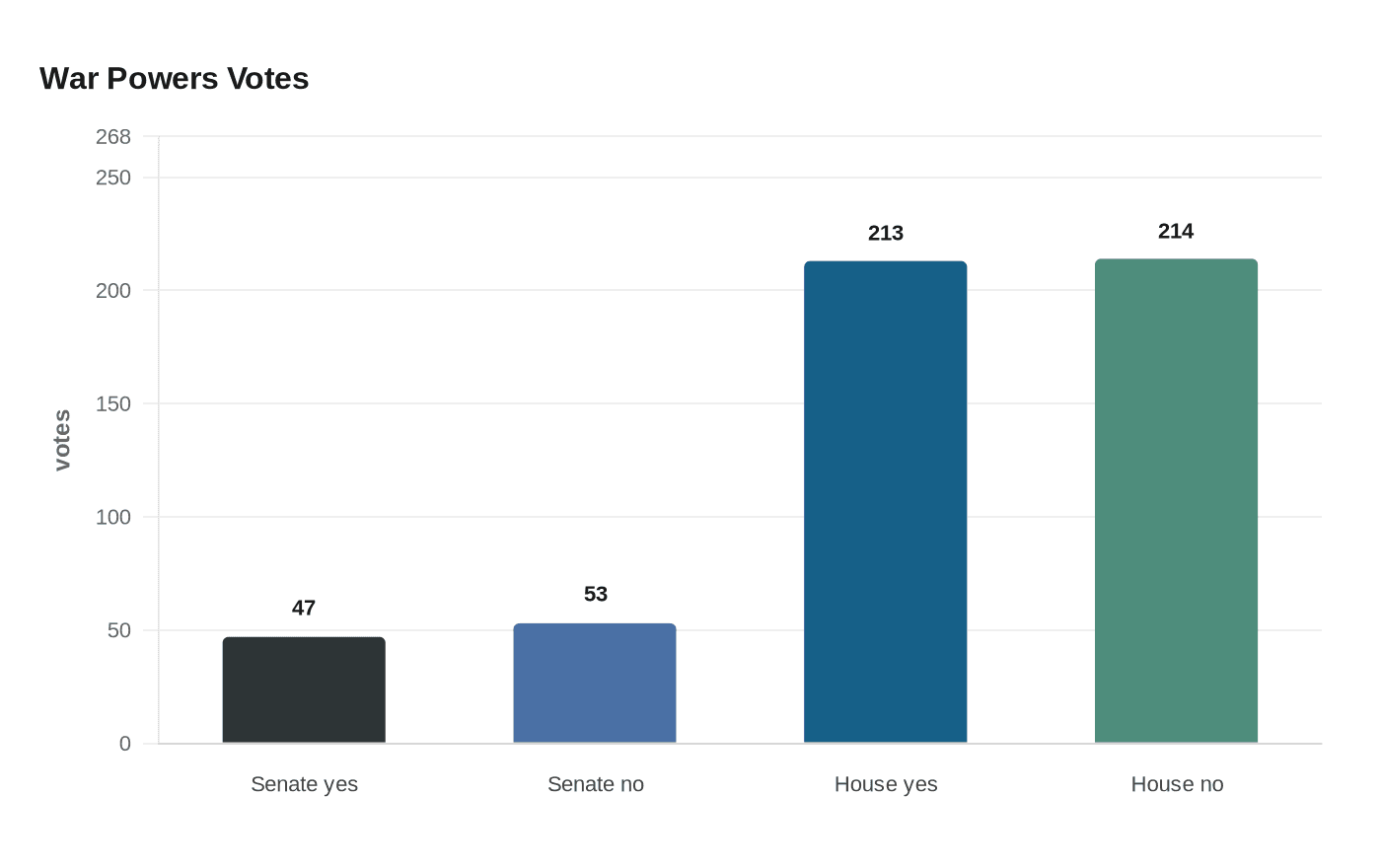
Congress has already tested that argument twice and lost narrowly. On March 4, the Senate rejected a war powers resolution 47-53, with Rand Paul the only Republican to support it and John Fetterman the only Democrat to oppose it. On April 16, the House failed by a single vote, 213-214, to order an end to the war. Thomas Massie was the lone Republican voting yes, Jared Golden was the lone Democrat voting no, and Warren Davidson voted present.
The legal dispute is sharpened by the ceasefire’s uncertain terms. On April 8, no official agreement had been released. Trump said on Truth Social that he would suspend bombing for two weeks, while Iran’s Supreme National Security Council said it would stop its “defensive operations” only so long as U.S. and Israeli strikes stopped. The Strait of Hormuz also loomed over the fallout, underscoring how quickly the conflict could affect global energy and shipping.
Republicans on Capitol Hill have largely deferred to Trump, even as Thomas Massie and Rand Paul warned that presidents cannot sidestep Congress by declaring a conflict closed after the fact. That leaves the Iran episode as more than a one-off dispute: it is a test of whether future presidents can use a ceasefire to reset the clock on war powers, or whether Congress will finally enforce the limits written into law.
Sources:
Know something we missed? Have a correction or additional information?
Submit a Tip