Trump Set to Make History Attending Supreme Court Birthright Citizenship Arguments
No sitting president has ever attended SCOTUS oral arguments. Trump changed that Wednesday, as justices weighed whether to gut a citizenship right held for 160 years.
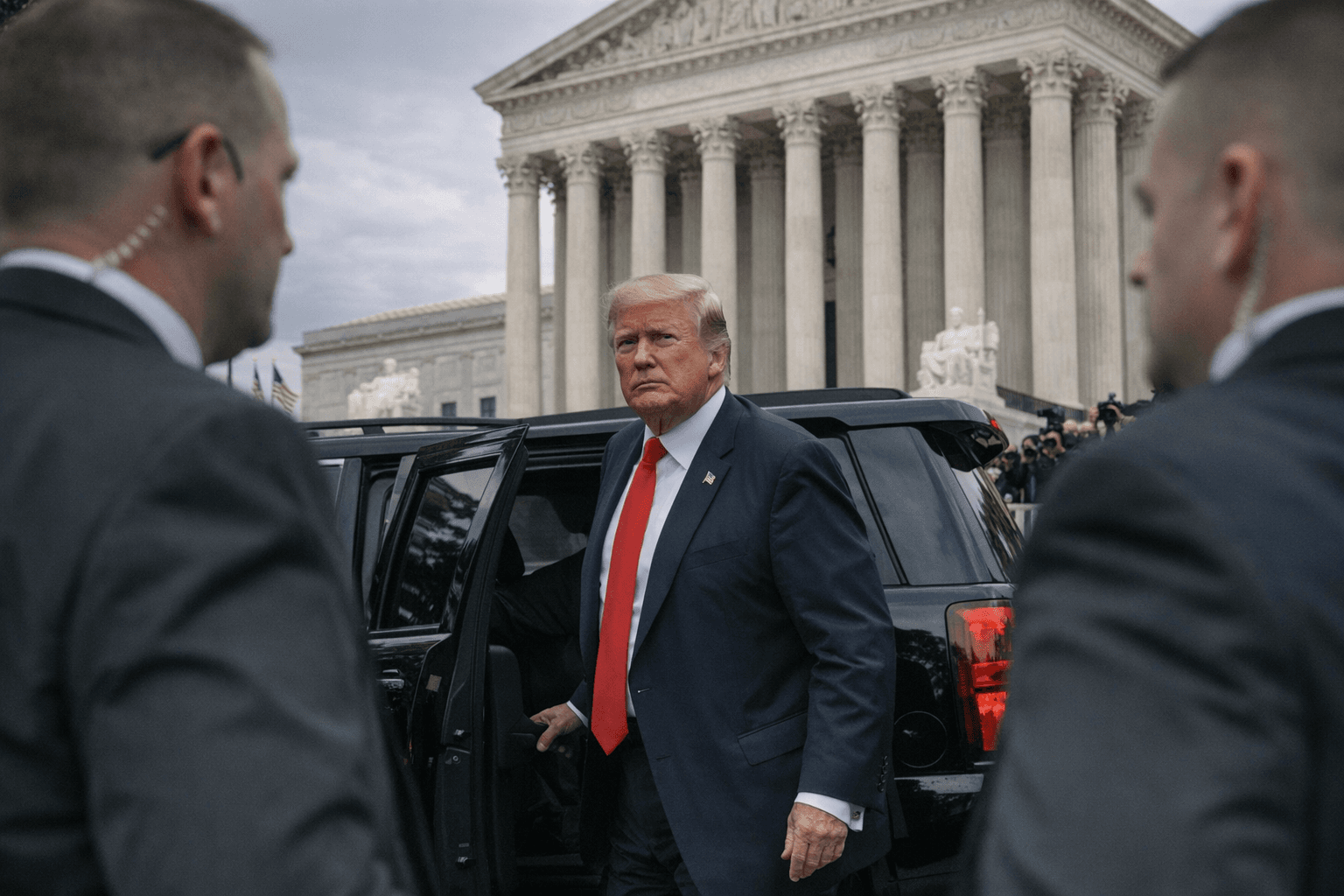
No sitting president has ever walked into the Supreme Court chamber to watch his own case argued before the justices. Donald Trump did exactly that Wednesday morning, taking his seat in the courtroom as the high court heard oral arguments in Trump v. Barbara, the most consequential immigration case in a generation and one whose ruling could strip U.S. citizenship from millions of American-born children.
Neither the Supreme Court nor the Supreme Court Historical Society has any official record of a sitting president ever attending oral arguments. Trump announced his intent Tuesday from the Oval Office, telling reporters, "I'm going. Because I have listened to this argument for so long." White House press secretary Karoline Leavitt confirmed his attendance.
The case turns on a deceptively compact question: whether the 14th Amendment's Citizenship Clause, which has guaranteed birthright citizenship for more than 160 years, applies to children born in the United States to undocumented parents or parents on temporary visas. Trump signed the executive order redefining that eligibility on January 20, 2025, his first day back in office. Every lower court to examine it has blocked it. A federal appeals court in California ruled in July 2025 that the order "contradicts the plain language of the 14th Amendment," and U.S. District Judge Joseph Laplante issued a class-wide injunction on July 10, 2025. The order has never taken effect.
At the center of the case is a Honduran woman identified in court filings only as "Barbara," her full name withheld for her safety. She represents a class of families whose children, if the administration prevails, would be born in the United States and denied the citizenship that American law has extended since ratification of the 14th Amendment in 1868. The downstream consequences would be immediate and concrete: children losing access to Social Security numbers and U.S. passports, families navigating overlapping documentation burdens, and individuals potentially rendered stateless in the only country they have ever known.
Solicitor General D. John Sauer is arguing for the administration, anchoring the government's case on the phrase "subject to the jurisdiction thereof" in the Citizenship Clause. The administration contends the amendment was designed to grant citizenship to freed slaves and their children, not to children of undocumented immigrants or temporary visa holders. ACLU National Legal Director Cecilia Wang is arguing for the plaintiffs.
The governing precedent is United States v. Wong Kim Ark, decided in 1898. The Supreme Court ruled 6-2 that the 14th Amendment conferred birthright citizenship on anyone born in the United States regardless of the parents' nationality or citizenship status. Wong Kim Ark was born in San Francisco to Chinese immigrant parents and had been denied re-entry after traveling abroad. The ACLU argues the Trump administration is seeking to undo that 128-year-old ruling without constitutional justification. ACLU deputy director Cody Wofsy called the policy "deeply illegal, unconstitutional and morally wrong."
Georgetown Law Professor Michele Goodwin warned that narrowing the Reconstruction amendments could unravel "100 years' worth of jurisprudence." Amicus briefs supporting the plaintiffs came from the Cato Institute, the American Bar Association, Race Law Scholar Sherrilyn Ifill, Originalist Scholar Evan Bernick, and historians filing through the Brennan Center for Justice, who argued the framers of the 14th Amendment adopted a universalistic concept of birthright citizenship "knowing that it would apply to all children born in the United States, including the children of Black Americans and immigrants."
Trump's presence in the courtroom carried its own weight. Chief Justice John Roberts has repeatedly defended judicial independence as a check on the executive branch, and the court has historically resisted any appearance of political pressure from the White House. Trump has publicly attacked justices who ruled against his agenda, and his decision to attend oral arguments, in a case bearing his own name, tested those norms in a way no president had before. He had floated the idea of attending Supreme Court arguments on tariff authority in November 2025 but did not appear. Wednesday was different.
Arguments began at 10 a.m. ET and were streamed live on the Supreme Court's website. A ruling is expected by late June or early July 2026, before the court's term concludes.
Sources:
Know something we missed? Have a correction or additional information?
Submit a Tip