Trump Uses Paxton-Cornyn Senate Race to Force the SAVE Act Through
Trump is leveraging a Texas Senate runoff to pressure Republican senators on voter ID legislation, with Paxton offering to quit if the filibuster falls.
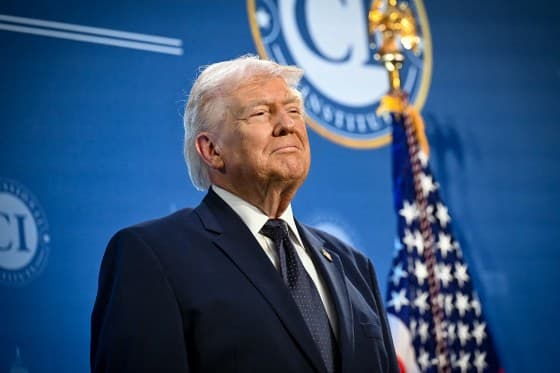
A high-stakes political standoff is reshaping the Texas Republican Senate runoff, with former President Donald Trump using his silence on the Cornyn-Paxton contest as a pressure tool to force Senate action on the SAVE Act, a bill that would require voters to show identification at the polls. The result is a race that has become something far larger than a Texas primary: a test of Trump's leverage over Senate Republicans and their willingness to dismantle one of Congress's most enduring procedural guardrails.
The Race Taking Shape
1. The Runoff's Basic Contours
Incumbent Senator John Cornyn and Texas Attorney General Ken Paxton are locked in a Republican primary runoff that carries national implications well beyond the Lone Star State. Cornyn spoke to media at the Austin Marriott Downtown on March 3, 2026, while Paxton was campaigning in Fort Worth as recently as February 28. The race pits a veteran institutionalist senator against a combative attorney general who has cultivated deep loyalty among the GOP base, setting up a collision between establishment Republican strategy and grassroots energy.
2. Paxton's Polling Advantage
Fresh data from Texas Public Opinion Research indicates a volatile race with Paxton starting from a stronger position among likely GOP voters. A Texas Politics Project poll conducted February 2-16, surveying 1,300 registered Texas voters with a margin of error of plus or minus 2.72 percentage points, found Paxton holding a net favorability rating of plus 34 points among Republicans, compared to Cornyn's plus 29. Newsweek's reporting notes, however, that voters appear less swayed by a potential Trump endorsement than party strategists might expect, a finding that could complicate the calculus for both campaigns.
The SAVE Act Ultimatum
3. Paxton's Conditional Dropout Offer
In a posting on X that electrified political observers, Paxton laid out an extraordinary conditional offer: "I would consider dropping out of this race if Senate leadership agrees to lift the filibuster and passes the SAVE America Act. John Cornyn is a coward who has refused to support abolishing the filibuster to pass this bill." The SAVE America Act, described in reporting as a priority piece of legislation for Trump, would require voters to show identification at the polls. By tying his potential withdrawal from a Senate race to a congressional policy outcome, Paxton transformed the Texas runoff into an explicit instrument of national legislative pressure.
4. Cornyn's Careful Response
Cornyn moved quickly to claim ownership of the bill's substance while carefully avoiding the filibuster question entirely. "I repeat what I have consistently said: I support the bill and have encouraged Senate Republicans to get it done," Cornyn said, as quoted by KBTX. Reporting from KBTX noted directly that Cornyn did not address his position on abolishing the filibuster in that response. Cornyn and a number of Senate Republicans have long bristled at talk of abolishing the filibuster, a procedural protection that requires 60 votes to advance most legislation and that the Republican conference has historically defended as a minority safeguard.
5. Cornyn's Counterattack on Paxton
Beyond the policy dispute, Cornyn made clear his campaign intends to prosecute a personal case against Paxton over the coming weeks. "Over the next 12 weeks, Texas Republican primary voters will hear more about my record delivering conservative victories in the U.S. Senate and learn more about Ken's indefensible personal behavior and failures in office," Cornyn said, as quoted by CBS News. Fox News reported that Cornyn separately vowed "judgment day is coming for Ken Paxton," signaling an aggressive campaign posture from the incumbent.
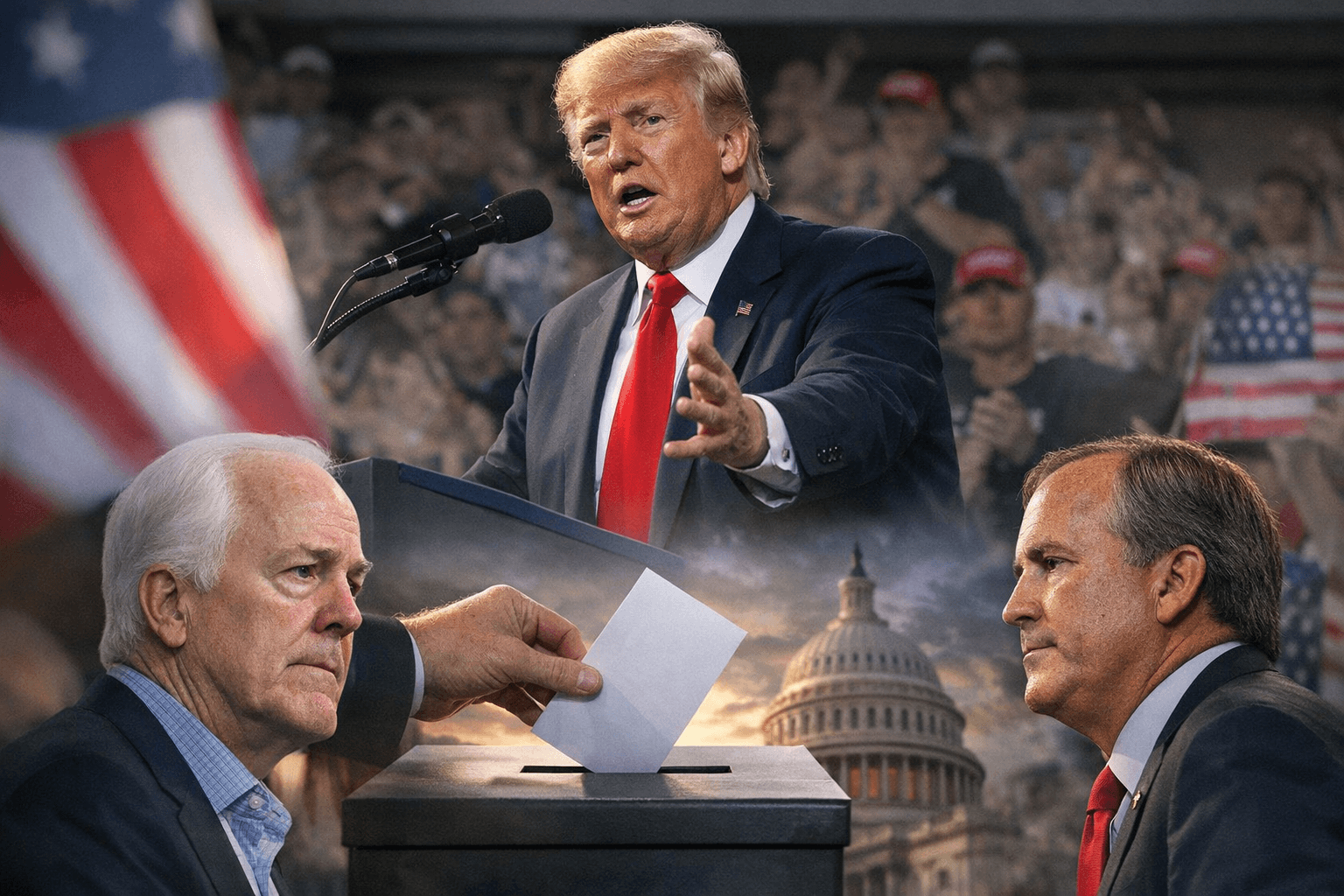
Trump's Leverage and the Institutional Response
6. Trump's Strategic Silence
Trump had refused to make a formal endorsement in the Cornyn-Paxton contest for months, a silence that itself generated maximum political pressure on both candidates and on the broader Senate Republican conference. CBS News reported that Trump eventually posted on his Truth Social account about the race, writing: "The Republican Primary Race for the United States Senate in the Great State of Texas..." though the full text of that post was not available in reporting at the time of publication. The original sourcing on this story frames Trump's non-endorsement as intentional leverage: he "has yet to make an endorsement in the contest between John Cornyn and Ken Paxton as he tries to push the Senate to pass a bill requiring voters to show identification at the polls."
7. Institutional Republicans Rally for Cornyn
The Senate Leadership Fund, described as the top super PAC backing Senate Republicans, spent millions on Cornyn's behalf during the primary campaign and announced it will continue to support him through the runoff. The National Republican Senatorial Committee framed Cornyn's candidacy in explicitly national terms. NRSC Communications Director Joanna Rodriguez said: "John Cornyn remains the only candidate who guarantees state Rep. Talarico never becomes a United States senator and ensures the fight for President Trump's Senate majority is waged in true battleground states, not Texas." The argument from institutional Republicans is that a Paxton nomination risks putting a Senate seat in play that should not be competitive, diverting resources from genuine battleground contests.
8. The Trump Endorsement's Potential Weight
Republican operatives close to Trump are tracking the Democratic side of the race with attention. One GOP political operative in Trump's orbit told Fox News: "Talarico being the nominee makes President Trump's endorsement of Cornyn more important than ever." The implication is that Trump holds a potential endorsement in reserve, ready to deploy it as both a reward for Senate compliance on the SAVE Act and a general-election insurance policy should the runoff produce a nominee vulnerable to Democratic attack.
What Comes Next
The convergence of a Texas Senate runoff, a filibuster fight, and Trump's deliberate withholding of his endorsement has created a pressure system with no easy release valve. Senate Republicans who support the SAVE Act on its merits now face a demand to go further: abolish the filibuster as the price of Paxton's potential exit from the race. Cornyn's refusal to address that demand directly reflects the deep institutional resistance within the Republican conference to permanently altering Senate rules, even for legislation the membership broadly supports. Whether Trump ultimately uses a formal endorsement to resolve the standoff, or continues to use ambiguity as his primary instrument of pressure, the Cornyn-Paxton race has already succeeded in making the SAVE Act a defining test of Republican Senate loyalty in 2026.
Know something we missed? Have a correction or additional information?
Submit a Tip