Trump’s Greenland push overshadows Davos as tariff threats loom
President Trump arrives in Davos as Greenland takeover bid and tariff threats overshadow the World Economic Forum.
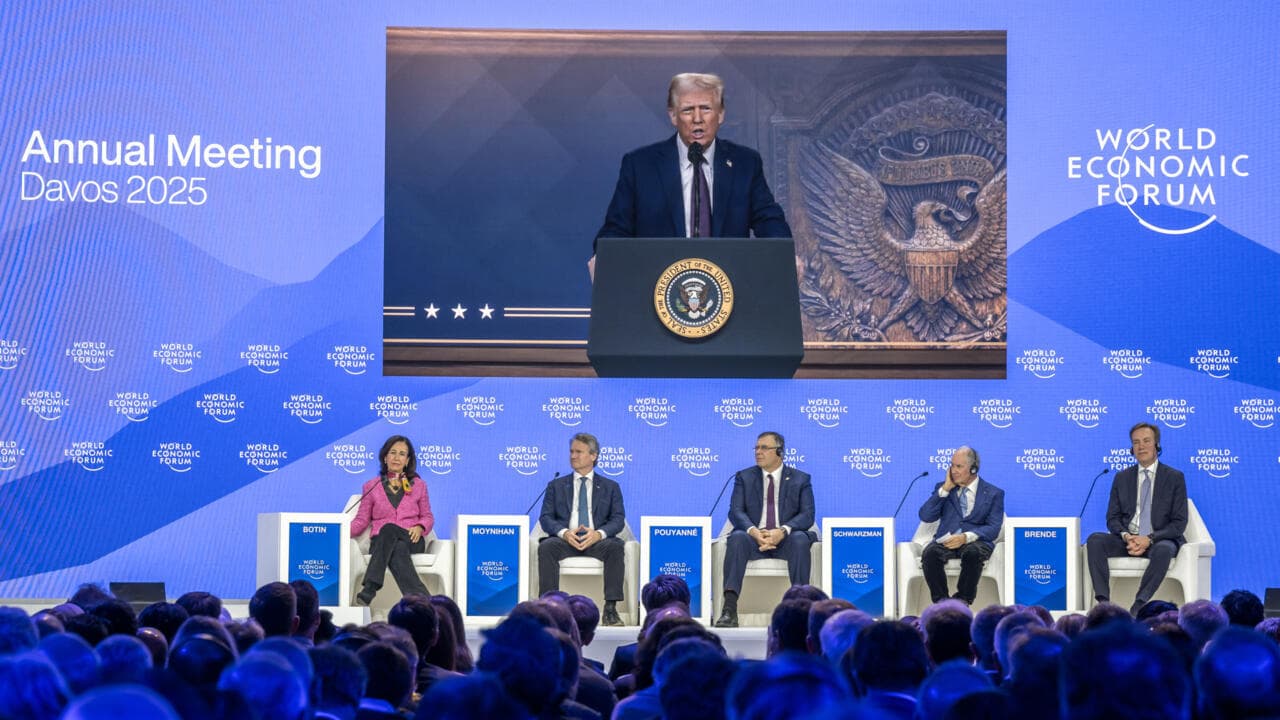
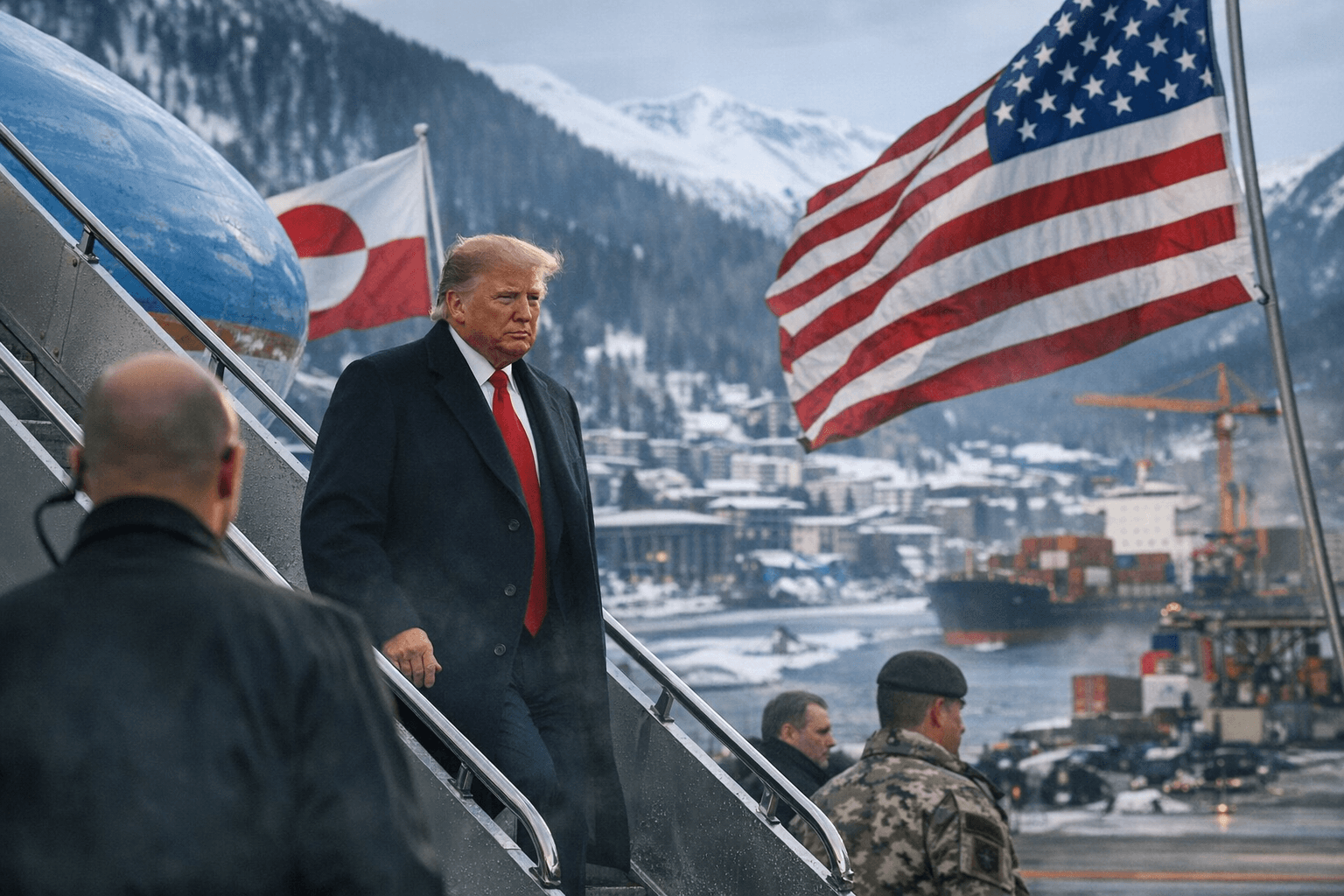
President Donald Trump lands in Davos with an agenda that is supposed to center on the global economy and technology but is instead dominated by his renewed bid to acquire Greenland and repeated threats of tariffs against European countries that oppose the plan. His arrival was briefly delayed after Air Force One experienced what officials called a minor electrical issue that forced the aircraft to turn back before touching down.
Speaking to reporters on arrival, Trump framed the effort as a matter of strategic necessity, saying, "we will work something out where NATO is going to be very happy and where we're going to be very happy," and that the United States "need[s] it for security purposes. We need it for national security." When pressed on whether the United States would press ahead regardless of resistance, he said there is "no going back" and offered a terse warning to skeptics: "You'll find out."
The comments have injected an unusually high-stakes geopolitical tone into the World Economic Forum, where leaders and corporate chiefs had convened under the motto "A Spirit of Dialogue" to discuss trade, artificial intelligence and global recovery. Organizers had scheduled appearances by European Commission President Ursula von der Leyen, French President Emmanuel Macron and Chinese Vice Premier He Lifeng, as well as panels featuring U.S. Treasury Secretary Scott Bessent and Microsoft CEO Satya Nadella. At one point in Davos, Treasury Secretary Bessent asked rhetorically, "Why doesn’t Europe just sit down and wait for Trump to address them?"
Trump has publicly justified the push by citing Arctic security concerns, portraying Greenland as critical to deterring Russia and China in the high north and signaling a willingness to consider military options to secure the island. He has also linked the broader approach to pressure on other states in his foreign policy remarks.
The proposal has unsettled Copenhagen and Nuuk. Denmark’s prime minister Mette Frederiksen and Greenland’s leader Jens-Frederik Nielsen have said they "cannot rule out" the possibility of a U.S. military intervention, underscoring the seriousness with which regional officials are treating the rhetoric. NATO officials and some European leaders warn that the strategy risks fraying alliance ties and could upend long-standing security arrangements.
Across Europe, leaders are balancing condemnation of the approach with appeals to preserve transatlantic cooperation. Poland’s president Karol Nawrocki, noting his country’s hosting of American troops and deep defence ties, urged that the Greenland controversy not eclipse the need for "strong transatlantic relations," calling the United States "a very important ally" and Denmark "our partner."
The president’s public threats of tariffs have intensified the diplomatic standoff. Reports emerging from Davos cite a range of potential measures, with threatened levies described in varying figures from roughly 10 percent to as high as 25 percent and some accounts pointing to a 10 percent tariff effective Feb. 1. The campaign has reopened scrutiny of a July 2025 accord reached in Scotland that involved tariff adjustments, and leaders of the European Parliament’s main political groups have called for that agreement to be frozen. Iratxe García Pérez, president of the S&D group, said there was a "broad agreement" among political groups to suspend the deal.
Beyond the immediate disputes, the episode raises questions about international law, sovereignty and the rights of Greenlanders, whose island is an autonomous component of the Kingdom of Denmark. Diplomats in Davos are now tasked with preventing a bilateral spat from rippling into trade ruptures and strategic fissures across NATO at a moment when alliance cohesion is already being tested by global rivalries.
This article was produced by Prism’s automated news system from verified source data, official records, and press releases, then run through automated quality and moderation checks before publishing. The system is built and supervised by the people who set the standards it runs under. Read our full AI policy.
Did this article answer your question?

