Trump's Iran Fury Pushes NATO Into Its Worst Crisis Since Founding
Trump called NATO allies "cowards" over Iran and threatened to quit, putting the alliance at its lowest point since its 1949 founding, analysts say.
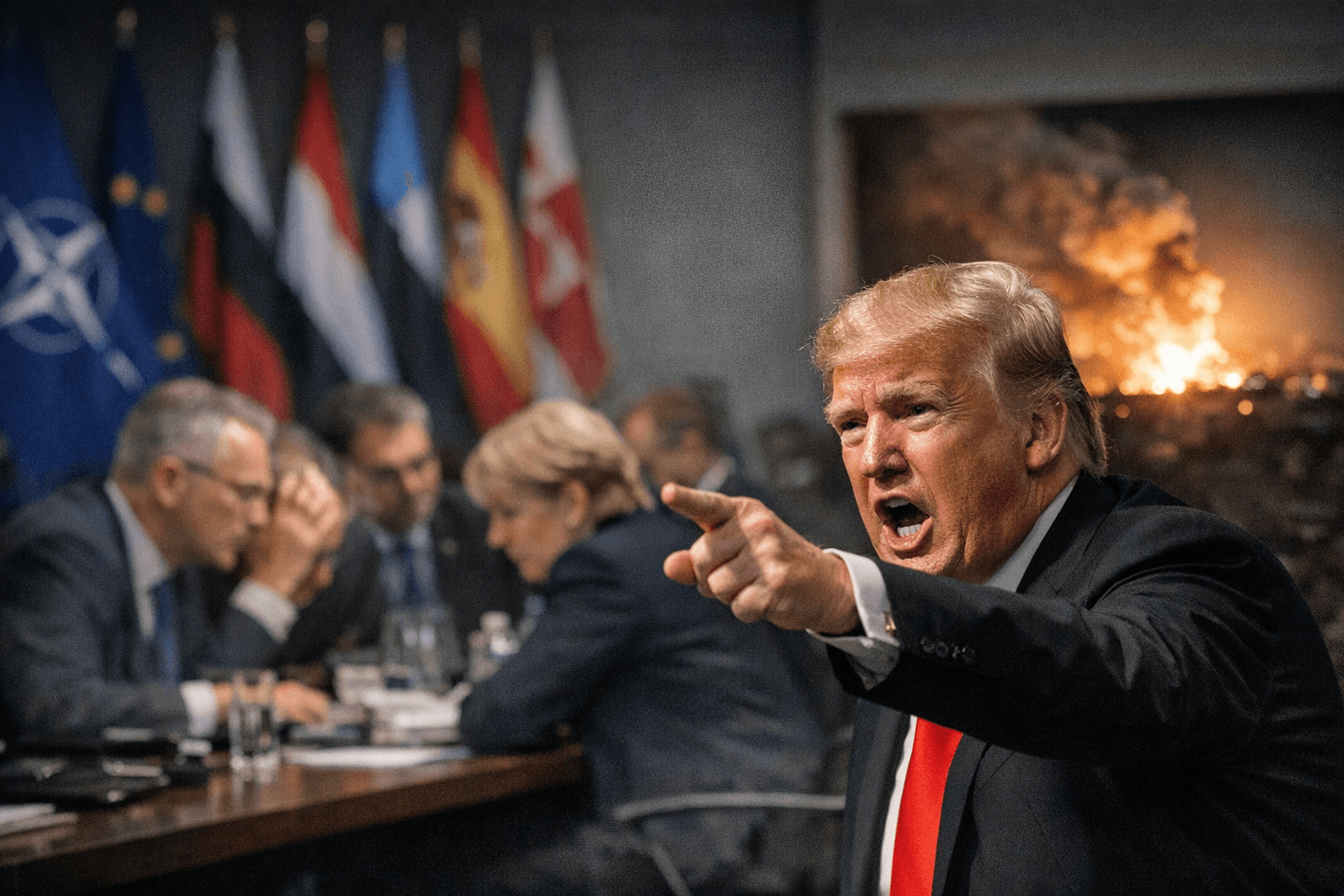
Donald Trump labeled European NATO allies "cowards" for refusing to deploy warships to the Strait of Hormuz, threatened to quit the alliance entirely, and prompted Secretary of State Marco Rubio to declare that Washington would "have to reexamine the value of NATO," a sequence of moves that has driven the 77-year-old alliance to what analysts describe as the lowest point in its history.
The rupture traces to the U.S.-Israeli air campaign against Iran that began in late February 2026. After Iran responded by choking the Strait of Hormuz, a corridor for roughly 20 percent of global oil, Trump demanded that European allies dispatch naval forces to reopen it. When they declined, the White House turned the disagreement into an open confrontation. A White House spokesperson confirmed the depth of presidential displeasure, saying Trump "has made his disappointment with NATO and other allies clear." When a Reuters reporter pressed Trump on his anger at allies who would not join the fight, he replied: "Wouldn't you if you were me?"
Max Bergmann of the Center for Strategic and International Studies did not soften his assessment. The situation, he said, represents "the worst place (NATO) has been since it was founded" in 1949. That founding premise, collective defense through Article 5, has been invoked only once in the alliance's history, after the September 11 attacks.
European governments resisted Trump's pressure for reasons that are simultaneously military, economic, and political. Deploying NATO warships into an active conflict zone would expose them to Iranian missile and drone retaliation, drawing them into a war their governments played no part in initiating. With global energy prices already under severe strain from Iran's blockade, escalation threatened to intensify the commodity shock. And across the continent, public opinion firmly opposed the conflict. The United Kingdom, France, Germany, Italy, and the Netherlands signaled a vague "readiness to contribute" to reopening the Strait but stopped short of committing warships or combat roles. Allies have also noted, pointedly, that Trump launched the war against Iran without consulting them, without an international legal framework, and then demanded they help manage the fallout.
Rubio's intervention sharpened the stakes. One of the most pro-NATO figures in Trump's inner circle, the secretary of state told Al Jazeera that allied governments' response to the war was "very disappointing" and indicated Washington would reassess its commitments to them once the conflict ended. Trump separately threatened to halt U.S. weapons sales to Ukraine through NATO if European partners refused to act on Hormuz, entangling the Iran standoff with the unresolved war in eastern Europe.
Samir Puri, a visiting lecturer on war studies at King's College London, warned that the accumulated weight of the disputes was structural, not episodic: "The bond of NATO weakens further." Thomas Wright of the Brookings Institution noted that allies had previously navigated Trump's turbulence by cultivating personal relationships and making targeted accommodations, a strategy of muddling through. The Iran war is testing whether that approach can survive a direct demand to join a live military operation.
The strategic implications extend far beyond the Persian Gulf. Analysts warn that a durable transatlantic rift weakens deterrence against Russia, complicates intelligence-sharing, and accelerates pressure on European capitals to build autonomous defense capacity. Whether this crisis becomes a permanent reorientation of the alliance or another survivable rupture is now the defining foreign-policy question on both sides of the Atlantic.
This article was produced by Prism’s automated news system from verified source data, official records, and press releases, then run through automated quality and moderation checks before publishing. The system is built and supervised by the people who set the standards it runs under. Read our full AI policy.
Did this article answer your question?