Trump’s sweeping use of executive power faces mounting challenges
Trump has turned emergency powers and executive orders into a governing strategy, setting up lawsuits, Senate pushback, and a pivotal Supreme Court test.

A presidency built around unilateral power
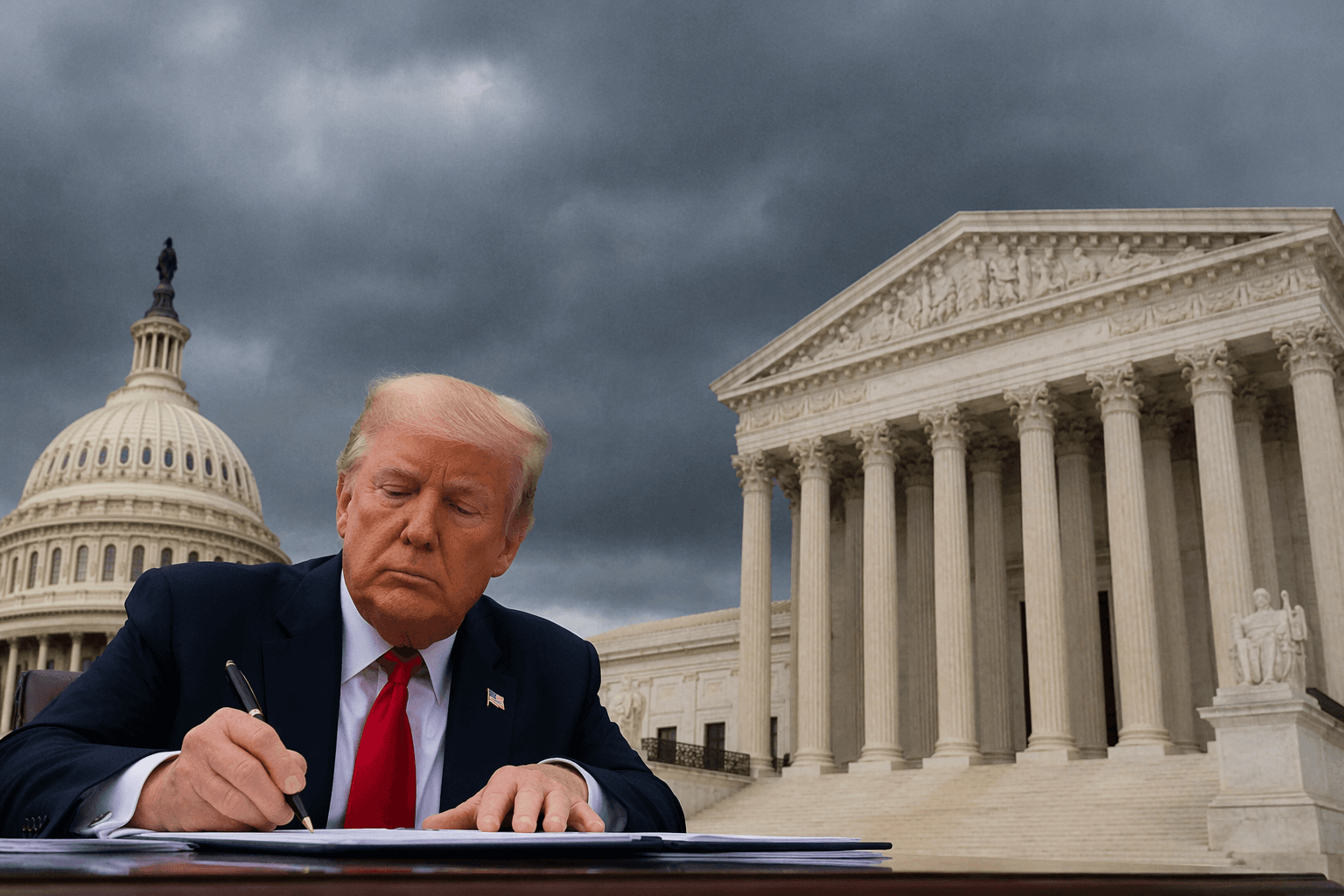
Donald Trump’s second term is being defined by how far he is willing to push presidential authority without waiting for Congress. The clearest example came on April 2, 2025, when the White House said he declared a national emergency tied to foreign trade and tariffs, a move presented as part of a broader campaign to restore U.S. economic security.
That decision matters far beyond tariff policy. It shows a president treating emergency powers as a central governing tool, not a last resort. By May 20, 2026, Trump had signed 261 executive orders, 77 memoranda and 144 proclamations since taking office on January 20, 2025, a pace that has shifted much of his agenda into unilateral action and prompted hundreds of lawsuits.
The specific power being stretched
The power at the center of this fight is the presidential emergency authority, especially when paired with trade and tariff powers. In practice, that means the executive branch can try to move quickly around the slower machinery of legislation, using declarations of emergency to justify actions that would otherwise demand explicit congressional approval.
That is why Trump’s April 2025 trade emergency drew such sharp attention. Tariffs are ordinarily a policy area where Congress has a constitutional role, even if presidents have long used delegated authority to act on trade. When a president frames a broad economic strategy as an emergency, critics see more than policy aggression, they see a test of whether the White House can turn temporary powers into a standing substitute for lawmaking.
Why this moment feels unusually aggressive
Analysts have described Trump’s use of national emergencies as more aggressive and expansive than the approach taken by modern presidents. That comparison is important because presidents of both parties have relied on emergency declarations before, usually to respond to wars, disasters, sanctions, or discrete national security threats.
What distinguishes Trump’s second term is scale and frequency. The emergency declaration on tariffs is not an isolated act; it sits alongside a flood of executive orders, memoranda and proclamations that have made unilateral action the organizing principle of the administration. The result is a governing style that critics say stretches presidential power beyond historical norms, while supporters argue that it restores energy to an institution they see as overly constrained.
The legal backlash is already here
The courts have become the first major checkpoint. Hundreds of lawsuits have already been filed challenging Trump administration actions during the second administration, a sign that opponents are not waiting for the political process to catch up. Many of those challenges go to the same core question: how far can a president go when he says the country faces an emergency?
That question is now headed straight toward the U.S. Supreme Court. Reuters reported on May 20, 2026, that four more major Trump-related cases were expected to be decided by the end of next month. The timing matters because the Court’s rulings could help define whether emergency-driven governance remains a limited tool or becomes a durable model for future presidents.
For communities, the stakes are practical as well as constitutional. When executive action moves fast and gets challenged in court, the result can be instability for businesses, workers and state governments trying to plan around tariffs, regulations or agency directives. In health, labor and social policy, that uncertainty can ripple outward, delaying services, complicating budgets and widening the gap between communities with the resources to adapt and those that do not.
Congress is testing its own limits
Congress is not absent from the story, but its resistance has been uneven. On May 19, 2026, the Senate advanced a resolution to halt military action in Iran after a surprise defection from Republican Sen. Bill Cassidy. That vote was not about tariffs, but it reflects the same underlying struggle: whether the legislature will reclaim authority when the White House pushes into areas that Congress believes should not be controlled by executive fiat.
The Cassidy defection is notable because it shows resistance can emerge even within Trump’s own party when lawmakers believe the president is moving too far or too fast. Still, the fact that Congress must rely on resolutions, defections and narrow procedural openings underscores how much leverage the presidency has already accumulated.
The guardrails that still exist
If this becomes the new normal, the remaining guardrails will matter more than ever.
Courts remain the most immediate check, because they can block unlawful actions, narrow broad interpretations of emergency statutes and force the White House to justify its claims under existing law. Congress still holds the power of the purse, can rewrite statutes and can limit delegated authority if enough lawmakers are willing to use it. Agency rules also matter, because executive actions often depend on how departments interpret and implement them on the ground.
Norms are the weakest but still essential guardrail. Presidents historically have relied on the expectation that emergency powers are exceptional, not routine. Once that norm weakens, each successor inherits a larger toolbox and a lower threshold for using it. That is why Trump’s second term is being watched so closely: the issue is not only what he can do now, but what future presidents may claim as precedent.
What to watch next
The next phase of this fight will likely be decided on two tracks. One is judicial, with the Supreme Court expected to weigh several major Trump-related disputes by the end of next month. The other is political, with Congress deciding whether it will tolerate a presidency that increasingly governs through executive order, memorandum, proclamation and emergency declaration.
Trump’s supporters see strength and speed. His critics see a presidency testing how much constitutional resistance can be bypassed before the system pushes back. The answer will shape not just this administration, but the boundaries of executive power for years to come.
Know something we missed? Have a correction or additional information?
Submit a Tip