Two babies among 53 dead or missing after Libya boat capsizes
A rubber dinghy carrying 55 migrants capsized off northwest Libya; 53 people are dead or missing and two Nigerian women survived, the IOM said.
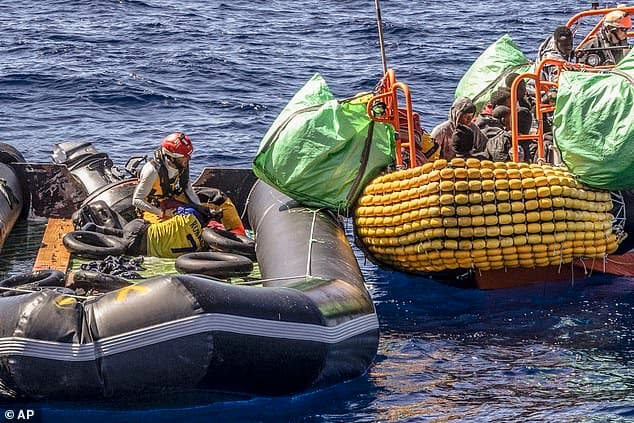
The International Organization for Migration said in a statement on Feb. 9 that a rubber dinghy carrying 55 people overturned and sank off the northwest Libyan coast early on Feb. 6, leaving 53 people dead or missing and two women rescued by Libyan authorities. The vessel had set off from Zawiya late on Feb. 5 and began taking on water roughly six hours later north of Zuwara in the central Mediterranean, the agency said.
The two survivors, both identified as Nigerian women, were taken ashore and given medical attention. One woman told rescuers she had lost her husband and the other that both of her infants had died. IOM teams provided the two survivors with emergency medical care upon disembarkation, "in coordination with the relevant authorities," the agency said.
The dinghy was described by IOM as an unseaworthy inflatable used by smugglers. "Trafficking and smuggling networks continue to exploit migrants along the central Mediterranean route," the agency warned, noting that organized criminal groups profit by moving people in dangerously inadequate vessels. The agency and U.N. officials said the crossing took place in the "perishingly cold waters" of the central Mediterranean, a factor that has contributed to a sharp rise in deaths and disappearances this winter.
The capsizing is the latest in a wave of lethal crossings tracked by IOM’s Missing Migrants Project. According to IOM figures, 484 people have been reported dead or missing on the central Mediterranean route so far in 2026, including at least 375 in January alone amid what IOM described as multiple "invisible" shipwrecks. Last year saw more than 1,300 dead or missing on the same route, and since IOM began tracking in 2014 more than 33,400 migrants have died or gone missing in Mediterranean waters, the agency said.
IOM and U.N. reporting also underscored the connection between maritime disasters and abuses on land in Libya, where migrants are frequently detained by smugglers or traffickers. Authorities recently raided an illegal detention site in Ajdabiya and uncovered an underground holding facility in Kufra, three metres below ground, from which 221 migrants and refugees were released, including women, children and a one-month-old baby. "Investigations indicate that the victims had been held in captivity and subjected to torture to coerce ransom payments from their families," IOM and U.N. reporting said.
Humanitarian groups and analysts say the sharp toll stems from a mix of factors: chaotic and violent smuggling networks operating out of Libya, harsher winter weather including the effects of Cyclone Harry in January, and diminished rescue capacity across the Mediterranean since 2016 as several European states reduced state-led search-and-rescue operations and placed greater restrictions on private vessels.
Libya remains a central transit point for people fleeing conflict, poverty and instability across Africa and the Middle East, and the IOM called attention to the continuing human cost of attempts to reach Europe by sea. Investigations into the capsizing and the fate of the missing remain under way, and IOM reiterated its appeal for greater protections for migrants and more effective measures to disrupt trafficking and smuggling networks.
This article was produced by Prism’s automated news system from verified source data, official records, and press releases, then run through automated quality and moderation checks before publishing. The system is built and supervised by the people who set the standards it runs under. Read our full AI policy.
Did this article answer your question?