UC Davis Engineers Built an Engine That Runs on Darkness Itself
A UC Davis team ran a fuel-free engine using only the cold of outer space, generating power all night with no batteries or grid connection.

Every clear night, Earth quietly bleeds heat into the void of space. Engineers at UC Davis have turned that invisible loss into a source of usable power, demonstrating a fuel-free engine that runs entirely after dark by exploiting the temperature gap between warm ground and the cold sky above.
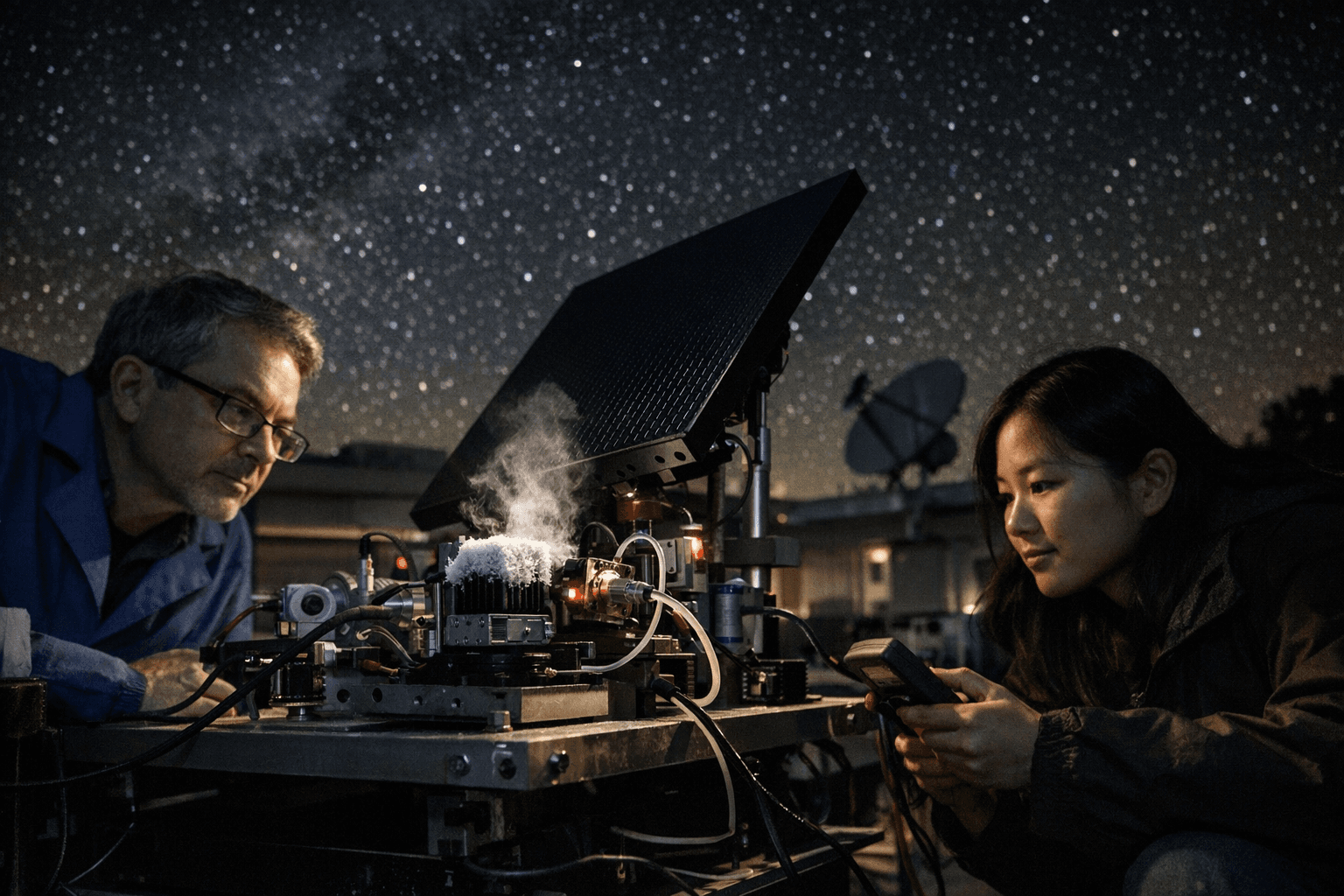
The device, a modified Stirling engine developed by professor Jeremy Munday and his team, sat outdoors facing upward and drew on one of thermodynamics' most basic principles: heat flows from warm to cold, and that flow can do work. The bottom plate stayed in thermal contact with the soil, which retains warmth through the night. The top plate, coated with an infrared-emissive paint and optically coupled to the sky, shed heat directly into space through the atmosphere's natural transparency window, the narrow band of wavelengths that infrared radiation can pass through largely unobstructed.
The result was a persistent temperature difference of more than 10 degrees Celsius between the two plates, sustained across long stretches of the night. That gap was enough to keep a sealed gas inside the engine expanding and contracting, turning a flywheel at roughly one rotation per second.
After a year of nighttime outdoor testing at UC Davis, the researchers measured at least 400 milliwatts of mechanical power per square meter. The engine directly powered a small fan and, when connected to a small motor, produced a modest electrical current. No fuel, no batteries, no grid connection.
"These engines are very efficient when only small temperature differences exist, whereas other types of engines work better with larger temperature differences and can produce more power," Munday said.
Stirling engines, unlike internal combustion engines, exchange heat externally, which allows them to run on subtle temperature gradients that would be useless to conventional machinery. The UC Davis design was specifically adapted to minimize energy losses during the gentle pressure swings produced by a 10-degree difference, far smaller than the gradients that typically drive industrial power generation.
The current output is modest. At 400 milliwatts per square meter, the device would not run a household. But the researchers project that optimized components could push output beyond 6 watts per square meter, a 15-fold increase that would broaden the range of practical applications considerably. Performance peaks in dry, low-humidity climates with consistently clear skies, because atmospheric water vapor absorbs infrared radiation and reduces the cooling effect on the top plate. Deserts and arid regions are the most favorable environments.
The envisioned near-term uses are deliberately humble: ventilating greenhouses overnight, circulating air in off-grid structures, or powering low-draw sensors in remote locations. What makes the approach significant is not its current output but its operating window. Solar panels go dark at sunset; this engine wakes up.
UC Davis has filed a provisional patent on the technology, and the study was published in the journal Science Advances.
The device is a proof of concept, and the engineering work to scale it remains substantial. But Munday's team has shown that the darkness of space is not simply an absence, it is a heat sink large enough to turn a flywheel, and with the right machine, that is enough to start.
Know something we missed? Have a correction or additional information?
Submit a Tip