Uganda's aging nuns face a growing care crisis
Uganda’s nuns helped hold schools and clinics together for decades. Now they are aging into a system that barely funds pensions, health care or dignified care.

Uganda’s elderly nuns are entering old age after a lifetime spent filling gaps in classrooms, clinics and community life, but the safety net around them is thin. Associated Press reporting shows that across Uganda and much of Africa, governments have invested little in pensions, health care and caregiving support for older people. The result is a quiet crisis: women who spent decades serving others are now facing the question of who will care for them when they can no longer work.
A continent aging faster than its systems
The strain is not limited to one country or one religious order. In just 15 years, the number of people age 60 and older in sub-Saharan Africa has grown by an estimated 50 percent, reaching about 67 million. The World Health Organization projects that the region will have 163 million older people by 2050, a demographic shift that is moving faster than many governments and health systems can adjust.
That growth is unfolding in settings where poverty, pain and limited access to care already shape daily life. AP has noted that even minor illnesses can become serious without treatment, which makes aging especially dangerous in communities where routine care is hard to reach. In places like Nabalanga, Uganda, the problem is not simply that people are living longer. It is that longer lives are arriving in systems that were never built to support them.
The women who kept institutions running
Catholic sisters have long been among the quiet infrastructure of public life in Uganda. They taught children, supported clinics and often stepped into roles that weak state systems could not reliably fill. AP’s framing of the story makes that history central, because the same women who helped carry schools and health work now need help themselves.
That contrast gives this crisis its moral force. The sisters’ later years are exposing a gap between the lives they led in service and the support available when their own health declines. For aging caregivers, the question is no longer what they can do for others, but what will happen when they need basic assistance, medical attention and a safe place to live.
The names attached to the reporting, including Kenneth Mugayehwenkyi, Dr. Mie Rizig and Yafesi Nakyanga, point to how personal and local this issue is even as it reflects a much larger continental trend. Their inclusion underscores that the care crisis is not an abstract policy concern. It is a lived reality for communities that have depended on religious women for generations.
What happens when the state does not build a safety net
AP’s account is blunt about the policy gap: in Uganda, as elsewhere in Africa, there has been little government investment in pensions, health care and caregiving support for older people. That means aging sisters, like many older adults, cannot count on a broad public system to underwrite housing, treatment or long-term care.
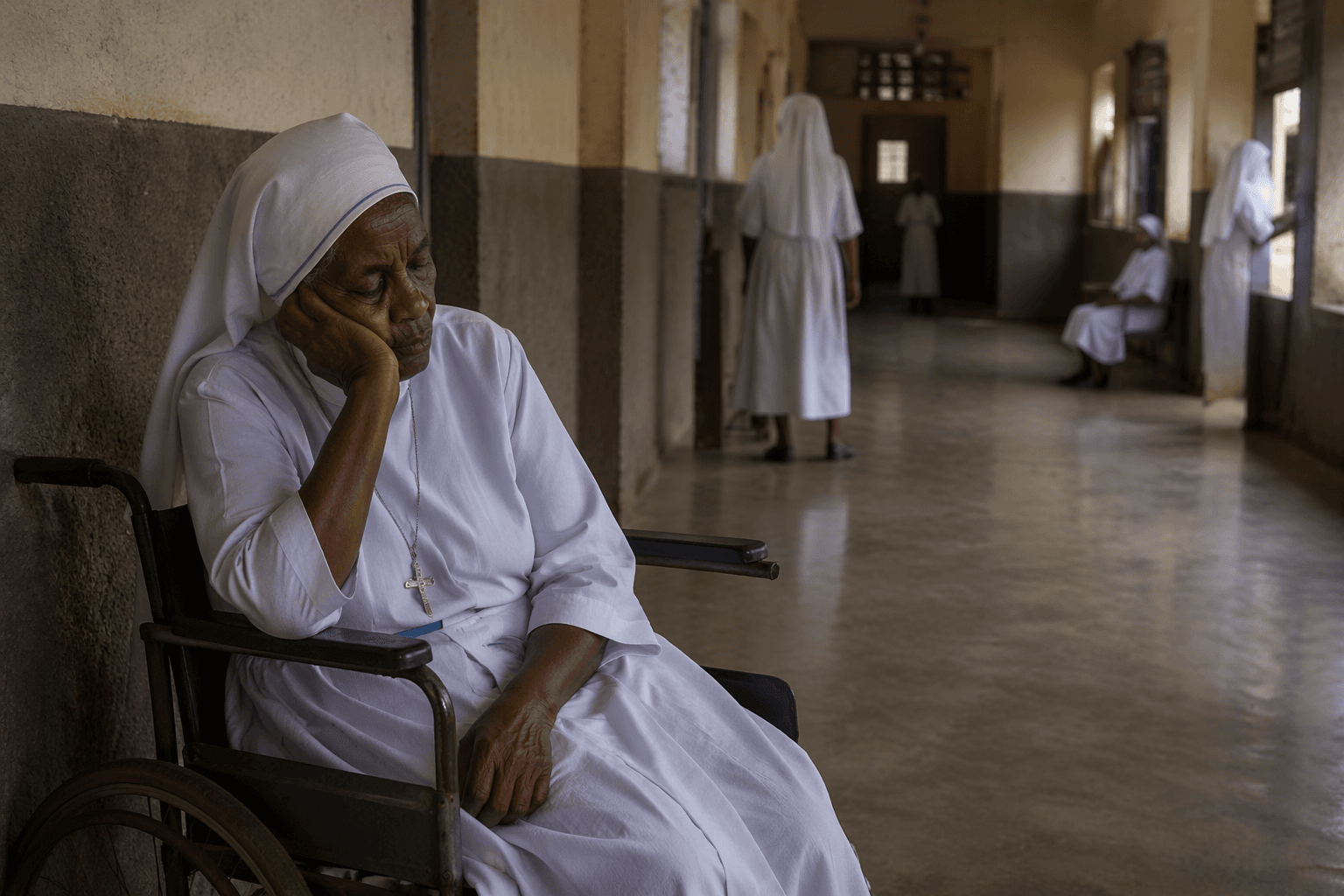
When support is thin, the burden falls back on families, church communities and the orders themselves. But those networks are often stretched too. This is why the crisis matters far beyond convent walls. It shows how low-income countries can ask women to sustain schools, clinics and ministries for decades, then offer very little when those same women age out of the work that made the system function.
The AP reporting also points to Reach One Touch One Ministries as part of the wider landscape of care in Uganda. Its presence reflects how much elder support in many communities depends on patchwork institutions rather than strong public guarantees. That patchwork may keep people afloat in the short term, but it rarely provides the security older adults need over many years.
A church challenge that crosses borders
Uganda’s sisters are not the only aging religious women confronting this problem. AP has also reported that Catholic sister communities in the United States are redesigning housing to fit changing health needs as members age. The Presentation Sisters planned $5 million residences in two cities because their current Aberdeen convent could house more than 100 nuns but was bigger than needed, with only 27 sisters living there.
That example matters because it shows how even wealthier church communities are being forced to rethink space, staffing and medical needs. The new facilities were meant to be more efficient and to meet the changing health demands of aging nuns. In other words, this is not a niche housing issue. It is a long-term care challenge reshaping religious life across borders.
For Uganda, the comparison is sobering. If larger, better-resourced orders are redesigning convents to handle aging, then the gap for poorer communities is even wider. The question is not whether the need exists. It is who will pay for care, who will organize it, and whether older women who spent their lives serving others will be able to age with dignity.
What this crisis says about aging care in low-income countries
The story of Uganda’s aging nuns is ultimately about the value societies place on care workers once their own labor slows down. It is also about the hidden cost of relying on women, especially religious women, to substitute for weak public systems in schools and clinics. When those women grow old, the same systems often fail to return the favor.
As sub-Saharan Africa grows older, the region will need more than sympathy. It will need pensions that exist, clinics that can treat chronic illness, and caregiving structures that do not collapse when a sister, teacher or nurse can no longer keep working. Uganda’s nuns reveal what happens when that support is missing: the people who once held communities together are left asking, in their final years, who will hold them.
This article was produced by Prism’s automated news system from verified source data, official records, and press releases, then run through automated quality and moderation checks before publishing. The system is built and supervised by the people who set the standards it runs under. Read our full AI policy.
Know something we missed? Have a correction or additional information?
Submit a Tip