UK Records Hottest and Sunniest Year on Record in 2025
The Met Office has declared 2025 the warmest and sunniest year in UK records, with a national mean temperature of 10.09°C and a sunshine total of 1,648.5 hours. Those provisional figures underline accelerating climate trends that have immediate consequences for water supply, agriculture and coastal seas, and they will shape policy debates as Britain adapts to a warmer future.

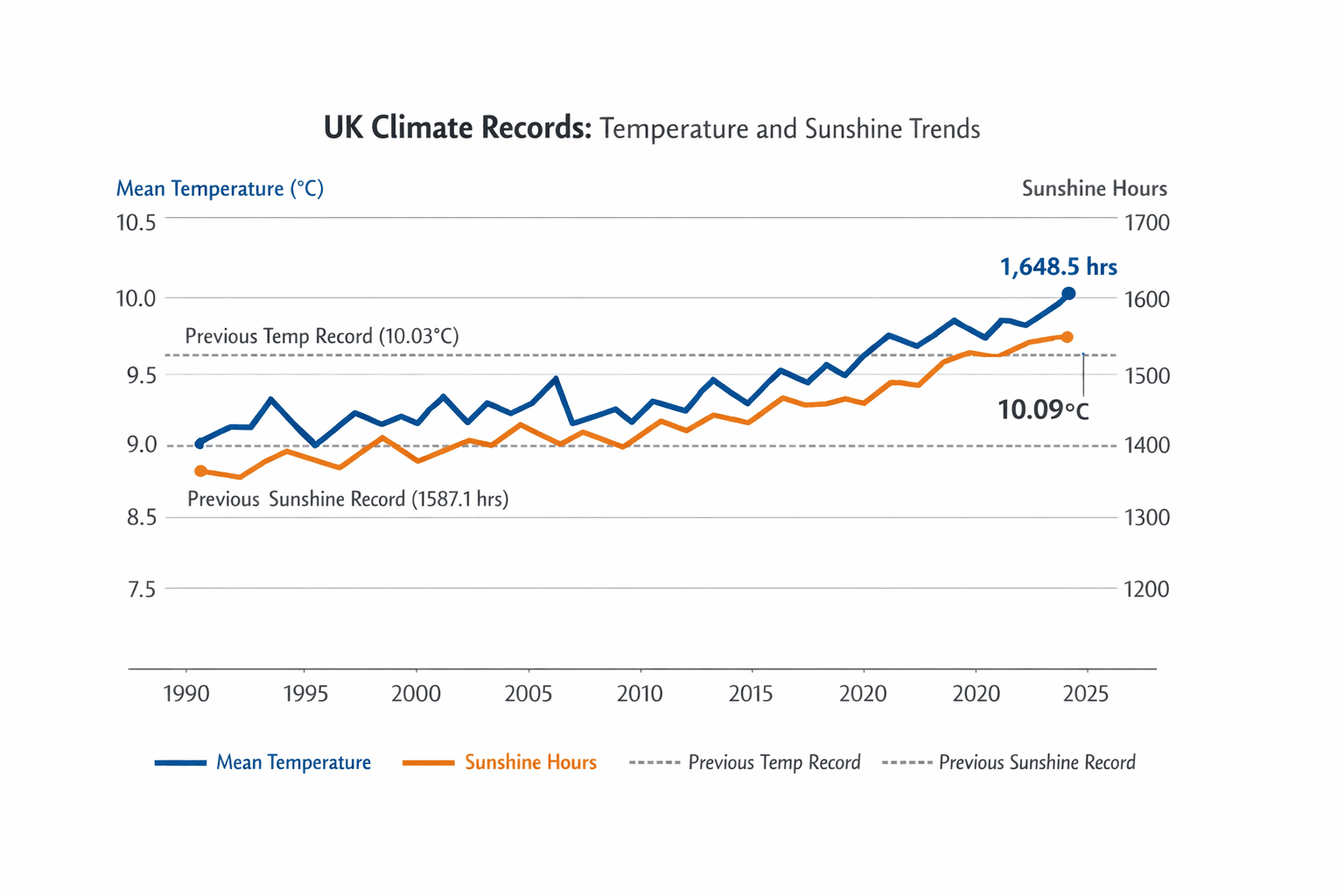
The United Kingdom experienced its warmest and sunniest year on record in 2025, the Met Office announced in provisional national calculations released on 2 January 2026. The agency described the year as a "double‑record breaker," reporting a mean annual temperature of 10.09°C, surpassing the previous high of 10.03°C set in 2022, and 1,648.5 hours of sunshine, 61.4 hours more than the previous sunshine record from 2003.
The long-run context underscores the scale of change. The Met Office places its temperature series back to 1884 and the sunshine series to 1910; 2025 now joins 2022 and 2023 among the warmest years in that era. Other analyses note that all of the UK’s top 10 warmest years have occurred in the past two decades and that four of the top five fall in the current decade, a pattern that points to a sustained upward trend rather than isolated anomalies.
Temperature anomalies were widespread. Every month in 2025 except January and September was warmer than the 1991–2020 average, and March through August were each at least 1.0°C above that baseline. The spring of 2025 was recorded as the warmest on record, producing an extended period of warmth that set the stage for dry conditions later in the year. Surrounding seas were also unusually warm; provisional data indicate near‑continuous sea‑surface "marine heatwave" conditions relative to a 1982–2012 reference period for almost the entire year.
The meteorological record translated into tangible impacts. Persistent dryness through March, April and May raised drought concerns, and parts of the Midlands were formally declared in drought. Water companies introduced restrictions: hosepipe bans and other measures affected customers of Yorkshire Water, Southern Water and Thames Water, and water users across the South East faced curbs by July. At the other end of the spectrum, the year also produced extreme events, including Storm Éowyn, one of the most notable windstorms of the century, and heavy November snow in areas such as the North York Moors, illustrating the variety of weather even during an exceptionally warm year.
Met Office scientists framed the findings as both exceptional and consistent with a changing climate. The agency highlighted the persistence of warmer-than-average months and linked the string of new temperature highs to longer-term climate trends, while specialists pointed to the role of unusually warm sea surfaces in amplifying impacts on weather and ecosystems.
The figures are provisional, released in a Met Office statement timestamped 12:30 UTC on 2 January 2026, and will be subject to final verification. Still, for policymakers and communities the data crystallise familiar challenges: managing water resources under greater variability, protecting vulnerable ecosystems and infrastructure, and accelerating adaptation across sectors. Internationally, the UK’s new records mirror warming patterns seen across northern Hemisphere nations, reinforcing calls for coordinated mitigation and investment in resilience.
This article was produced by Prism’s automated news system from verified source data, official records, and press releases, then run through automated quality and moderation checks before publishing. The system is built and supervised by the people who set the standards it runs under. Read our full AI policy.
Did this article answer your question?


