Ukraine Allocates UAH 1.6 Billion to Repair and Secure Chornobyl Confinement
Ukraine's Cabinet approved more than UAH 1.6 billion to repair and strengthen the New Safe Confinement at Chornobyl after a 14 February 2025 drone strike pierced the Arch.
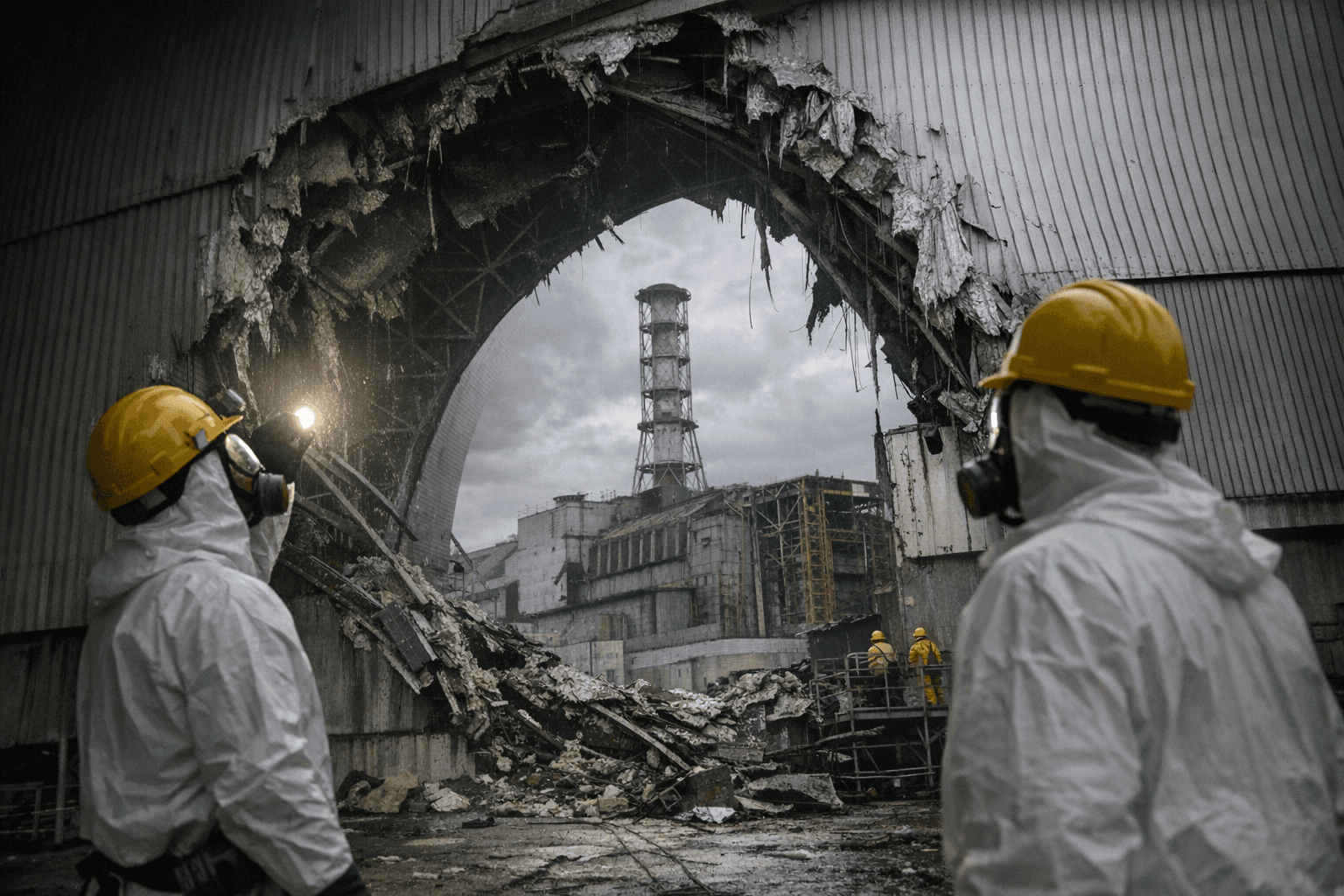
The Cabinet of Ministers of Ukraine approved more than UAH 1.6 billion from the state budget to repair and secure the New Safe Confinement (NSC) that covers Reactor Unit 4 at the Chornobyl Nuclear Power Plant, the Ministry of Energy said, directing funds to works that address the consequences of the 14 February 2025 drone strike. The allocation is intended to fund near-term repairs and safety measures for the Arch and for associated systems needed to keep the site stable while longer-term engineering work is planned.
Ukranews’ published line-item breakdown shows UAH 790 million earmarked to maintain the three shutdown ChNPP units, the spent fuel storage facility ISF-1 and radioactive waste storage facilities; UAH 285.1 million for decommissioning and partial dismantling of individual systems and elements; and UAH 542.3 million for organizational and technical measures to manage, operate, maintain, repair and control safety of systems that will operate in the future. Those three items total UAH 1,617.4 million. International reporting converted the package at roughly US$37 million and €31.4 million.
Interfax-Ukraine cites Cabinet Resolution No. 237 of February 25 as the legal measure envisaging the allocation; other outlets place the Cabinet action in the same late-February 2026 window. The Ministry of Energy framed the allocation explicitly as recovery from what it called a Russian attack, stating, “The government has allocated more than UAH 1.6 billion in budget funds to carry out work to secure the Chornobyl NPP containment. These funds will be used, among other things, to overcome the consequences of the Russian terrorist attack on the plant's shelter.”
The funding follows the February 14, 2025 combat-drone strike that Ukrainian reports described as carried out by a Russian combat drone with a high-explosive warhead, piercing a large hole in the NSC roof and triggering fires and smouldering that took weeks to extinguish. Ukrainian teams carried out temporary repairs in May 2025. The IAEA Nuclear Energy Commission’s December 2025 report concluded the Shelter “has lost its basic safety functions due to the damage and urgent repairs are needed,” a finding that underpins the Cabinet allocation.
Operational measures are already under way: Oleh Korikov, chairman of the State Nuclear Regulatory Inspectorate of Ukraine, reported end-of-January implementation of temporary urgent steps to reduce negative consequences for the NSC, including a technical solution to temporarily close the opening in the Arch’s outer shell at the drone impact site to limit precipitation ingress. The new budget lines are aimed at turning temporary fixes and emergency actions into maintainable systems and to fund partial dismantling where required to reduce risk.
The Ministry tied the domestic funding move to an appeal for an international reaction, saying “a clear response from the world to such terrorist attacks is needed, in particular, restrictions on the rights of the aggressor state within the IAEA structure,” and arguing that “However, eliminating global risks is only possible if Russia stops attacks on Ukrainian nuclear facilities.” The February 2026 allocation supplements a February 2025 Cabinet allocation of UAH 1.5 billion and signals continued prioritization of ChNPP stabilization, procurement of repair works and extended safety oversight while the NSC is restored to functional condition.
Know something we missed? Have a correction or additional information?
Submit a Tip