Ukraine, Germany deepen defense ties with drone deal and Patriot funding
Berlin paired Patriot funding with a drone-production push, signaling a defense partnership meant to outlast another ad hoc aid package.
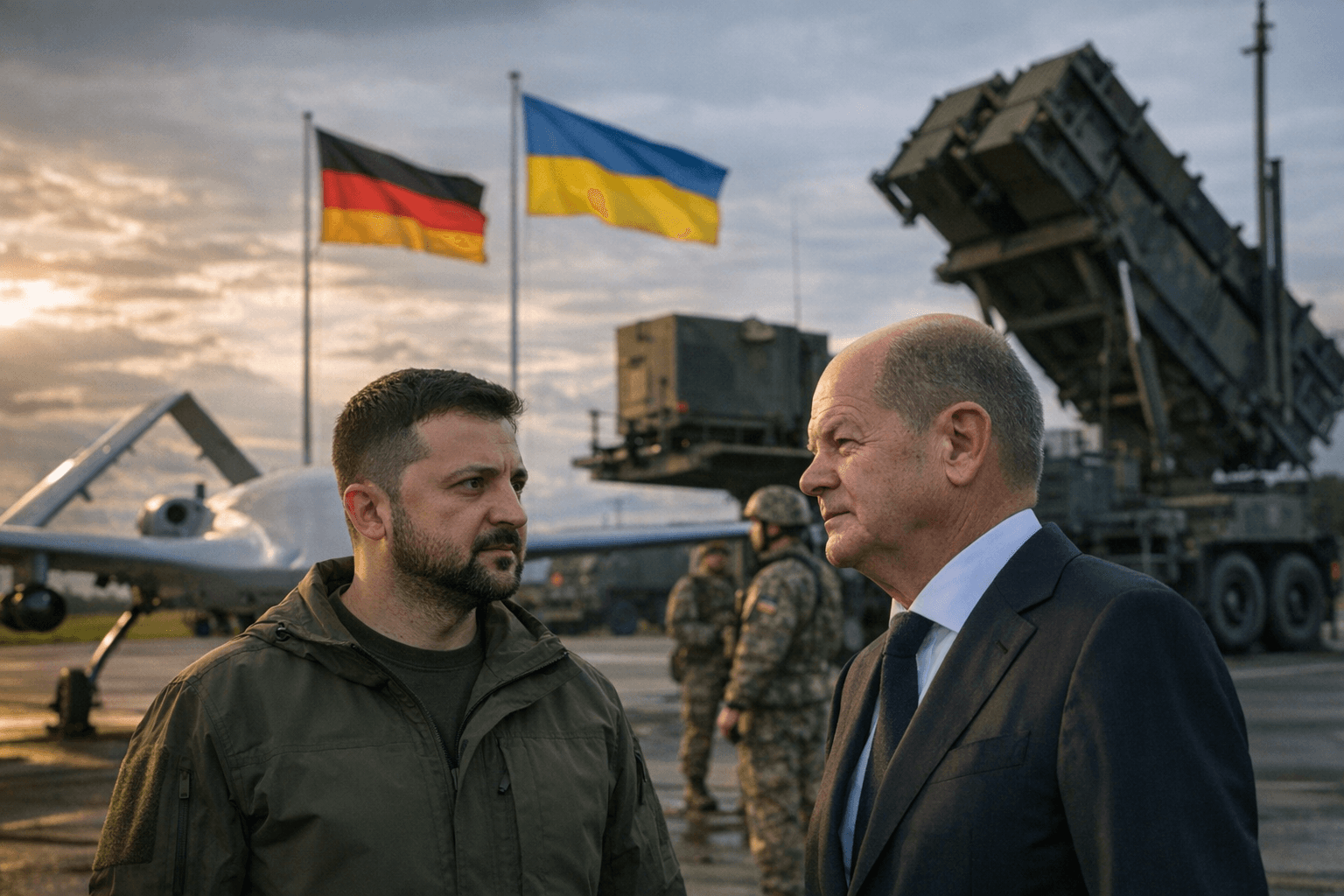
Ukraine and Germany used Volodymyr Zelenskyy’s visit to Berlin to turn wartime aid into a broader defense partnership, one that both governments presented as a longer-term answer to a war entering its fifth year. The two sides agreed to begin concrete work on a bilateral drone deal covering multiple types of drones, missiles, software and modern defense systems, a step that Kyiv has pushed as Russian pressure on its air defenses and front lines continues.
The meeting produced a package worth about €4 billion, including a defense cooperation agreement and a memorandum of understanding on reconstruction. Berlin said it would help finance several hundred Patriot missiles made by Raytheon, while Ukrainian officials said the deal also covers 36 IRIS-T launchers, €300 million for deep-strike capabilities and joint production of several thousand mid-strike drones. Germany’s defense ministry said the arrangement will also include battlefield-data sharing and analysis of systems such as the PzH 2000, RCH 155 and IRIS-T, underscoring that the partnership is now as much about military learning as hardware.
For Kyiv, the timing mattered. Mykhailo Fedorov described the package as a major boost to air defenses against Russian strikes, and Zelenskyy said Ukraine urgently needs a promised €90 billion European Union loan that has been blocked by Hungarian Prime Minister Viktor Orbán. That money could become more significant if Hungary’s political arithmetic changes after an election. The talks in Berlin took place during German-Ukrainian government consultations, reinforcing the idea that the relationship is being managed as a standing strategic channel, not just a series of crisis shipments.
Friedrich Merz framed the new commitment as a message to Moscow that Berlin will not step back from Ukraine, and he argued that Europe must be part of any future peace settlement. That reflects a wider European calculation as U.S.-led diplomacy loses momentum and global attention shifts elsewhere: if Washington’s role becomes less predictable, Berlin and other European capitals are trying to build a more durable long-war support model of their own.
Germany remains Ukraine’s biggest European backer. Berlin says it has provided roughly €55 billion in military support since Russia’s full-scale invasion on February 24, 2022, alongside about €39 billion in bilateral civilian support. It has also allocated another €11.5 billion in its 2026 budget. The Kiel Institute’s Ukraine Support Tracker continues to catalog pledges across military, financial and humanitarian aid, but the political signal from Berlin was clearer than any spreadsheet: Germany is no longer just funding Ukraine’s defense, it is helping shape how Europe intends to sustain it.
This article was produced by Prism’s automated news system from verified source data, official records, and press releases, then run through automated quality and moderation checks before publishing. The system is built and supervised by the people who set the standards it runs under. Read our full AI policy.
Did this article answer your question?