Ukraine’s medium-range drone strikes hit Russia’s war effort and energy system
Ukraine’s drone campaign is now biting twice, choking Russian oil infrastructure while forcing Moscow to scatter defenses far from the front.

Ukraine’s medium-range drone strikes are turning Russia’s own territory into a second battlefield. A Reuters analysis says the campaign is doing more than burning fuel depots and refineries: it is forcing Moscow to divert air defenses, logistics assets and communications systems away from the war in Ukraine, while also exposing the strain on Russia’s energy network.
Middle strikes and the new pressure point
The shift is centered on what Ukrainian officials call middle strikes, attacks aimed roughly 30 km to 180 km behind the front line. That depth matters because it lets Ukraine suppress radars and short- and medium-range air defenses before longer-range drones move deeper into Russian-held space, opening a path toward oil and military infrastructure that would otherwise be harder to reach.
Robert Brovdi, commander of Ukraine’s Unmanned Systems Forces, captured the current thinking in a voice message cited by Reuters: “The role of middle strikes is currently decisive.” That is not a claim that drones alone can decide the war. Defense analysts quoted in the Reuters analysis argue they cannot reverse the conflict on their own. But the same analysts say the attacks are clearly changing the war’s dynamics by stretching Russian defenses and widening the number of assets Moscow must protect.
The strategic effect is two-front pressure. On one front, Ukrainian drones are hitting installations that support the Russian military machine. On the other, they are forcing Russian planners to defend territory deep inside the country, where the Kremlin must now spend air-defense resources that might otherwise be reserved for the front. The result is a more complicated battlefield for Moscow, one in which the rear is no longer secure.
Russia’s energy system is absorbing the damage
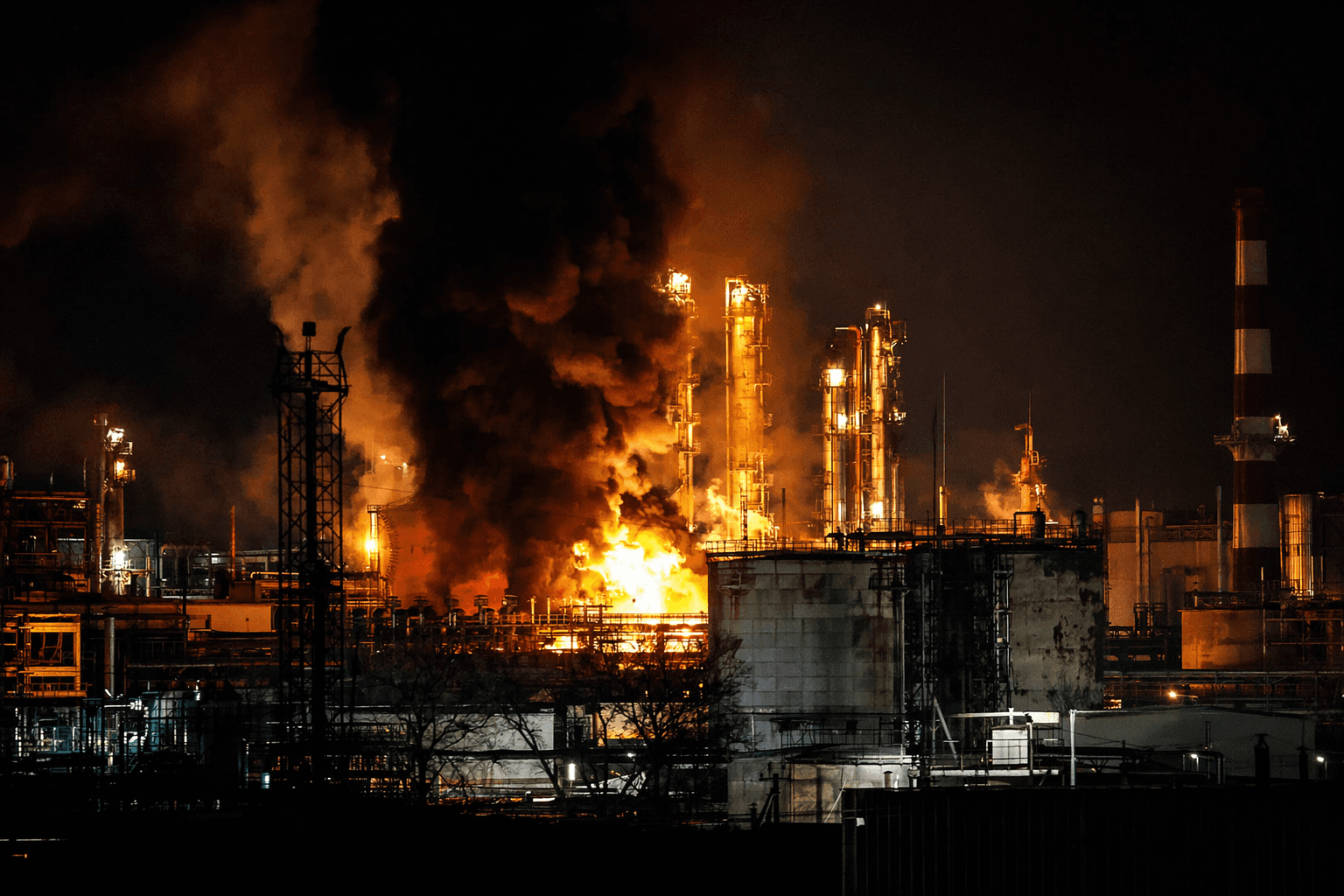
The most visible impact has come in Russia’s oil sector. Reuters reporting says Ukraine’s long-range drone campaign has caused the most extensive damage to Russian oil infrastructure since Moscow’s 2022 invasion. In April 2026, Russia reduced oil output because of drone attacks on ports and refineries, and crude supplies through its only remaining oil pipeline to Europe were halted.
Reuters-calculated estimates put that April decline at about 300,000 to 400,000 barrels per day, with a possible total drop of up to 600,000 barrels per day compared with late-2025 levels. That is a large hit for a system that has long helped finance Russia’s war effort. At the same time, the International Energy Agency said Russia’s oil and fuel export revenue rose to about $19 billion in March 2026 after a February slump, showing that the pressure on Moscow’s energy earnings is unfolding inside a volatile global market rather than in isolation.
The damage is not abstract. Reuters-related factbox reporting says Ukrainian drone attacks on Primorsk, one of Russia’s largest oil export gateways, left it with at least 40% of its storage facilities damaged after strikes in April 2026. Primorsk can handle about 1 million barrels per day, so disruption there reverberates well beyond a single facility. In Tuapse, another key site, the refinery halted operations after a Ukrainian drone strike on April 16, 2026, and a major fire followed another strike on April 28. Those attacks show how Ukraine’s campaign is no longer limited to symbolic damage. It is affecting physical throughput, storage and processing capacity.
Why the attacks matter militarily, not just economically
The deeper significance lies in how the strikes force Russia to allocate resources. Every radar, missile battery and mobile air-defense unit moved to protect refineries, ports and transport nodes is one less asset available near the front. That does not automatically collapse Russian operations, but it does complicate command decisions and increases the cost of holding occupied territory and supply corridors.
Reuters says Ukrainian commanders and analysts describe the strikes as aimed at air defenses, logistics hubs, communications systems and large military vehicles at operational depth. That combination matters because it targets the connective tissue of Russia’s war effort, not just isolated targets. If logistics are disrupted, fuel deliveries slow. If communications are degraded, coordination suffers. If air defenses are thinned out to cover a wider geography, more drones can get through.
This is where the medium-range campaign and the longer-range campaign reinforce each other. Middle strikes create gaps by weakening the screen. Longer-range drones then exploit those gaps to hit still farther back. In practical terms, Ukraine is building a layered strike system that can keep pressure on both military supply chains and energy infrastructure at the same time.
Escalation and scale
The scale of the attacks has also risen sharply. On May 17, Ukraine launched more than 1,000 drones at Russia in a single 24-hour period, according to ABC News citing Reuters. Four people were killed, including three in the Moscow region and one in Belgorod region. The attack underscored how widespread the threat has become and how far the conflict now reaches into Russia’s interior.
Volodymyr Zelenskyy said Ukraine could hit targets more than 500 kilometres from the border despite dense Russian air defenses around Moscow. That statement reflects both technical progress and a broader political message: Ukraine is signaling that Russian territory itself is now vulnerable to sustained, repeated attack. For the Kremlin, that means defending not only the occupied territories and the border areas, but also critical sites much deeper inside Russia.
The response from Moscow has reinforced the same point. Russian officials and city authorities have repeatedly had to manage air-defense alerts and the domestic fallout from drone incursions, showing how the war is forcing new burdens onto Russian institutions far from the battlefield. Even when the material damage is limited, the need to react at scale reveals a defense system under constant strain.
What this means for the war ahead
Ukraine’s drone campaign is not a standalone strategy. It is a pressure system designed to erode Russia’s ability to sustain offensive operations while raising the cost of defending the home front. The immediate effect is visible in damaged infrastructure, reduced output and disrupted transport routes. The broader effect is structural: Moscow must now distribute its defenses across a much larger map, from frontline logistics nodes to oil gateways and refineries deep in Russian territory.
That is why the current phase matters. By treating drones as a systematic operational weapon rather than a nuisance, Ukraine is altering the geometry of the war. Russia can still absorb damage, but it must do so while protecting more territory, defending energy assets that help fund the war, and coping with the reality that the rear is no longer safely behind the front.
Know something we missed? Have a correction or additional information?
Submit a Tip