UN Launches First Global AI Scientific Panel to Assess Societal Impacts
A 40-member UN scientific body modeled on the IPCC convened Saturday and launched a global AI impact study whose annual findings could reshape international standards and domestic policy worldwide.

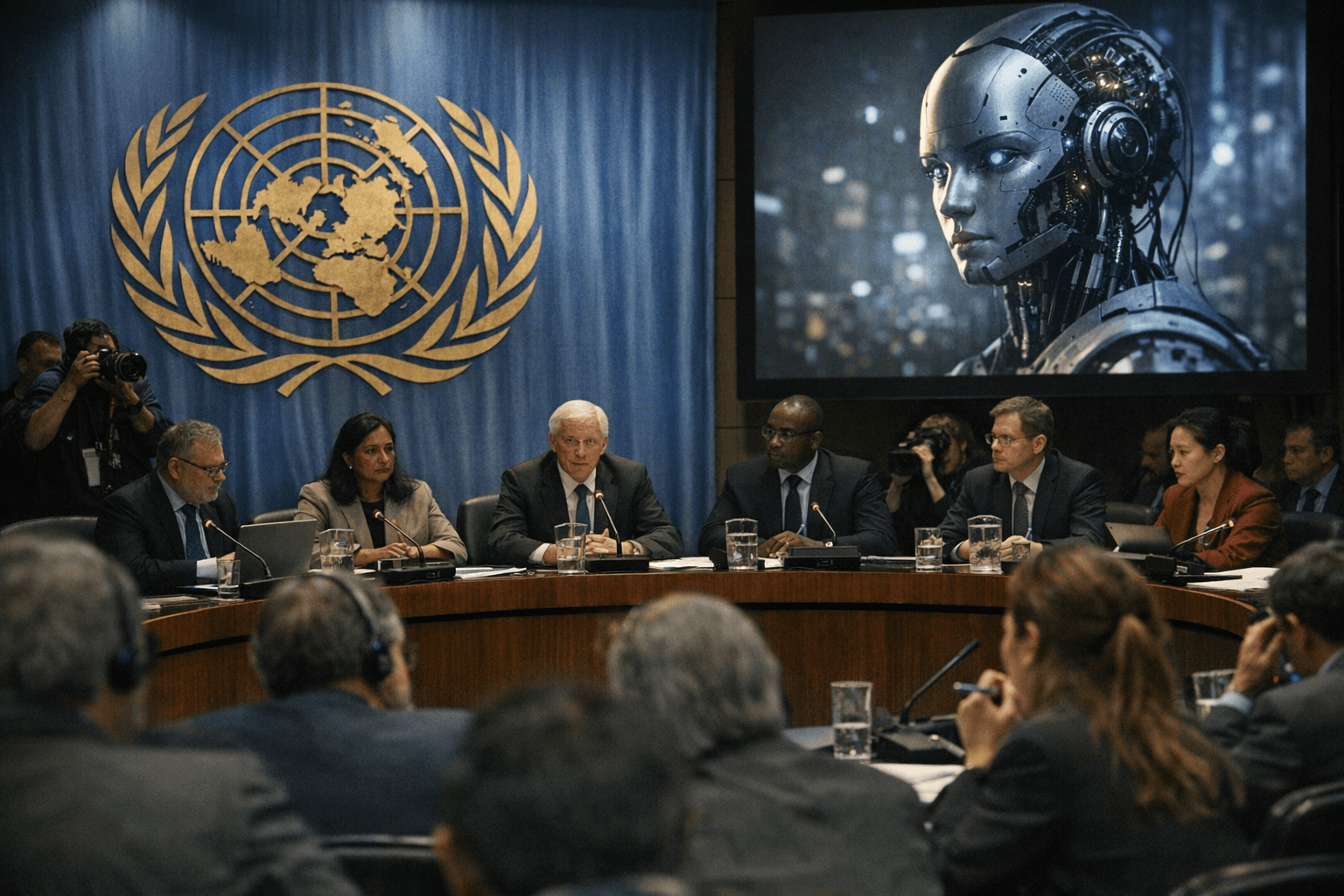
The United Nations' first global scientific body dedicated to artificial intelligence convened its inaugural in-person sessions Saturday, launching a landmark impact study designed to provide governments with the evidentiary foundation they need to negotiate AI standards, safety requirements and governance frameworks in the years ahead.
The Independent International Scientific Panel on Artificial Intelligence was established by General Assembly resolution in August 2025 and formally seated on February 12 of this year. Its 40 members serve three-year terms through February 2029. The structure deliberately mirrors the Intergovernmental Panel on Climate Change: an independent body that synthesizes scientific literature and issues annual reports meant to inform intergovernmental negotiations, with the ambition that its assessments become unavoidable reference points the way IPCC reports have in three decades of climate diplomacy.
The membership spans academia, private industry, civil society and government across every world region. Among the founding members are Menna El-Assady and Bernhard Schölkopf, both professors at ETH Zurich, as well as Maximilian Nickel, Meta's Research Director focused on alignment and democratic governance of frontier AI. The 40 were drawn from an open call administered by Secretary-General António Guterres and confirmed by member states in a recorded General Assembly vote, with the United States requesting the vote go on the record before February's confirmation.
El-Assady, who leads ETH Zurich's Interactive Visualization and Intelligence Augmentation lab, articulated the panel's governing philosophy plainly. "We are not just focusing on AI as a mathematical or algorithmic field," she said. "We are also looking at ensuring that humans are central to decision-making." Her concept of "augmented intelligence," designing AI to amplify rather than supplant human judgment and labor, frames the impact study's approach: not simply cataloguing what AI can do, but assessing who it serves and who it excludes.
That equity lens extends to infrastructure. El-Assady has pushed for investment in "public digital infrastructure" so that low- and middle-income countries can build and test AI systems without depending on a handful of dominant private platforms. The panel's mandate explicitly covers how AI handles language and cultural representation in systems overwhelmingly trained on English-language data, a gap that shapes which communities benefit from the technology and which are effectively locked out of governance conversations about it.
The policy stakes are concrete. Annual reports delivered to member states will carry weight as the authoritative scientific basis for intergovernmental AI negotiations. Those findings could directly inform the technical standards and safety-testing thresholds embedded in domestic regulation and government procurement rules. For nations trying to position themselves against China's state-backed AI infrastructure buildout and the regulatory template the European Union has already set through its AI Act, an independent scientific consensus on genuine risk and critical governance gaps provides firmer ground in the standards and trade negotiations that will shape AI's long-term geopolitical architecture.
The panel was established precisely because policymaking had outpaced scientific consensus on AI's real tradeoffs in health, labor markets, national security and information integrity. Its credibility will rest on whether its first annual report delivers the kind of authoritative, politically durable findings that persuade governments to anchor their domestic rules to something larger than their own competitive interests.
Sources:
Know something we missed? Have a correction or additional information?
Submit a Tip