Under fire, Ukraine’s postal workers keep front-line deliveries moving
Oleksiy Klochkovsky drives Ukraine’s front-line mail routes with one ear on the sky, as Ukrposhta keeps pensions, medicines and parcels moving under fire.
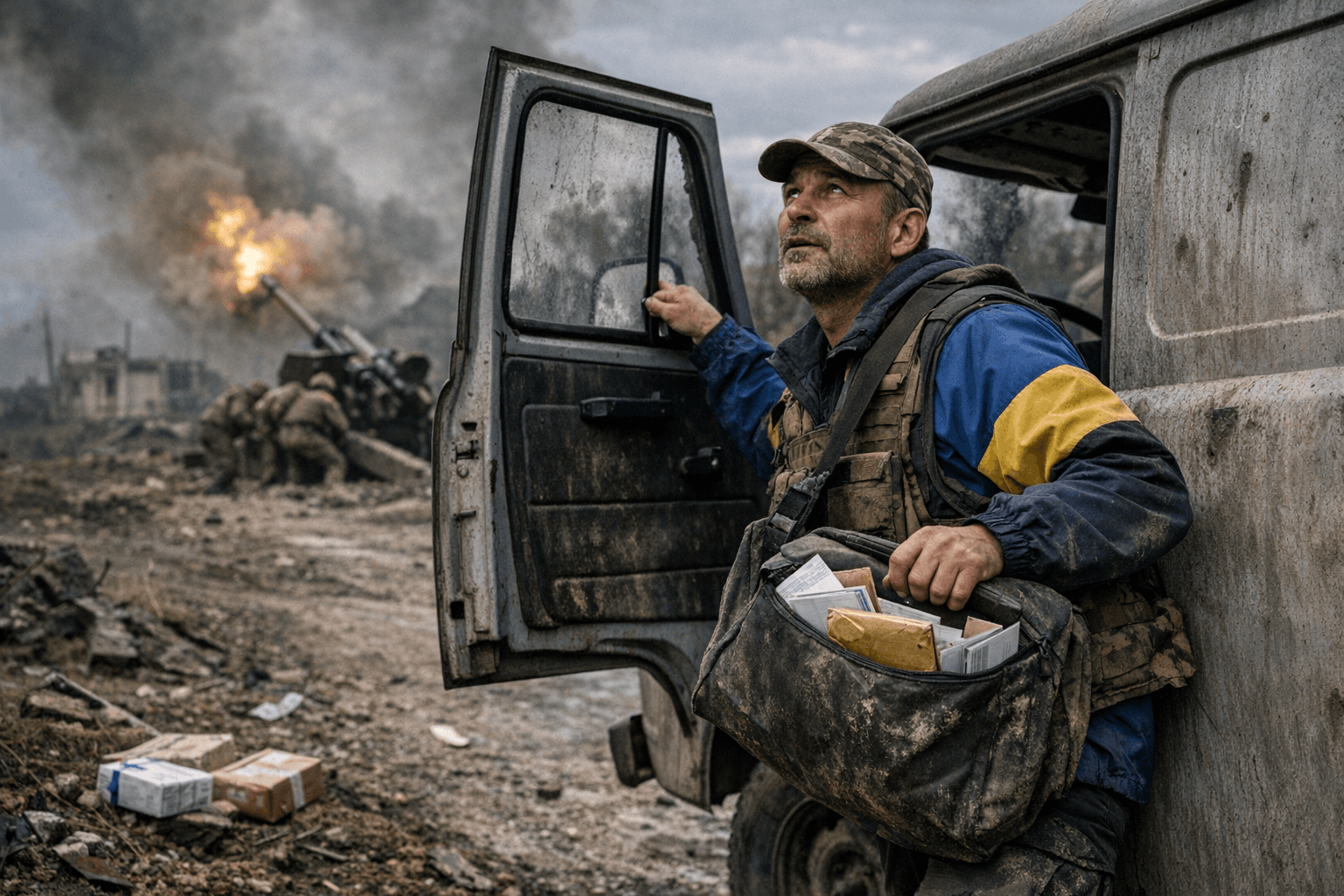
Oleksiy Klochkovsky has spent four years driving mail and parcels around Ukraine’s front line, a job that now means scanning the road and listening for danger from above. In settlements where other services have been cut off or damaged, his route is part of something larger than delivery: it is the daily proof that the state still reaches people living under attack.
Ukrposhta, Ukraine’s state postal service, says that since Russia’s full-scale invasion began on February 24, 2022, it has lost 418 vehicles. Of those, 281 were lost during the temporary occupation of Ukrainian territory in 2022. The company says 103 mobile post-office crews have come under fire, and in 2025 alone Russian forces attacked 21 mobile branches. Even so, Ukrposhta says it still delivers 95% to 98% of parcels on time in regions where routes can change at any moment.
That reliability matters because the postal network has become a frontline lifeline. In towns and villages near the fighting, postal workers deliver pensions, social benefits, medicines, aid packages and parcels, often where banks, shops and other public services have stopped operating. For many residents in isolated communities, the post office is one of the few remaining links to cash, treatment and the outside world.
The risks have sharpened as the war has settled into a pattern of repeated strikes on civilian infrastructure. UN humanitarian reporting says short-range drone attacks remain a major threat near the front line, while a March 2026 update said front-line hostilities and shifting battle lines forced at least 30,000 people to flee in January. That instability has made postal routes a moving target, especially in Donetsk, Kherson, Dnipropetrovsk, Sumy and Chernihiv oblasts, where access can change without warning.
Ukrposhta has responded by hardening its operations. It has used armored vehicles and drone-jamming equipment on some front-line routes, and at the end of 2025 it received 160 new MAN and Iveco vehicles to replace part of the fleet it has lost. The service has also kept expanding in safer cities, opening the first 70 parcel lockers in Kyiv in April and planning 30 more in Odesa that same month, with 1,000 lockers expected nationwide by the end of the year.
Four years into the war, the postal van has become a symbol of endurance. It carries more than mail. It carries pensions, medicine, state presence and the stubborn routine of civilian life into places where constant attack is meant to erase it.
This article was produced by Prism’s automated news system from verified source data, official records, and press releases, then run through automated quality and moderation checks before publishing. The system is built and supervised by the people who set the standards it runs under. Read our full AI policy.
Did this article answer your question?