University of Michigan Postdoctoral Researcher Found Dead After Fall in Campus Building
A Chinese postdoc's death at the University of Michigan after an alleged FBI interrogation has ignited a diplomatic standoff Beijing says reflects a "chilling effect" on researchers.
A semiconductor researcher whose published work on ferroelectric nitrides broke new scientific ground was found dead inside a University of Michigan building on March 20, setting off a diplomatic confrontation between Beijing and Washington that has left core questions unanswered three weeks later.
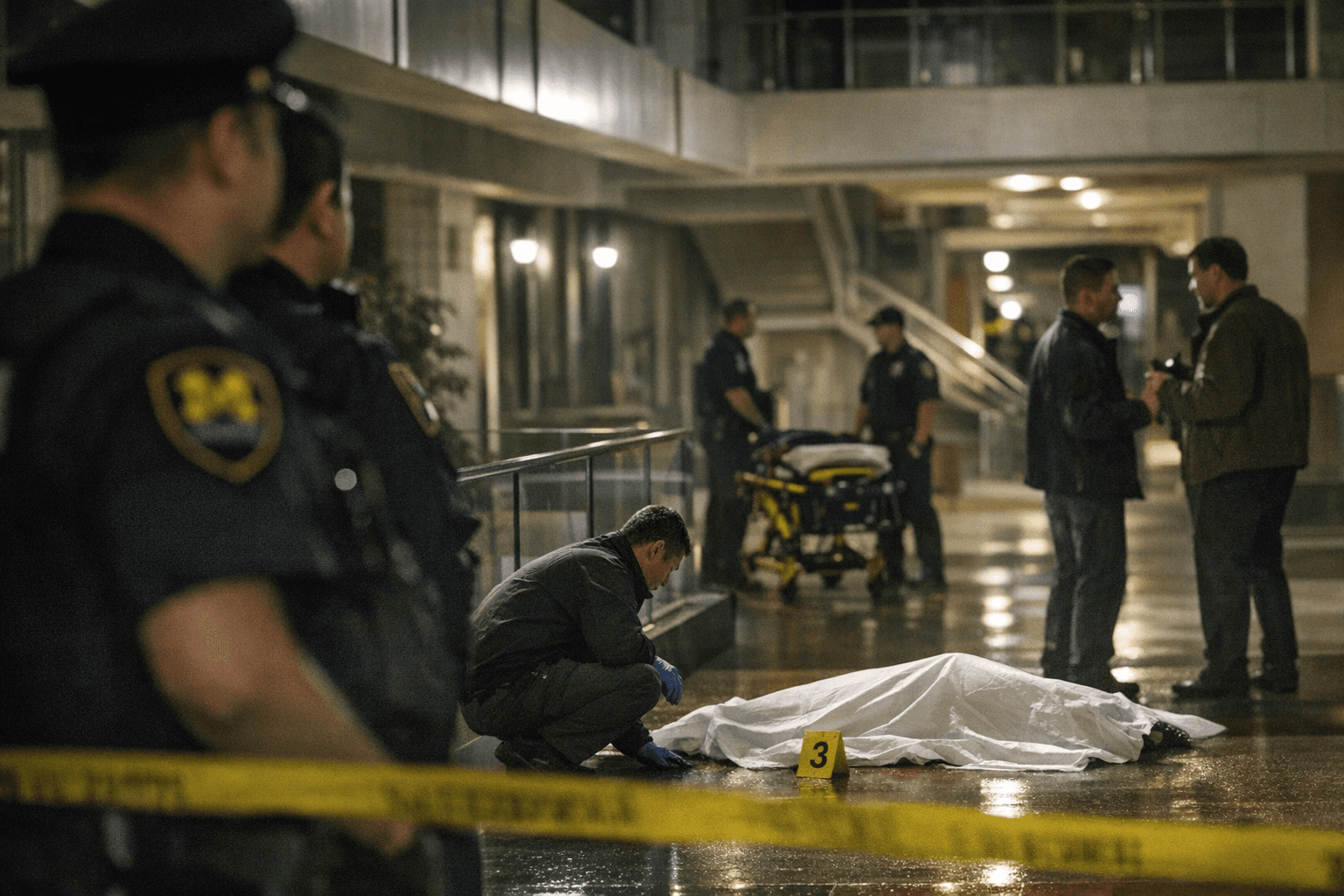
Danhao Wang, a postdoctoral researcher in the College of Engineering, died after falling from the George G. Brown Building. Melissa Overton, deputy chief of the UM Department of Police and Public Safety, confirmed in writing that officers responded at approximately 11 p.m. on March 19 to "a report of a subject who fell inside the George G. Brown Building." The UM Division of Public Safety and Security is investigating the death as a "possible act of self-harm" and confirmed no ongoing threat to the campus community; the investigation remains open pending toxicology results.
The central unresolved question is whether U.S. federal agents interrogated Wang the day before he died. China's Ministry of Foreign Affairs posted on X on March 27 claiming Wang had been subjected to "hostile questioning" by U.S. law enforcement. Liu Pengyu, spokesman for China's embassy in Washington, confirmed Wang had taken his own life, writing, "We are deeply distressed by this tragedy," and adding that the U.S. had "overstretched" the concept of national security by subjecting Chinese scholars to "unwarranted questioning and harassment." The FBI has not responded to requests for comment, and the U.S. Department of Justice similarly issued no response to media inquiries.
Wang, a Chinese citizen, earned his PhD in electrical and electronics engineering from the University of Science and Technology of China in 2022 and joined U-M that same year, working in the lab of Professor Zetian Mi. His focus on wide bandgap III-nitride semiconductor materials sits at the convergence of advanced physics and strategic defense technology: gallium nitride-based materials are foundational to next-generation radar and military electronics. His Nature-published research uncovered for the first time the switching and charge compensation mechanisms of emerging ferroelectric nitrides. Engineering Dean Karen Thole described Wang as "a promising and brilliant young mind" whose research "stands as a landmark." Thole also issued an unusual warning against AI-generated misinformation circulating about the case, a signal that university officials anticipated a fast-moving and potentially distorted information environment.
Wang's death arrived against a backdrop of sustained federal pressure on the university. In July 2025, the Trump administration announced it was investigating potential foreign influence at U-M after the university was found to have misreported Chinese government funding. At least seven Chinese nationals with U-M ties were charged with federal crimes in the preceding months in biological materials smuggling cases; some charges were dropped in February 2026 after China produced evidence the seized materials were roundworms, not dangerous pathogens. Just one week after Wang's death, Interim President Domenico Grasso, an engineer and Army veteran with a top-secret security clearance, testified before the House Committee on Education and Workforce about espionage threats on campus.
In the death's immediate aftermath, the university's Postdoctoral Researchers' Organization described "a climate of fear felt by immigrant workers from all industries, home countries, and walks of life under the current administration" and formally advised its members not to speak with law enforcement without a lawyer present. The Chinese Consulate General in Chicago confirmed the case and stated it had "lodged stern representations to the relevant departments of the US government and relevant universities on this case many times."
The broader pattern underlying Wang's case is documented. The original DOJ China Initiative, launched in November 2018, led to roughly 250 Chinese-American academics losing jobs and contributed to at least one prior suicide among those targeted. A 2024 study found that Chinese-born scientists leaving the U.S. increased 75 percent after the initiative began, with most returning to China. The questioning comes at a time of increased scrutiny toward Chinese international students and scholars, who have increasingly been targeted by the federal government over alleged national security concerns. Beijing formally demanded Washington conduct a full investigation and provide Wang's family a "responsible explanation." Whether the FBI's silence will be broken remains the one question neither government has shown urgency in answering.
This article was produced by Prism’s automated news system from verified source data, official records, and press releases, then run through automated quality and moderation checks before publishing. The system is built and supervised by the people who set the standards it runs under. Read our full AI policy.
Did this article answer your question?