U.S. and China begin talks on AI safety guardrails
U.S. and Chinese officials opened talks on AI guardrails in Beijing, with Scott Bessent saying the goal was to stop criminals or terrorists from abusing advanced models.
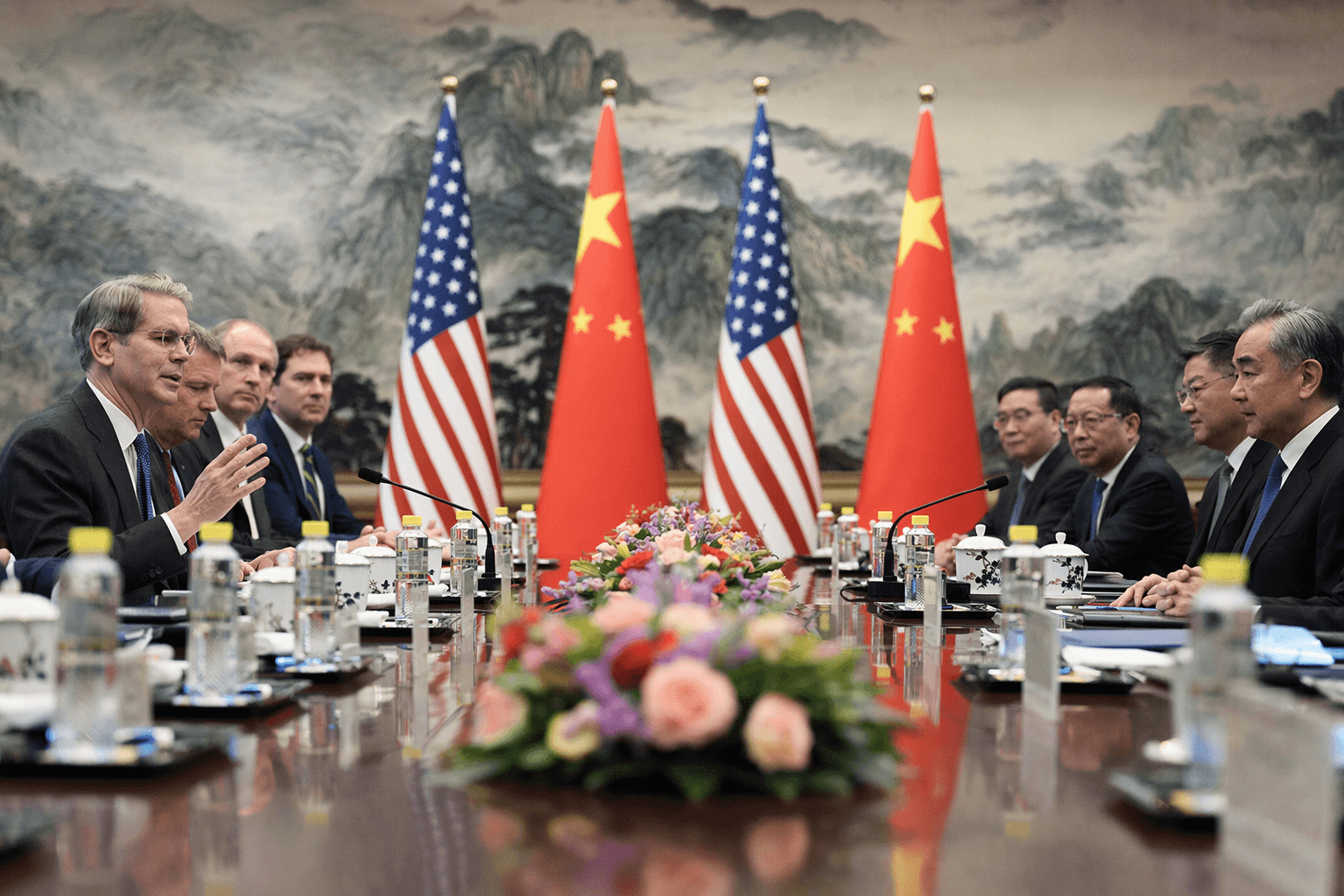
The United States and China opened a narrow but consequential channel on artificial intelligence safety in Beijing, with Treasury Secretary Scott Bessent saying the two delegations were discussing guardrails meant to keep non-state bad actors from exploiting the most powerful AI models.
Bessent said the talks would set up a protocol for best practices and described the U.S. lead in AI as central to making the discussion possible. He said it was “of utmost importance” that the United States maintain its lead over China, and added that America was able to have “wholesome” discussions because it was ahead in the race to develop the technology.
The focus of the Beijing meeting was not a broader détente in the AI rivalry. The immediate aim was safety: limiting the chance that criminal or terrorist groups could use advanced systems to launch cyberattacks, find software vulnerabilities, disrupt markets or threaten the global financial system. Those concerns have sharpened as Anthropic’s Mythos AI tool has drawn alarm over its possible cyberattack capabilities and exposure of software security weaknesses.
The AI discussion unfolded alongside trade and other geopolitical tensions during President Donald Trump’s May 2026 trip to Beijing for talks with Chinese President Xi Jinping. That broader setting underscored the split between competition and coexistence: Washington and Beijing remain locked in a fight over chips, models and military applications, yet both sides have reason to treat catastrophic AI misuse as a shared risk too serious to ignore.
The Biden administration had already pushed international coordination on AI safety. The U.S. Department of Commerce and the U.S. Department of State co-hosted the inaugural convening of the International Network of AI Safety Institutes in San Francisco on November 20 and 21, 2024, an effort aimed at advancing research, best practices and evaluation. In September 2024, then-Secretary of State Antony Blinken also announced the Global AI Research Agenda and AI in Global Development Playbook.
Still, cooperation between Washington and Beijing has a difficult track record. Earlier U.S.-China AI dialogue in Geneva in 2024 did not produce meaningful progress, a reminder that even as both governments talk about guardrails, deeper rivalry continues to shape what kind of agreement is possible.
This article was produced by Prism’s automated news system from verified source data, official records, and press releases, then run through automated quality and moderation checks before publishing. The system is built and supervised by the people who set the standards it runs under. Read our full AI policy.
Did this article answer your question?


