U.S. and Iran Dispute Whether Ceasefire Covers Lebanon as Bombing Continues
Israel struck 100+ targets in Lebanon on the same day a US-Iran ceasefire was declared, killing at least 254 people, as Washington and Tehran clashed over whether the truce covered Beirut.
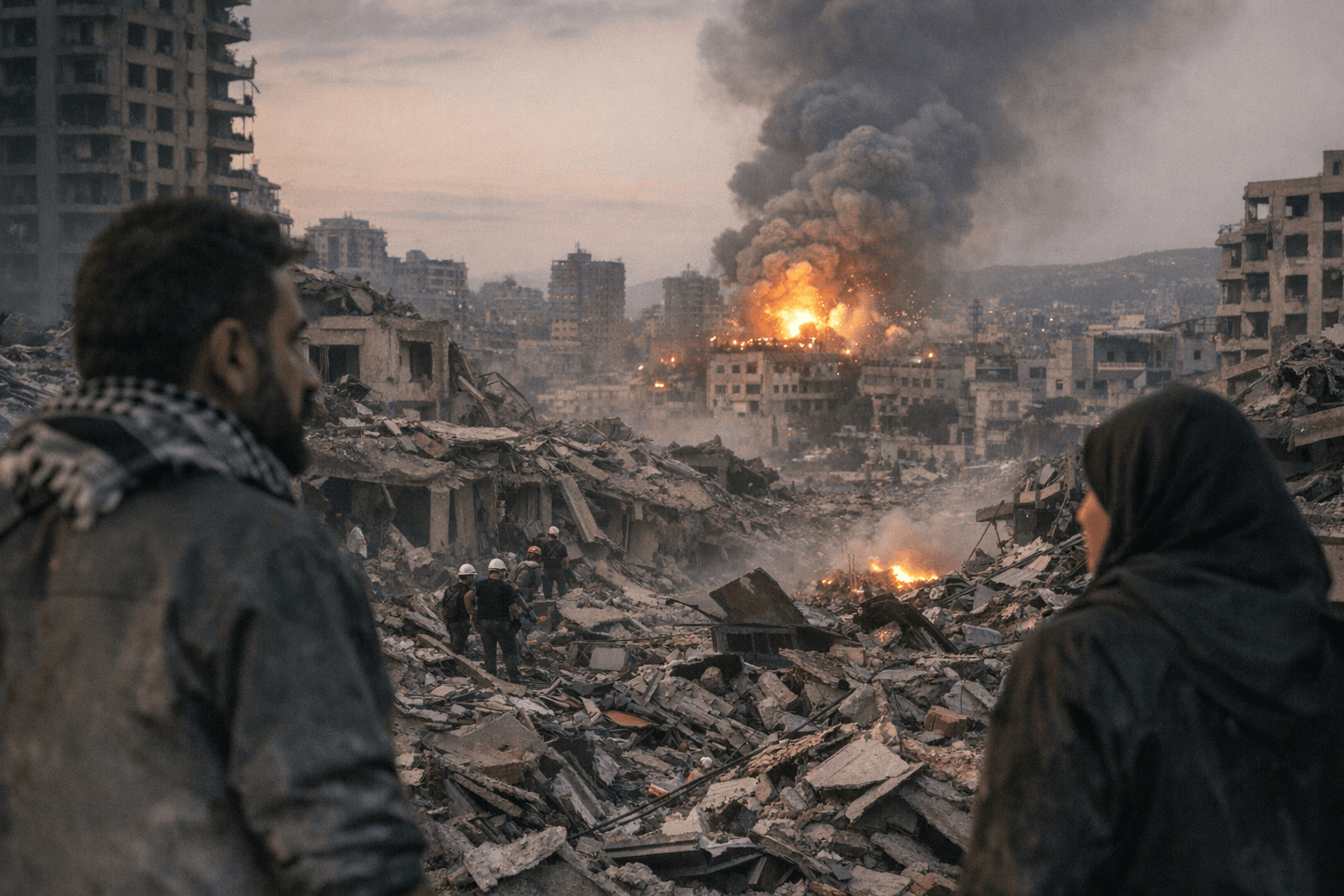
Within hours of a fragile US-Iran ceasefire taking hold on April 8, Israel launched what it described as its most powerful assault on Lebanon since the war began, striking more than 100 targets in 10 minutes across Beirut, the Beqaa Valley, and the south. Lebanon's Civil Defence reported at least 254 people killed and 1,165 wounded in that single day, the highest single-day death toll of the entire Israel-Hezbollah conflict. The strikes hit dense commercial and residential neighborhoods in central Beirut without warning.
The ceasefire itself, a two-week agreement brokered largely by Pakistani Prime Minister Shehbaz Sharif, was reached hours before President Trump's deadline for Tehran to reopen the Strait of Hormuz, which Iran had closed, or face what Trump threatened would be the end of "a whole civilization." Iran's Supreme National Security Council formally accepted the deal. But within hours of the announcement, a fundamental dispute erupted over its scope: did the ceasefire cover Lebanon?
Sharif said publicly it covered all fronts. Netanyahu said it did not. Trump dismissed the Lebanon war as a "separate skirmish." Netanyahu went further, declaring the ceasefire "does not include Lebanon" and that all Israeli goals would still be achieved, while Israeli Chief of Staff Lt. Gen. Eyal Zamir vowed Israel would continue to "utilize every operational opportunity" to strike Hezbollah.
Vice President JD Vance, speaking to reporters while departing Budapest, acknowledged what he called a "legitimate misunderstanding": "I think the Iranians thought that the ceasefire included Lebanon, and it just didn't." He described three competing 10-point proposals circulating simultaneously, dismissing the first as something "probably written by ChatGPT" that went "in the garbage." Iran's semi-official Tasnim news agency, affiliated with the Islamic Revolutionary Guard Corps, claimed Tehran had "forced the criminal America to accept its 10-point plan," a characterization the White House flatly rejected. Iran also accused the US of violating multiple clauses of the deal framework and threatened to withdraw from the ceasefire if Israeli attacks on Lebanon continued.
An Israeli source familiar with the negotiations said Israel worked overnight with the US to ensure Lebanon would not be included in any ceasefire terms. Vance's framing placed the burden on Tehran: "If Iran wants to let this negotiation fall apart… over Lebanon, which has nothing to do with them… That's ultimately their choice."
But Lebanon's own government said it had no idea where it stood. Economy Minister Amer Bisat told CNBC the country was receiving "mixed signals" and did not know whether it was part of the ceasefire deal. "Lebanon's demand has always been for a sovereign led ceasefire," Bisat said, adding that Lebanon felt it was "forced into this war." He noted that Lebanon had only just begun emerging from years of economic collapse: "In 2025, we started seeing a bit of a recovery, a bit of a resuscitation after years of a crisis. But then this was a huge setback." Lebanese President Joseph Aoun condemned the April 8 strikes as "barbaric."
For Iran, insisting Lebanon is covered is not merely a point of principle. Hezbollah, Tehran's most powerful proxy, is under severe military pressure and depends on Iran's diplomatic backing to secure any favorable terms. A Hezbollah official stated the group "will not accept for the Israelis to continue behaving as they did before this war with regards to attacks," rejecting any return to the pre-March 2 status quo. An analyst noted Hezbollah believes it holds "more political leverage when it joins Iran in possible negotiations," given its criticism of the Lebanese government's failure to enforce the November 2024 ceasefire that US envoy Amos Hochstein brokered.
That earlier deal had required Hezbollah to withdraw north of the Litani River and Israeli forces to pull back from southern Lebanon. Neither side fully complied. Israel conducted near-daily strikes killing approximately 500 people, while Hezbollah rebuilt its military infrastructure. The current war, which began March 2 when Israel retaliated against Hezbollah strikes following the US-Israeli assassination of Supreme Leader Ali Khamenei on February 28, has now killed at least 1,739 people and wounded 5,873 in Lebanon. More than 1.2 million people, nearly one in five Israelis, have been displaced in a country of five million, and Israel is moving to establish a security zone stretching to the Litani River that would indefinitely sever southern Lebanon from the rest of the country.
At a displacement camp on Beirut's waterfront, Fadi Zaydan, 35, had prepared to return home with his parents before Netanyahu's statement ended that hope. "We can't take this anymore," he said, "sleeping in a tent, not showering, the uncertainty." UN High Commissioner for Human Rights Volker Türk condemned the strikes, and the Arab League added its own condemnation. French President Emmanuel Macron consulted separately with the leaders of Qatar, the UAE, Lebanon, and Iraq. The ceasefire's survival now hinges on whether the US and Iran can resolve not just the Lebanon question, but a deeper disagreement about what they actually agreed to, before either side decides the cost of continuing is lower than the cost of standing down.
Know something we missed? Have a correction or additional information?
Submit a Tip