US, Australia and Philippines hold South China Sea naval drills ahead of Balikatan
The U.S., Australia and the Philippines ended a four-day drill in the West Philippine Sea as Chinese forces fired flares nearby, raising the stakes before Balikatan.
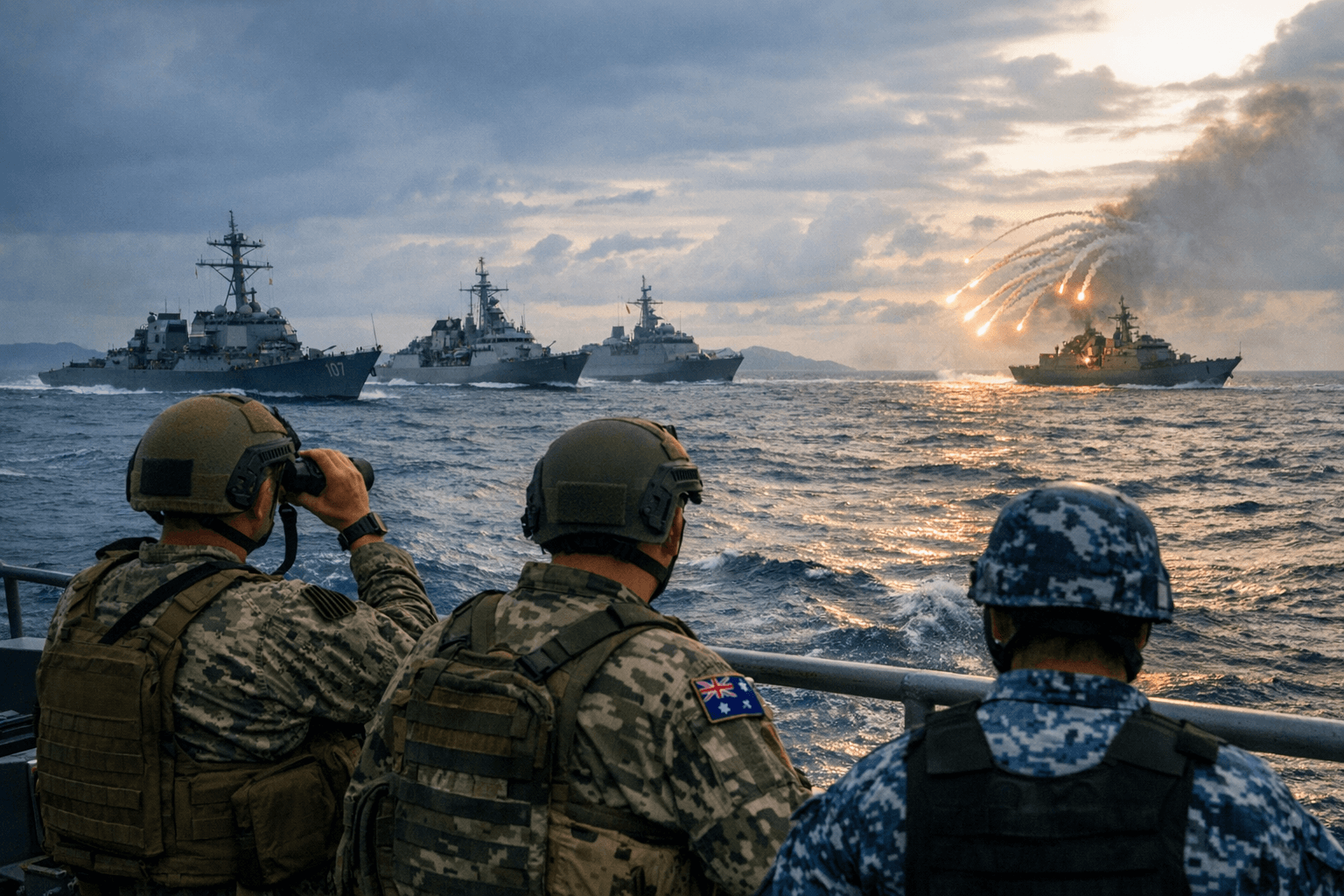
The United States, Australia and the Philippines have turned the South China Sea into a more regular stage for coordinated power projection, ending a second joint maritime exercise this year on April 12 inside the Philippine Exclusive Economic Zone. The Multilateral Maritime Cooperative Activity ran from April 9 to 12 and brought together Philippine FA-50 fighter jets, Australia’s P-8A Poseidon patrol aircraft and the USS Ashland, a U.S. Navy dock landing ship, in a drill that the Armed Forces of the Philippines said focused on logistical capability as much as tactical maneuvering.
That emphasis on logistics mattered. Philippine officials said the U.S. warship helped move AFP assets to Palawan, underscoring how the drills are no longer just about ships crossing tracks in contested waters but about making allied forces able to sustain each other in a real-world crisis. U.S. Indo-Pacific Command said the activity took place within the Philippine Exclusive Economic Zone and was meant to support a free and open Indo-Pacific, while the Australian Defence Force and the AFP framed it as part of broader regional cooperation.
The timing sharpened the message. On April 9, the same day the exercise began, Philippine officials said Chinese forces fired flares at a Philippine Coast Guard aircraft flying over Panganiban Reef and Zamora Reef in the Spratly Islands. Those reefs sit in waters Manila calls the West Philippine Sea and Beijing claims as part of its sovereignty, a recurring flashpoint that has produced repeated air and sea confrontations in recent years. Philippine officials have also alleged Chinese boats used cyanide near a military outpost in the area, adding to the sense that pressure at sea is widening beyond a single incident or a single platform.
The drill also landed just ahead of Balikatan, the annual U.S.-Philippine war games set to open on April 20. This year, Japan will join Balikatan as a full participant rather than an observer, alongside Australia, a step that Philippine military chief Gen. Romeo Brawner Jr. said would put Japanese combat troops on Philippine soil for the first time since 1945. That expansion gives the emerging coalition a wider cast and a more durable rhythm, with repeated exercises showing not just coordination in the moment but a normalization of tighter defense ties among the Philippines, the United States, Australia and Japan.
For Beijing, the signal is clear: the allies are not treating these drills as isolated events. The tempo is rising, the roles are becoming more defined, and the region is watching a network of military cooperation harden into something closer to routine.
This article was produced by Prism’s automated news system from verified source data, official records, and press releases, then run through automated quality and moderation checks before publishing. The system is built and supervised by the people who set the standards it runs under. Read our full AI policy.
Did this article answer your question?


