U.S. Begins Risky Mine-Clearing Operation in Strait of Hormuz
U.S. forces began clearing mines in the Strait of Hormuz, using drones and helicopters in a mission that could move oil prices and shipping insurance fast.
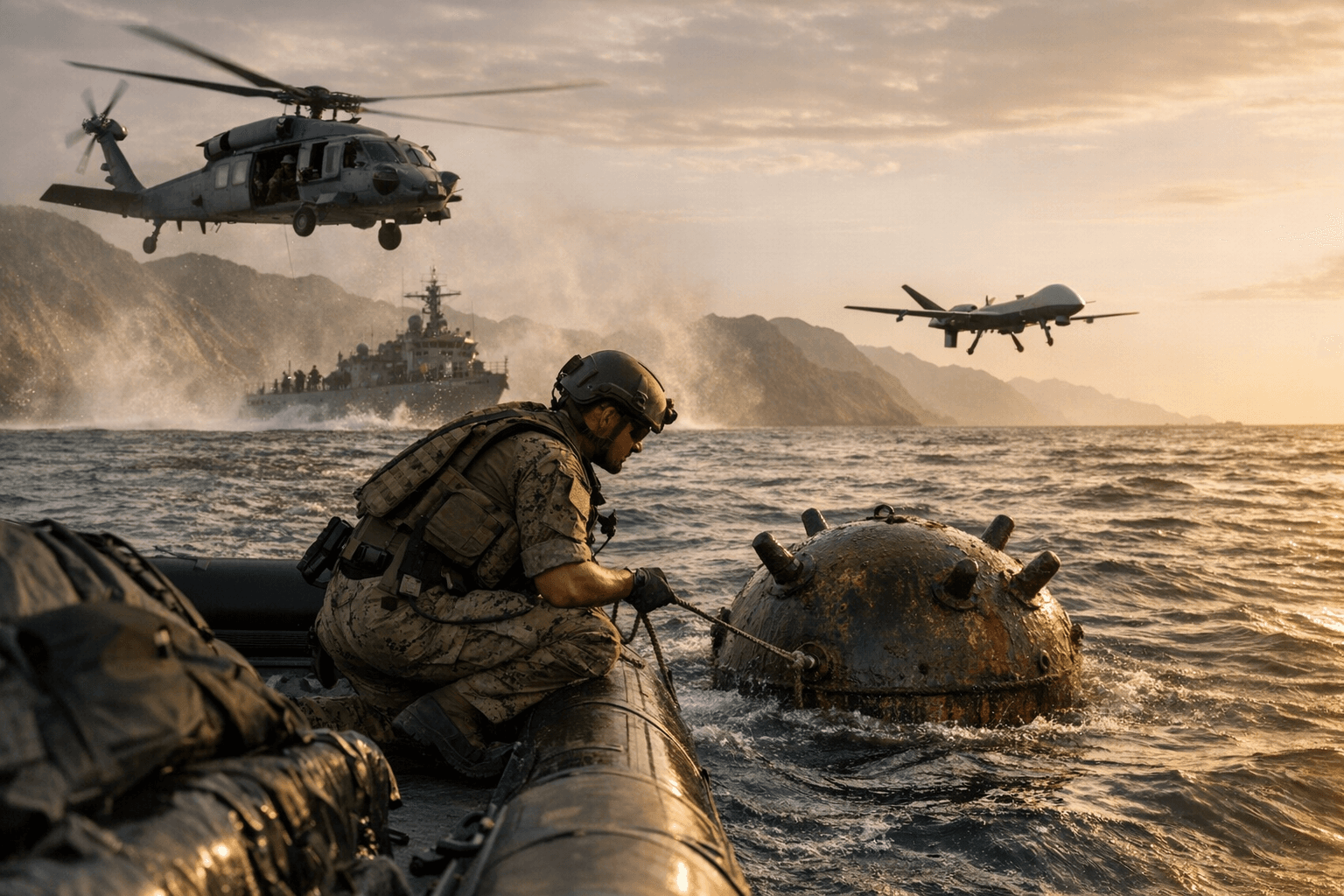
The Strait of Hormuz has turned into a mine-hunting zone, with U.S. forces beginning a clearance mission that relies on drones, robots and helicopters to keep sailors outside the most dangerous waters. Two U.S. Navy warships had already moved through the strait as the operation got underway over the weekend, and U.S. Central Command said additional forces, including underwater drones, would join the effort in the coming days.
The mission is built around standoff tactics. The Navy’s mine countermeasures package uses aviation assets and unmanned surface and underwater vehicles to detect, localize and neutralize mines while the host ship stays outside the threat area. The MH-53E Sea Dragon remains the Navy’s dedicated airborne mine countermeasures helicopter, a sign that the service still depends on heavy-lift aviation even as it has shifted toward unmanned systems. That shift became more visible after the Navy decommissioned its last forward-deployed Avenger-class mine countermeasures ships in Bahrain in September 2025, following nearly 40 years of service.
The danger is that mine-clearing in Hormuz is slow by nature and exposed by geography. Mines are hard to find, the work has to be done step by step, and the crews doing it remain vulnerable to Iranian attack while they try to open a route that carries a major share of the world’s oil and gas. The International Energy Agency says about 20 million barrels per day of crude oil and petroleum products transited the Strait of Hormuz in 2025, and that the waterway is the primary export route for oil from Saudi Arabia, the United Arab Emirates, Kuwait, Qatar, Iraq, Bahrain and Iran. The agency also says about 93% of Qatar’s liquefied natural gas exports and 96% of the UAE’s LNG exports pass through the strait.
That is why even a limited disruption can move markets far beyond the Gulf. The U.S. Energy Information Administration estimates only about 2.6 million barrels per day of Saudi and Emirati pipeline capacity could be available to bypass the strait in a supply emergency. The International Energy Agency said on March 11 that member countries agreed to release 400 million barrels from emergency reserves, the largest stock draw in the agency’s history, after the conflict that began February 28 cut export volumes through Hormuz to less than 10% of pre-conflict levels. Insurers and shippers have already responded by repricing or withdrawing war-risk coverage, and a recent move by the mine countermeasures ships USS Chief and USS Pioneer from Sasebo, Japan, toward the Middle East shows how seriously Washington is treating the threat.
Hormuz has a long memory. During the 1980s Tanker War, Iran and Iraq attacked merchant shipping in the Persian Gulf and the Strait of Hormuz, and the U.S. response escalated sharply after the guided-missile frigate USS Samuel B. Roberts struck a mine on April 14, 1988. Operation Praying Mantis began four days later, a reminder that a technical clearing mission in these waters can become a broader confrontation with very little warning.
This article was produced by Prism’s automated news system from verified source data, official records, and press releases, then run through automated quality and moderation checks before publishing. The system is built and supervised by the people who set the standards it runs under. Read our full AI policy.
Did this article answer your question?


