U.S. commanders tout Germany troop presence as Trump weighs cuts
At Hohenfels, commanders said Germany’s troop footprint powers NATO training, logistics and deterrence just as Trump again weighs cuts.
U.S. commanders at Hohenfels in southern Germany said the American presence there does far more than symbolize commitment to Europe. It deters adversaries, supports logistics across the continent, and gives U.S. and allied troops a place to train for the kind of war now being fought in Ukraine, even as Donald Trump again weighed trimming forces in Germany.
Hohenfels is central to that case. The Joint Multinational Readiness Center there is the U.S. Army’s only forward stationed Combat Training Center, and the Hohenfels Training Area covers 163 square kilometers. The site includes 1,345 buildings, 319 kilometers of road, numerous cross-country trails and a short take-off and landing airfield, a combination that lets troops rehearse movement, sustainment and command under realistic conditions before deploying elsewhere in Europe.
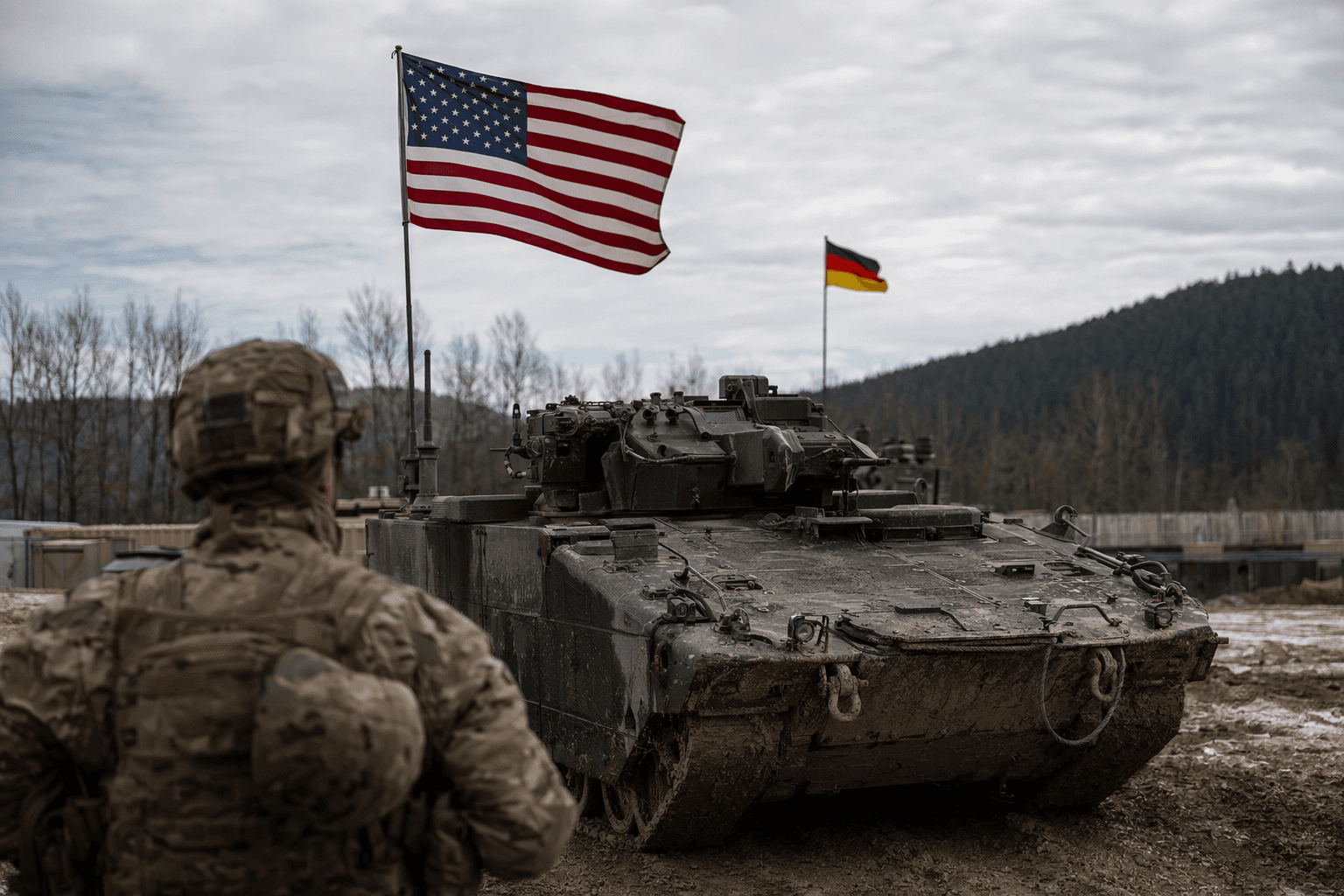
Germany hosts roughly 35,000 active-duty U.S. personnel, the largest American military footprint in Europe. Military planners say that presence is tied to interoperability with allies and to rapid response, because forces already in place can train, move and reinforce far faster than units sent from the United States in a crisis.
That practical value was on display at Hohenfels, where a U.S. armored unit was in the middle of a 10-day exercise that included evading an opposing force with surveillance and attack drones. The scenario reflected how quickly battlefield tactics are changing. The unit was also nearing the end of a nine-month deployment in Poland and elsewhere in Eastern Europe under a U.S. Army initiative aimed at supporting NATO and strengthening readiness.
NATO has pushed the same message. Exercise LOYAL LEDA 2026 brought together more than 4,000 warfighters across nine countries and nearly 1,000 military and civilian experts from 25 nations, underscoring how much alliance training now depends on coordinated infrastructure and forward-positioned forces like those in Germany.
Trump’s renewed interest in cuts revived an argument that has surfaced before. In 2020, he approved a plan to reduce U.S. troop levels in Germany from about 34,500 to 25,000. His latest warning comes after friction with German Chancellor Friedrich Merz over the Iran war, even as Merz has defended close U.S.-German ties and said Europe must take on more responsibility for its own defense. For commanders in Hohenfels, the military case for staying looks straightforward: fewer troops would mean less training capacity, a thinner deterrent and a weaker forward posture at a time when Europe is still bracing for the fallout of Russia’s war in Ukraine.
This article was produced by Prism’s automated news system from verified source data, official records, and press releases, then run through automated quality and moderation checks before publishing. The system is built and supervised by the people who set the standards it runs under. Read our full AI policy.
Did this article answer your question?