U.S. electricity demand to set fresh records in 2026 and 2027, EIA says
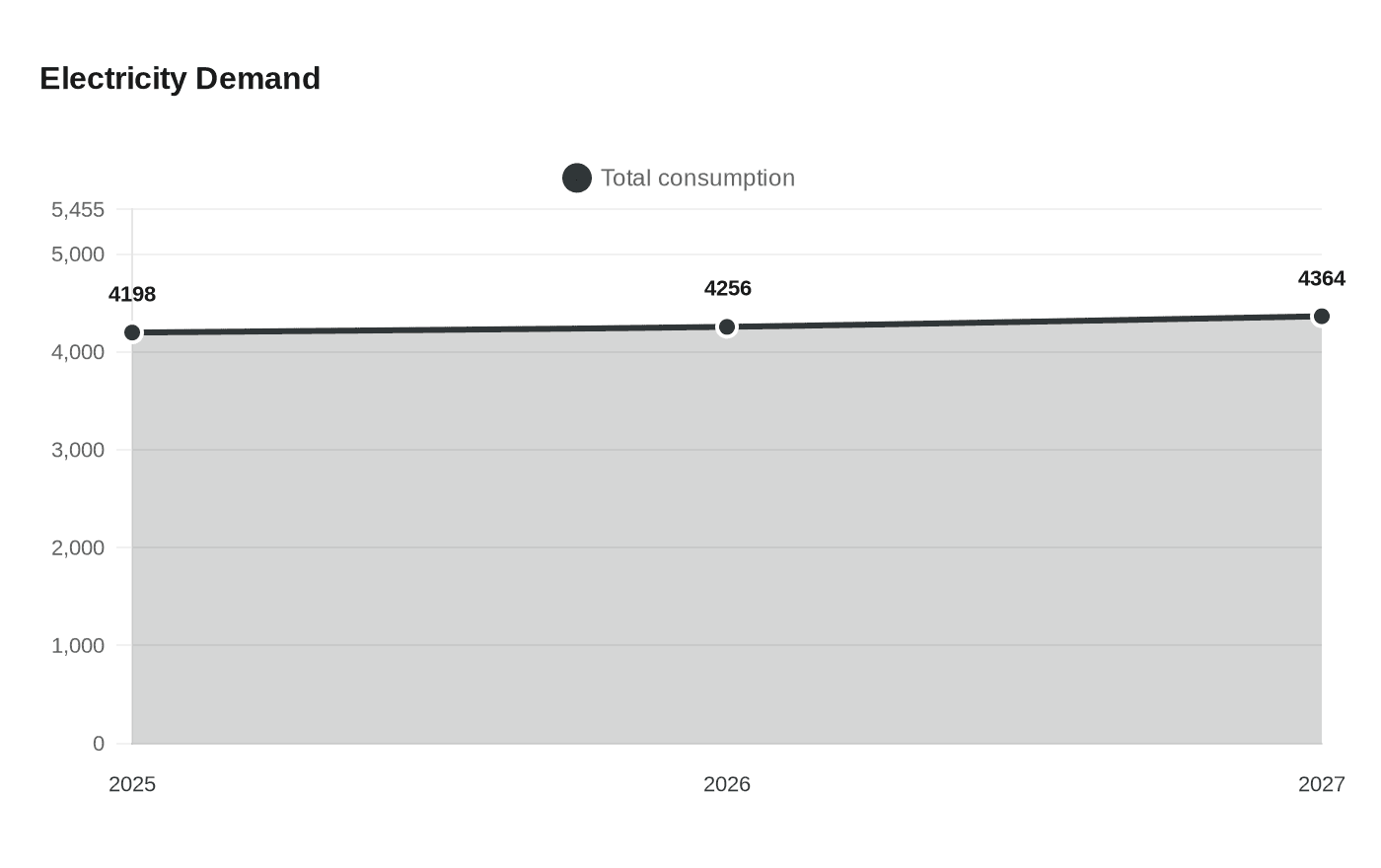
U.S. power use, already a record in 2025, is forecast to rise to about 4,256 billion kWh in 2026 and 4,364 billion kWh in 2027, amplifying grid and market pressures.

U.S. electricity consumption, already at a record 4,198 billion kilowatt‑hours in 2025, was forecast by the U.S. Energy Information Administration to climb to roughly 4,256 billion kWh in 2026 and 4,364 billion kWh in 2027, according to the agency’s Short‑Term Energy Outlook released Jan. 13. The rise reflects a confluence of structural forces reshaping electricity markets: rapid growth in data centers tied to artificial intelligence and cryptocurrency, and broader electrification as homes and transport shift away from fossil fuels.
The EIA projected sectoral sales for 2026 that underline how demand is broad based. Residential sales were expected to edge up to 1,519 billion kWh from 1,516 billion kWh in 2025. Commercial sales were forecast at 1,522 billion kWh, up from 1,486 billion kWh. Industrial demand was projected at 1,069 billion kWh, surpassing its previous all‑time high of 1,064 billion kWh set in 2000. Those numbers suggest rising baseline consumption across weather‑sensitive and business activity related categories, heightening the need for capacity near peak times.
The forecast showed notable shifts in the generation mix even as total demand grows. Natural gas’s share of power generation was projected to fall slightly from 40 percent in 2025 to 39 percent in 2026 and remain at 39 percent in 2027. Coal’s share was expected to decline from 17 percent to 15 percent in both 2026 and 2027, while renewables were forecast to rise from about 24 percent in 2025 to 25 percent in 2026 and 28 percent in 2027. Nuclear power’s share was projected at 19 percent in 2026 before dipping back to 18 percent in 2027. The result is a cleaner mix overall, but one that still relies substantially on fossil fuels for reliability and peak response.
Natural gas markets showed diverging trends across end uses. The EIA projected average daily U.S. natural gas sales in 2026 of 12.6 billion cubic feet per day (bcfd) for residential use, 9.4 bcfd for commercial, and 23.1 bcfd for industrial, each down from prior levels, while power generation demand was expected to rise to 35.8 bcfd. At the same time, U.S. liquefied natural gas exports were forecast to increase to 16.4 bcfd in 2026 and 18.1 bcfd in 2027, up from a record 15.0 bcfd in 2025, tightening global gas balances and exerting upward pressure on domestic gas prices in some scenarios.
Coal production was projected to continue its steep retreat, falling from 532.9 million short tons in 2025 to 512.3 million short tons in 2026, the lowest since 1964, and to 496.9 million short tons in 2027, the lowest since 1963. Fossil fuel carbon dioxide emissions were forecast to decline from 4.903 billion metric tons in 2025 to 4.796 billion metric tons in 2026, before edging back to 4.803 billion metric tons in 2027 as oil and gas use tick up.
The EIA projections carry immediate market and policy implications. Utilities and grid operators face mounting pressure to expand transmission, add flexible capacity and shore up reliability during summer peaks even as the resource mix shifts toward renewables. Rising electricity consumption and stronger LNG exports could lift fuel costs and reshape regional wholesale prices. For policymakers, the modest near‑term drop in emissions highlights progress but also underscores the gap between growing electricity demand and the pace of decarbonization needed to meet longer‑term climate goals.
Global context from the International Energy Agency pointed to similarly strong electricity growth worldwide, with global consumption expected to exceed 29,000 terawatt‑hours in 2026 and electricity demand rising faster than total energy demand through 2026, driven by industry, air conditioning and data centers. The EIA outlook therefore aligns with a broader structural trend: accelerating electrification that will test infrastructure, markets and climate policy in the years ahead.
This article was produced by Prism’s automated news system from verified source data, official records, and press releases, then run through automated quality and moderation checks before publishing. The system is built and supervised by the people who set the standards it runs under. Read our full AI policy.
Did this article answer your question?

