U.S. growth rebounds as AI investment and government spending surge
AI spending and a rebound in government outlays helped lift U.S. growth to 2.0%, but consumer demand stayed soft and inflation pressures persisted.

A burst of spending on artificial intelligence and a rebound in government outlays helped pull the U.S. economy back to a 2.0% annualized growth rate in the first quarter, but the composition of that gain pointed to a narrow recovery rather than a broad-based acceleration. Consumer demand, the economy’s main engine, lost momentum again even as business investment and exports carried more of the load.
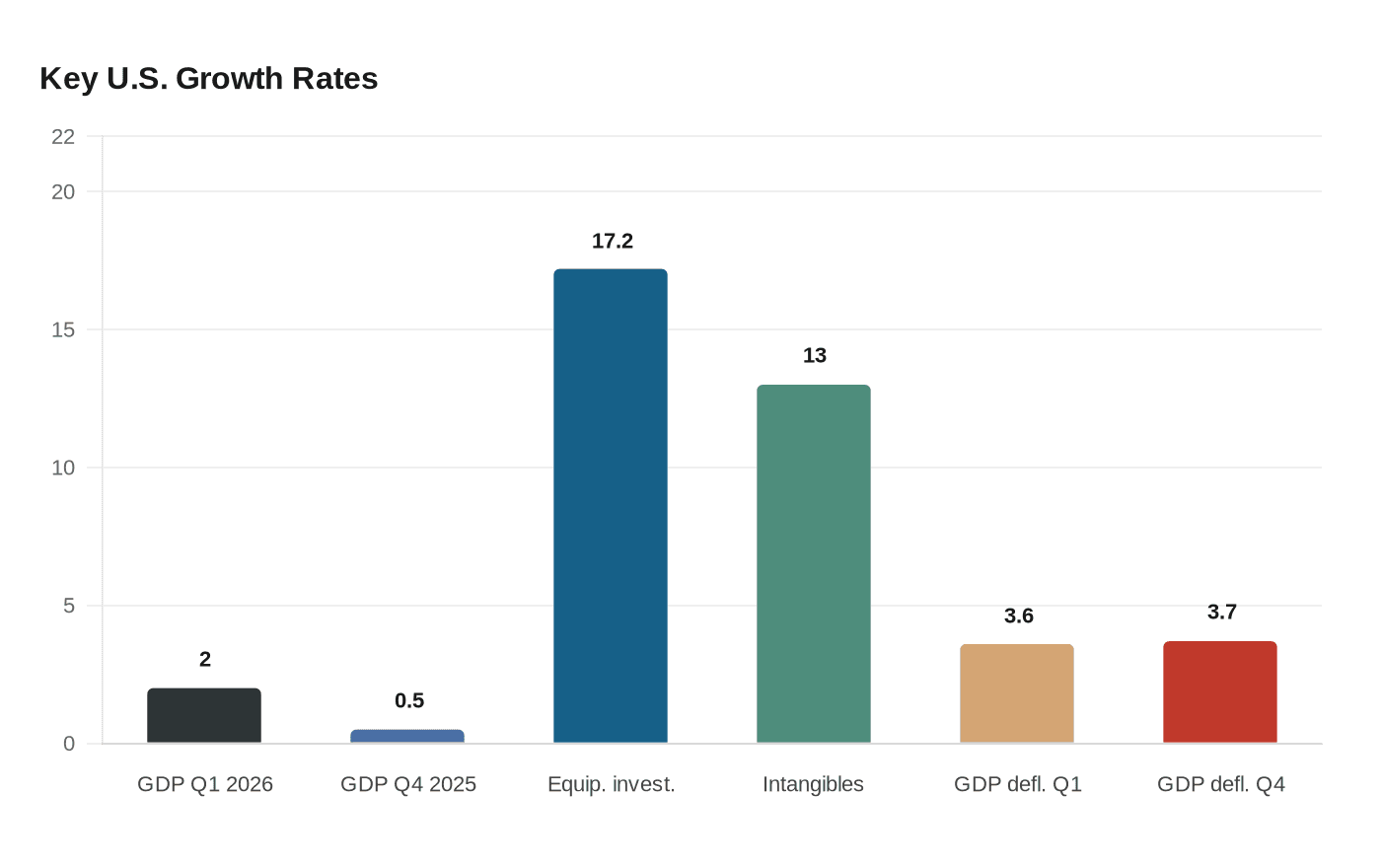
The Commerce Department’s advance estimate, released Thursday at 8:30 a.m. EDT and covering January through March 2026, showed real gross domestic product rising after a 0.5% pace in the fourth quarter of 2025. The increase was driven by investment, exports, consumer spending and government spending, while imports also climbed and subtracted from GDP, a reminder that trade flows can make the headline stronger or weaker than the underlying demand story.
The clearest sign of strength came from corporate spending. Business investment in equipment jumped at a 17.2% annualized rate, and investment in intellectual products rose 13%. Those gains were tied to AI buildout and data-center construction, an area that has become large enough to show up in the national accounts. A Federal Reserve assessment said about 18% of firms had adopted AI by year-end 2025, underscoring that the spending wave is no longer confined to a handful of tech giants.

That investment boom more than offset another weak patch in factory and commercial construction. Nonresidential structures, including factories, fell for a ninth straight quarter, the longest such stretch on record. The split leaves economists debating whether the country is seeing the early stages of a productivity lift that could eventually support wages and output, or a concentrated boom centered on a few sectors while the rest of the economy runs cooler.
Inflation and energy costs are clouding the picture. The GDP price deflator rose 3.6% in the quarter after a 3.7% gain in the fourth quarter, while gasoline prices climbed above $4 a gallon amid the war in the Middle East. Inflation accelerated at its fastest pace in nearly three years in March, adding pressure to households already pulling back.
“The economy still has momentum, but the road ahead is more dangerous than the GDP number suggests,” said Sung Won Sohn of Loyola Marymount University. The political stakes are rising as well: a Reuters/Ipsos poll in late April found Donald Trump’s approval rating at 34%, his lowest level of the term, and another poll found only about one in four Americans approved of his handling of inflation and rising prices.
This article was produced by Prism’s automated news system from verified source data, official records, and press releases, then run through automated quality and moderation checks before publishing. The system is built and supervised by the people who set the standards it runs under. Read our full AI policy.
Did this article answer your question?
%3Amax_bytes(150000)%3Astrip_icc()%2FCertificate-of-deposit-2301f2164ceb4e91b100cb92aa6f868a.jpg&w=1920&q=75)
