U.S.-Iran talks in Islamabad end without nuclear agreement after 21 hours
Islamabad talks led by Vice President J.D. Vance ran roughly 21 hours and ended after Iran declined to give an affirmative commitment not to pursue a nuclear weapon.
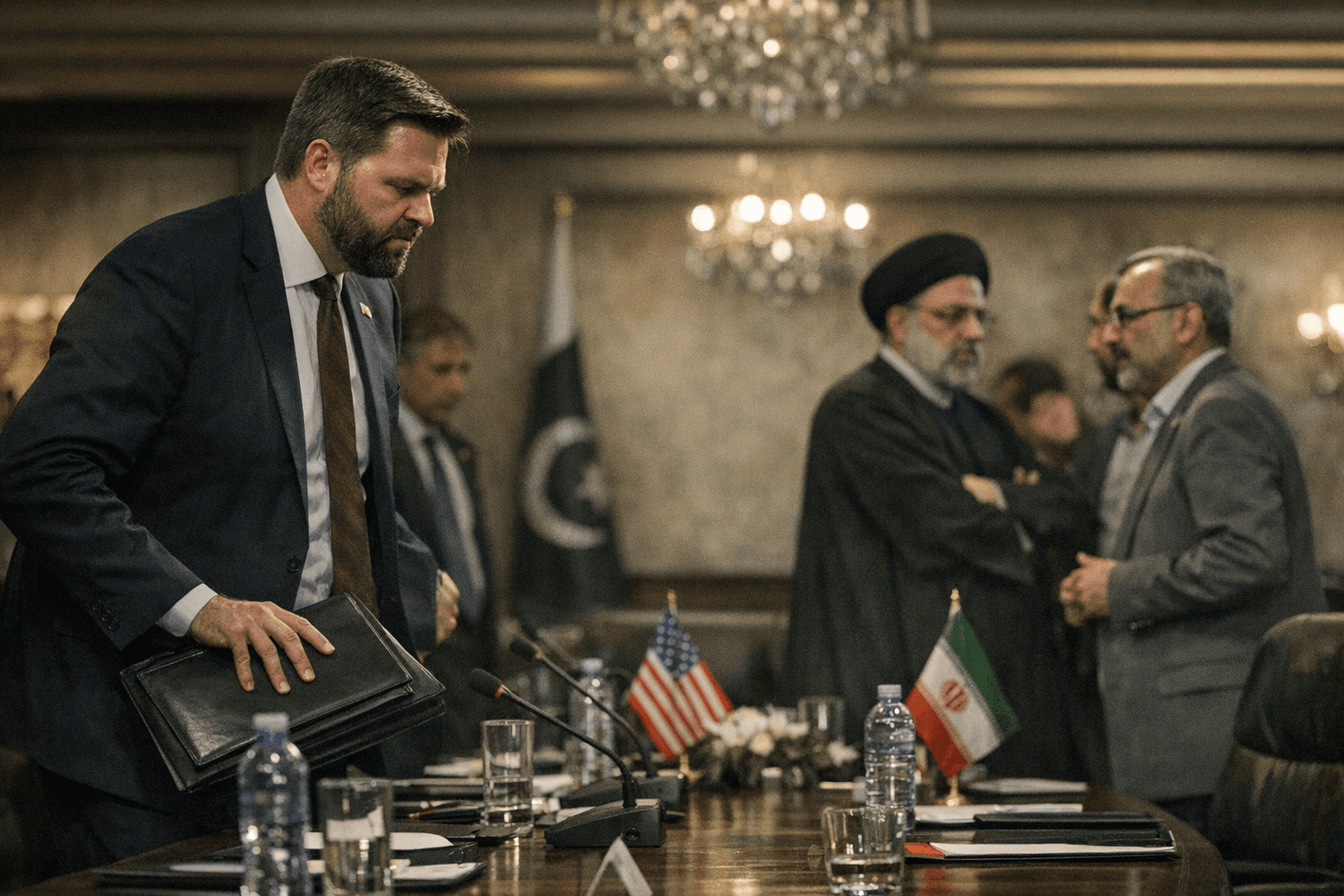
The failed, face-to-face negotiations in Islamabad sent a strategic signal about Washington’s posture toward Tehran: holding talks in Pakistan, running them roughly 21 hours, and publicly declaring a breakdown framed U.S. leverage and limits at once. The session, described by U.S. officials as the first direct in-person contact between top U.S. and Iranian officials since the outbreak of large-scale hostilities in the region, concluded April 12, 2026 without the explicit nuclear assurances the United States demanded.
Vice President J.D. Vance led the U.S. delegation, joined by special envoys and White House political figures, while senior Iranian officials attended and Pakistani hosts facilitated the meeting in Islamabad. Vance told reporters that the Iranians “have chosen not to accept our terms” and that the administration had presented the president’s “final and best offer.” He added the diplomatic aim in Islamabad was concrete: “The simple fact is we need to see an affirmative commitment that they will not seek a nuclear weapon and they will not seek the tools that would enable them to quickly achieve a nuclear weapon.”
The talks were intended to test whether two-week-old ceasefire momentum could be converted into a longer cessation of hostilities that would allow shipping through the Strait of Hormuz to resume and help ease a global energy shock. The Islamabad breakdown raises the prospect that the ceasefire will fray and that strikes, counterstrikes, or disruptions to commercial shipping could resume or escalate in the coming days. Financial markets and energy markets are watching closely because the talks were explicitly linked to reopening the Strait and stabilizing shipments.
Diplomatically, the collapse preserves a high-risk status quo in which military options and escalation remain on the table for multiple actors. Pakistani mediation placed Islamabad at the center of this diplomatic test; the Iranian side characterized the meetings as inconclusive and said it had conveyed its own conditions through Pakistani channels. Observers warned the impasse complicates U.S. messaging to allies and partners about whether sustained de-escalation is achievable through diplomacy.
U.S. officials said they would return to Washington to consult on next steps, with immediate priorities to sustain the ceasefire, protect commercial shipping, coordinate with regional partners, and calibrate military posture to deter further Iranian aggression while avoiding broader escalation. Closing the central gap on nuclear assurances will require time, hard guarantees, and likely third-party monitoring arrangements, all politically fraught and technically complex to negotiate quickly.
For the administration, the Islamabad outcome presents a choice between sharpening deterrence and reopening a protracted diplomatic track that would demand new verification mechanisms. With the talks concluded April 12, 2026, Washington must now translate a public failure into a coherent set of policy options that preserve the ceasefire and limit the risk of renewed regional conflagration.
Sources:
Know something we missed? Have a correction or additional information?
Submit a Tip