U.S. Jobs Report Smashes Forecasts With 178,000 March Gains
Health care's post-strike rebound drove 43% of March's 178,000 jobs, but wages grew at their slowest pace since 2021, keeping the Fed on hold.

The March jobs report delivered a headline number that stunned forecasters: 178,000 nonfarm payrolls added, more than triple the Dow Jones consensus estimate of 59,000 and a complete reversal from February's loss of 133,000 jobs. But dissecting where those jobs came from reveals a more complicated picture than the top line suggests.
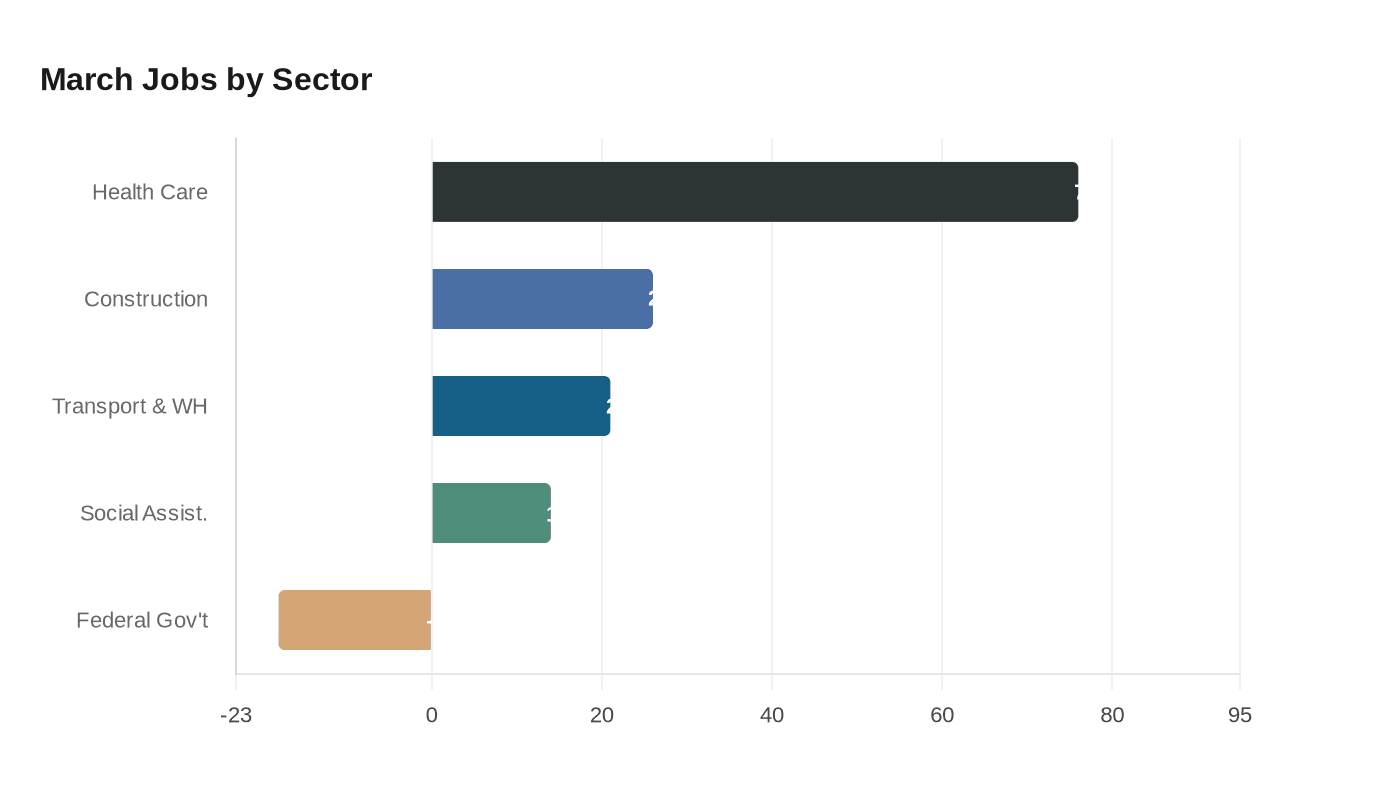
Health care did the heaviest lifting, accounting for 76,000 positions, roughly 43% of March's total. Physicians' offices alone added approximately 35,000 jobs as workers returned from a strike that had artificially compressed February's numbers. Hospital employment contributed another 15,000. Construction rebounded with 26,000 new jobs as harsh winter weather finally broke, while transportation and warehousing added 21,000 positions and social assistance contributed 14,000, led by individual and family services.
Moving in the opposite direction, federal government employment shed another 18,000 jobs. Since reaching a peak in October 2024, the federal workforce has contracted by 355,000 positions, a decline of 11.8%.
The unemployment rate held at 4.3%, representing approximately 7.2 million Americans out of work. Analysts cautioned that the figure edged lower in part because the labor force itself shrank rather than because hiring broadly accelerated. The broader U-6 measure, which captures discouraged workers and those working part-time for economic reasons, ticked up to 8%. Marginally attached workers, those who want employment but had not recently searched, increased by 325,000 in March to reach 1.9 million.
Stephen Brown, Capital Economics' chief North America economist, framed the report's limits directly, writing that the stronger-than-expected gains "reflect a reversal of the strike and weather effects that bogged down hiring in February, rather than strong momentum." The three-month average entering March stood at approximately 68,000 jobs per month, a fraction of the pre-slowdown pace of roughly 180,000. Full-year 2025 saw employers add only 181,000 jobs in total, the worst annual performance outside a recession year since 2003.
Wage data reinforced that caution. Average hourly earnings rose just 9 cents, or 0.2%, to $37.38, below the 0.3% monthly gain economists had expected. Annual wage growth came in at 3.5%, the slowest pace since May 2021. Average weekly hours slipped to 34.2, down from February.
Jeffrey Roach, chief economist at LPL Financial, took a more constructive view, arguing the report "gives the Federal Reserve more time to wait for inflation to decelerate before taking action." Macro economist Diane Swonk was more pointed: "It means the Fed could focus on inflation. And inflation is a problem."
The Fed held its benchmark rate at 3.50%-3.75% at its March meeting, and CME FedWatch data showed a 90%-95% probability that policymakers remain on hold in the near term. Annual wage growth at 3.5% remains above what most Fed officials consider compatible with a 2% inflation target, leaving little incentive to move.
Racial disparities in the data showed movement but persist. Black workers' unemployment fell from 7.7% to 7.1%, still nearly 3 percentage points above the national average and well above the 6.2% recorded in January 2025. Young Black workers saw unemployment drop from 14.7% to 12.3%, the lowest since March 2025. The Bureau of Labor Statistics also revised January's payroll count upward by 34,000 jobs.
Released on April 3 with U.S. stock markets closed for the Good Friday holiday, the report stands as the largest single-month payroll gain since President Trump began his second term. Whether it marks the start of genuine acceleration or a one-month correction from a disrupted winter will become measurably clearer when April's numbers arrive.
This article was produced by Prism’s automated news system from verified source data, official records, and press releases, then run through automated quality and moderation checks before publishing. The system is built and supervised by the people who set the standards it runs under. Read our full AI policy.
Did this article answer your question?
%3Amax_bytes(150000)%3Astrip_icc()%2FCertificate-of-deposit-2301f2164ceb4e91b100cb92aa6f868a.jpg&w=1920&q=75)