U.S. plane damaged during search and rescue for downed jet in Iran, officials say
An A-10 Warthog was struck and a rescue helicopter crew wounded during a SAR mission for the first U.S. jet confirmed downed by Iranian fire since Operation Epic Fury began.

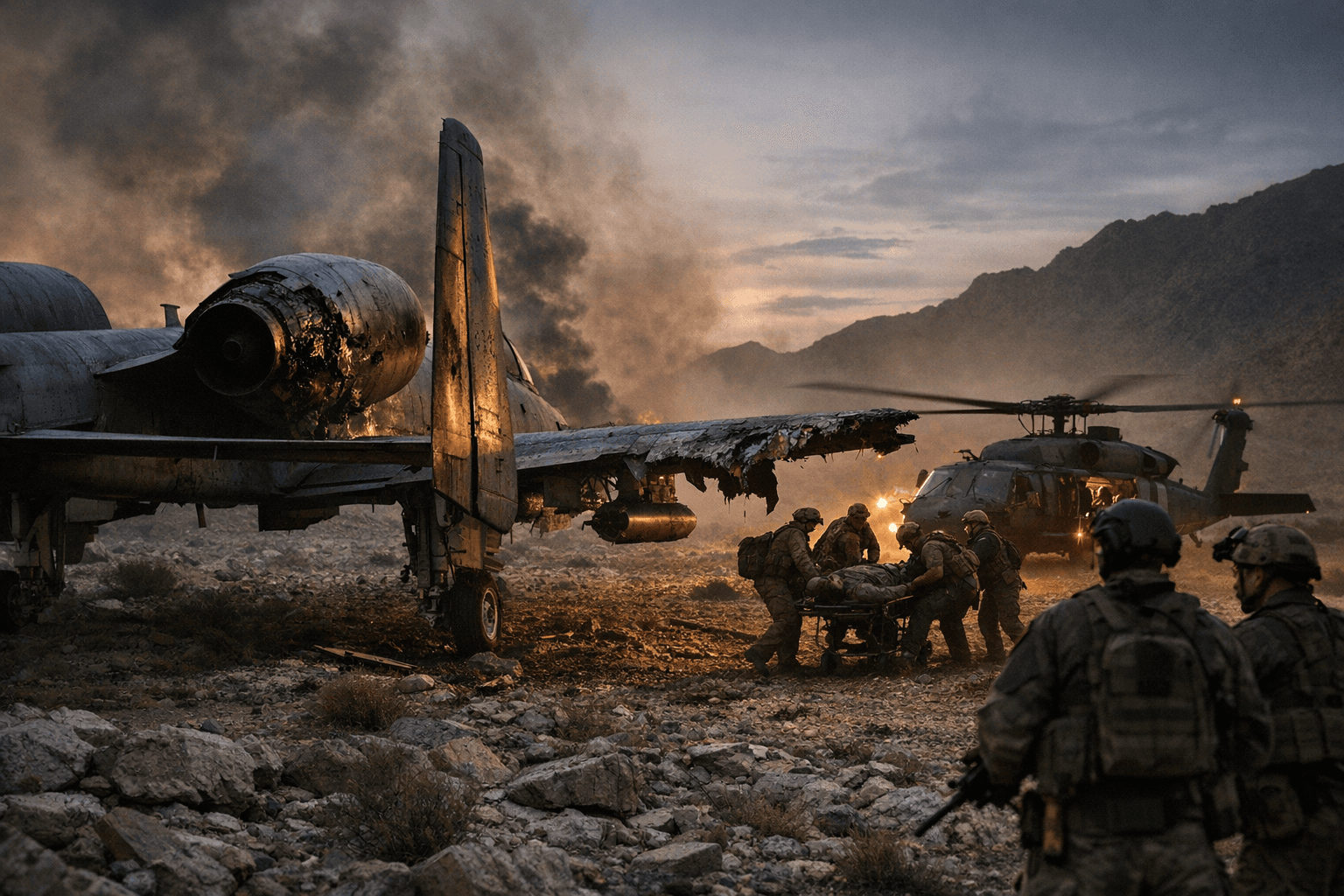
The rescue mission that followed the first confirmed shootdown of a U.S. aircraft by Iranian forces since Operation Epic Fury began rapidly cascaded into a multi-aircraft emergency on Friday, leaving an A-10C Thunderbolt II destroyed in Kuwait, two HH-60G Pave Hawk helicopters struck by enemy fire, and one F-15E Strike Eagle crew member still unaccounted for inside Iran.
The F-15E, a Boeing-built two-seater carrying a pilot and a weapons-systems officer, was shot down over western-central Iran by the Islamic Revolutionary Guard Corps, which claimed responsibility through its Nour News outlet and described the kill as the work of "a new advanced air defense system of the IRGC Aerospace Force." The loss marked a significant breach in the air superiority narrative that President Trump, Defense Secretary Pete Hegseth, and U.S. military commanders had maintained throughout the conflict. Iran had previously made at least six false claims about downing U.S. aircraft; this time, multiple American officials confirmed the loss.
U.S. special forces recovered one F-15E crew member after the pilot ejected and remained in active search Friday for the second. Two HH-60G Pave Hawk helicopters carried out the retrieval. The helicopter that recovered the downed pilot was struck by small arms fire, wounding crew members on board, though it landed safely. Both rescue helicopters were hit and their crews injured before safely returning to base.
Social media footage verified by CBS News showed a U.S. Air Force HC-130 refueling a pair of Pave Hawks over Khuzestan Province, consistent with the search-and-rescue timeline and geography.
The A-10C Thunderbolt II was struck by Iranian fire while supporting the rescue. Its pilot flew the damaged aircraft to Kuwaiti airspace before ejecting; the plane then crashed in Kuwait. The pilot is safe and receiving medical attention. Iran's bounty apparatus mobilized quickly: state television urged residents in the affected region to hand over any U.S. pilot to police in exchange for government rewards, and a regional governor issued a separate offer.
Israel cancelled planned strikes against Iran specifically to avoid disrupting the search-and-rescue effort and is providing intelligence to help locate the missing second crew member, according to an Israeli official. White House Press Secretary Karoline Leavitt confirmed that "the President has been briefed." Trump told NBC News on Friday that he did not expect the shootdown to affect indirect U.S. negotiations with Iran, even as his previous projection of wrapping up the military mission in two to three weeks drew renewed scrutiny.
Friday's losses accumulate against an already significant toll. Defense Manpower Data Center figures show 13 American personnel killed and at least 365 wounded since Operation Epic Fury began. Aviation losses have defined much of the conflict's danger: on March 1, three F-15E Strike Eagles were destroyed by friendly fire when a Kuwaiti F/A-18 engaged them in error, though all six crew members were safely recovered. A U.S. F-35 struck by enemy fire on March 19 made an emergency landing at a regional air base. Six U.S. airmen died on March 12 when a KC-135 refueling aircraft crashed in western Iraq.
The diplomatic picture shifted separately on Friday when Iran's former Foreign Minister Mohammad Javad Zarif published an op-ed in Foreign Affairs calling on Tehran to use its "upper hand" in the conflict to negotiate a comprehensive peace deal, proposing that nuclear capabilities and Strait of Hormuz access be addressed in exchange for lifting economic sanctions. The op-ed arrived as American forces were still searching Iranian territory for a missing airman.
This article was produced by Prism’s automated news system from verified source data, official records, and press releases, then run through automated quality and moderation checks before publishing. The system is built and supervised by the people who set the standards it runs under. Read our full AI policy.
Did this article answer your question?