Petraeus Praises Ukraine at Kyiv Forum, Says It Has Redefined Modern Warfare
Gen. Petraeus told the Kyiv Security Forum that Ukraine has redefined modern warfare with drone innovations and battlefield software no other military has yet matched.

General David Petraeus, former director of the CIA and a standing member of the Kyiv Security Forum Security Council, told an audience in Kyiv on Friday that Ukraine's armed forces have fundamentally rewritten the rules of modern war, offering a template that he argued allied militaries cannot afford to ignore. After his appearance at the forum, Petraeus sat down with CBS News international reporter Aidan Stretch to expand on those remarks.
The forum, organized by the Arseniy Yatsenyuk Open Ukraine Foundation, has become a recurring venue for Petraeus, who commanded U.S. Central Command from 2008 to 2010 and ran the CIA from 2011 to 2012. His praise on Friday was not rhetorical: it centered on specific Ukrainian innovations that analysts and military planners increasingly describe as the early architecture of a new kind of conflict. Chief among them is drone warfare at scale. Ukraine, a country with no standing navy at the start of Russia's full-scale invasion in February 2022, engineered maritime and aerial drone systems capable of coordinated strikes that have helped destroy roughly one-third of Russia's Black Sea Fleet, forcing the remainder to retreat to a port in the far eastern Black Sea, from which it barely operates. Those same design cycles, running from frontline need to mass-produced first-person-view drones in as little as two months, represent a procurement speed that NATO's more bureaucratic acquisition systems have struggled to match.
Petraeus has characterized what Ukraine is pioneering as the early stages of software-defined warfare: an approach where battlefield software, AI-assisted targeting, and rapid digital iteration matter as much as hardware. Ukraine's decentralized logistics model reinforces this edge. Ukrainian unit commanders can independently requisition drones, electronic warfare equipment, and ground robotics without waiting for centralized approval, shortening the feedback loop between the front line and the defense industry. The European Union and NATO have taken note of this model, with senior Ukrainian officials describing significant interest from allied capitals in replicating the approach.
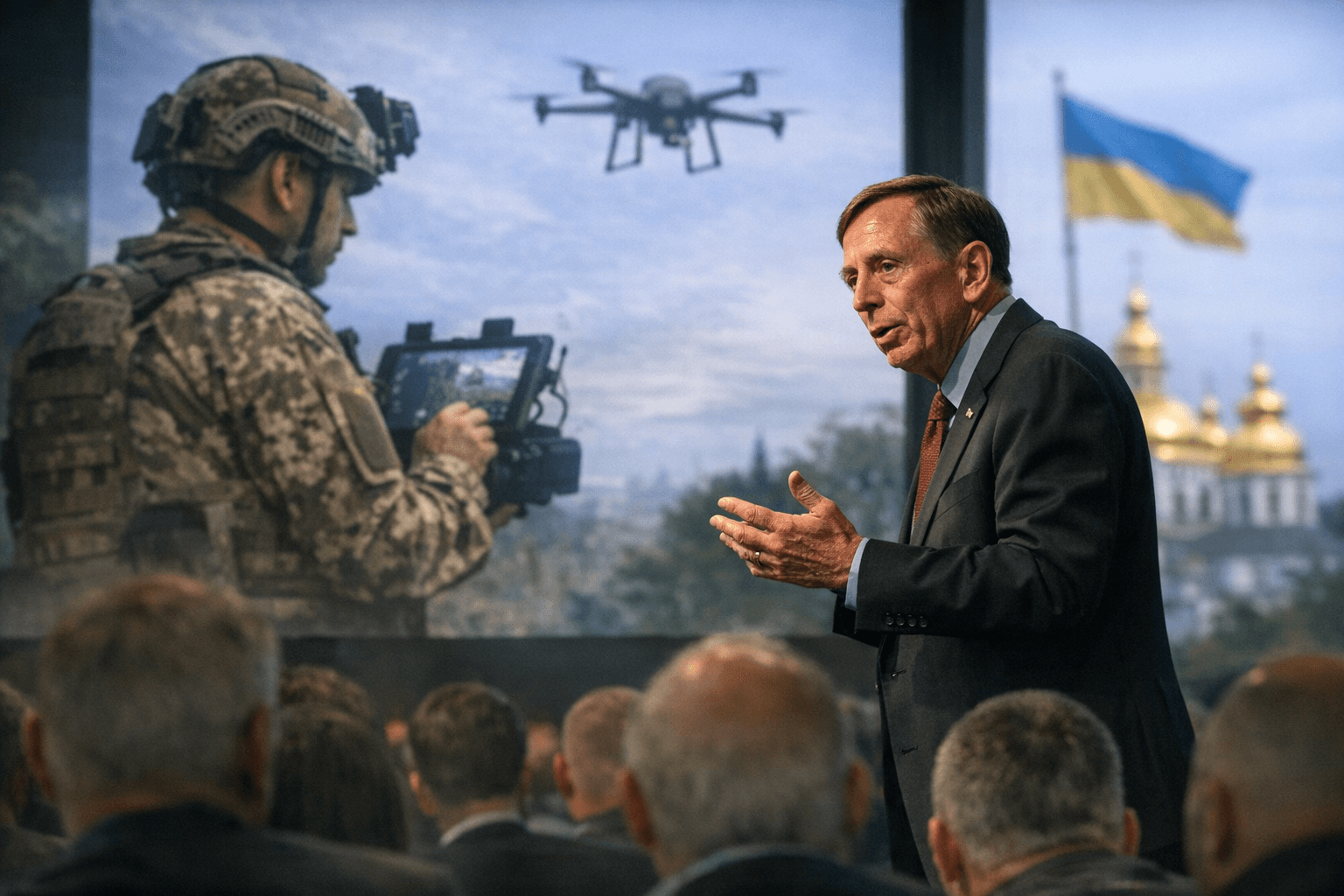
The praise, however, arrives alongside hard operational questions. Electronic warfare remains a double-edged reality: Russia has invested heavily in jamming and spoofing capabilities, and Ukraine's advantage in any single technology tends to compress as Russian engineers adapt within weeks. Scalability is the deeper challenge. Ukraine's innovation pipeline runs partly on necessity and a deeply mobilized domestic tech sector; whether NATO members with peacetime procurement cultures can internalize those same cycles before a crisis forces the issue remains unresolved. A 2025 Estonian military exercise offered a pointed illustration: a ten-person Ukrainian drone team simulated the destruction of two full NATO battalions in a single day, exposing gaps that years of doctrine have yet to close.
Petraeus has long argued that identifying lessons and actually learning them are two different things. The latter requires rewriting doctrine, restructuring forces, and overhauling training, not merely acknowledging that cheap drones and battlefield software now dominate the contact line. Ukraine, still fighting under fire, continues developing technologies it describes as without parallel anywhere in the world. Whether its partners can absorb those lessons fast enough, and sustain the funding and material support that keeps Ukraine's innovation engine running, is the question the Kyiv Security Forum was designed to press.
This article was produced by Prism’s automated news system from verified source data, official records, and press releases, then run through automated quality and moderation checks before publishing. The system is built and supervised by the people who set the standards it runs under. Read our full AI policy.
Did this article answer your question?


