Sizdah Bedar, Iran's Ancient Nature Day, Blends Luck, Picnics, and Nowruz Tradition
Ancient ritual meets wartime defiance as millions of Iranians marked Sizdah Bedar on April 2, picnicking on the 34th day of war in an act of civilizational continuity.

Every spring, a 3,800-year-old instinct pulls Iranians out of their homes and into nature. Sizdah Bedar, officially designated Nature Day and falling on the 13th day of Farvardin, the first month of the Persian calendar, closes the two-week Nowruz holiday with a collective exhale: picnic blankets unfurled beside rivers, kebabs grilled over open flame, children chasing each other through crowded parks. In 2026, that scene played out in Tehran on April 2, with one extraordinary difference. It was the 34th day of a war.
A Name With Two Meanings
The holiday's name itself contains a quiet tension. According to the Dehkhoda Dictionary, "Sizdah Bedar" translates literally as "towards the valley on the thirteenth day." Yet most Iranians carry a second interpretation alongside that one: "getting rid of the ominous thirteen." The number 13 holds an unlucky connotation in Iranian culture, and the prescribed remedy is simple and ancient: leave the house, go outside, let nature absorb whatever ill fortune the date might carry. The outdoor gathering is not incidental to the holiday; it is the ritual itself.
In the Gregorian calendar, Sizdah Bedar typically lands on April 1 or 2, a coincidence that gives it an accidental kinship with April Fools' Day in the Western world, though the Persian tradition is far older.
Roots in Persian Antiquity
The festival's origins predate Zoroastrianism and reach back to at least 1800 BCE, where they are linked to the mythological Persian King Jamshid. Ancient Iranians understood the day in cosmological terms: the angel of rain, Tishter, also known as Izad Tir, had on this date defeated the demon of drought. The proper response was celebration. Iranians sacrificed sheep and cooked kebab to mark the demon's defeat, establishing culinary customs that persist in recognizable form today.
Zoroastrian tradition added another dimension: joyous celebration on this day was believed to cleanse bad thoughts. Ancient Persian cosmology held that the world was created across a 12,000-year cycle, which is why the first twelve days of spring were considered sacred. The thirteenth day was the natural moment to step outside and formally close the festivities. References to "the thirteenth day of Farvardin" appear in the ancient epic Shahnameh, though formal documentation of the holiday as an organized celebration does not appear in historical records until the Qajar era.
The Rituals of the Thirteenth
Picnicking by rivers and streams is the day's central act, but Sizdah Bedar is layered with specific customs. Families prepare Ash Reshteh, a traditional Persian noodle soup, in the open air. They sip Sekanjabin, an ancient Iranian drink made from vinegar, honey, and sometimes mint, paired with lettuce as a symbolic promise of good health in the year ahead.
The most visually striking ritual belongs to young unmarried people, particularly women. Called "sabzeh gereh zadan," it involves knotting the stems of sprouted greens, the sabzeh, while making a wish for love and good fortune, then releasing the greens into a flowing river or stream. The sabzeh itself is not bought fresh for this moment; it was grown by each family during the final days of the old year as part of the Haft-Seen Nowruz display, the ceremonial table arrangement central to the New Year celebration. Its release into the water closes the circle of the holiday season. Music, dance, and traditional games round out the day.
The Lie of the Thirteenth
Sizdah Bedar doubles as Iran's own version of April Fools' Day. The tradition is called "dorugh-e sizdah," the Lie of the Thirteenth, and its roots are reported to stretch back to 536 BCE in the Achaemenid Empire. Pranks have been played on this holiday for millennia, making it one of the oldest documented joke-playing traditions in the world, predating the Western April Fools' Day by centuries.
Nature Day Under Fire
The 2026 observance carried a weight unlike any in living memory. On February 28, 2026, joint U.S. and Israeli strikes killed Supreme Leader Ayatollah Ali Khamenei along with other Iranian officials and civilians. The strikes targeted Islamic Revolutionary Guard Corps headquarters, military bases, radar installations, and nuclear facilities. Iran retaliated by launching hundreds of drones and ballistic missiles at targets in Israel and at U.S. military bases across the region. That conflict itself followed a prior escalation: Israel had waged what became known as the Twelve-Day War against Iran in June 2025, which included a U.S. airstrike aimed at destroying nuclear facilities at Natanz and elsewhere.
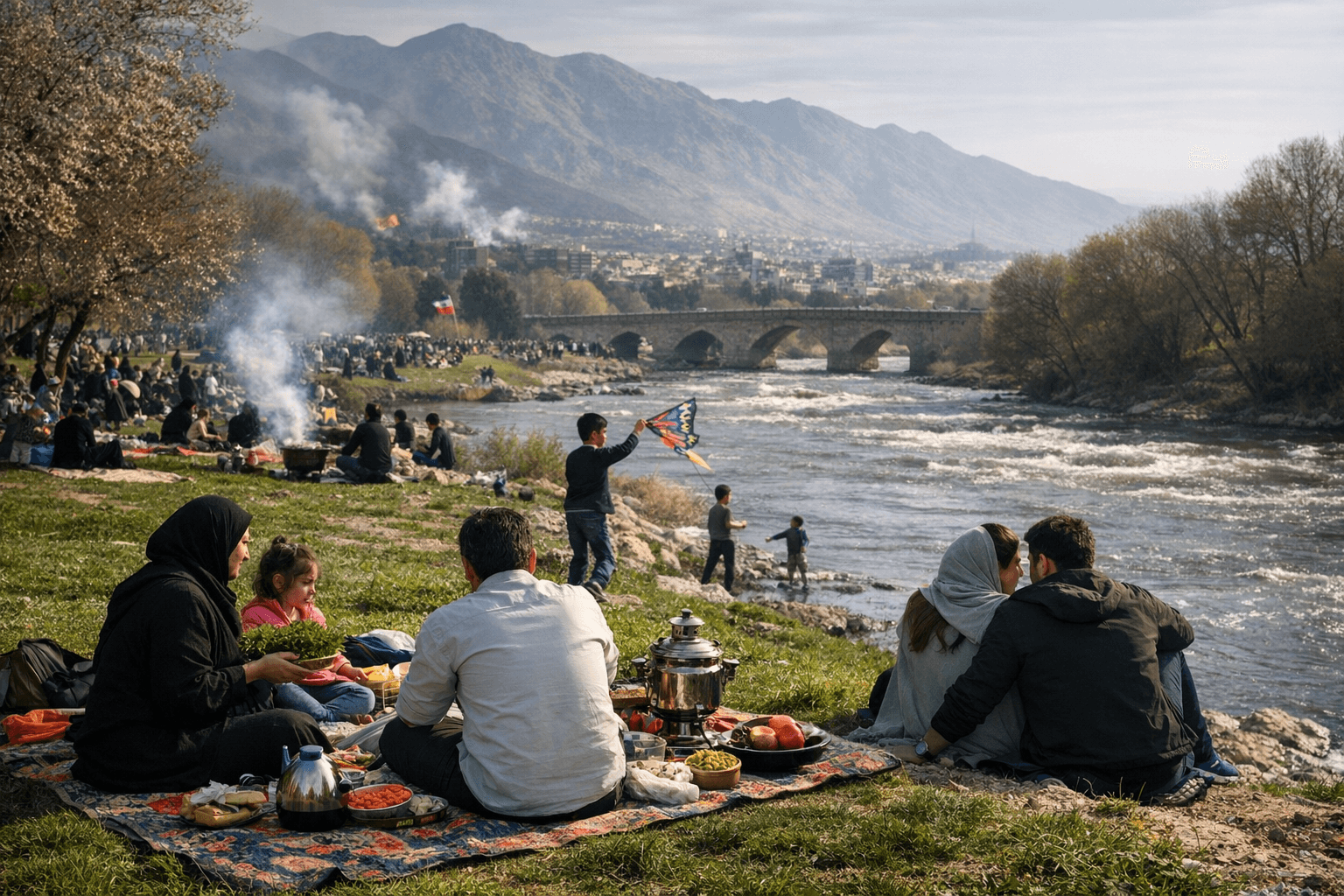
When April 2 arrived, it was Day 34 of an active war. And yet families across Tehran spread picnic blankets.
A City Unbowed
Reporting from Tehran by WANA, the West Asia News Agency, captured scenes that were at once ordinary and striking. Families grilled kebabs and played cards in public parks. Children ran through crowded green spaces while women painted Iranian flags on their faces. Groups exercised near Milad Tower, the capital's distinctive telecommunications landmark. Similar scenes were reported from cities across the country.
Two residents spoke to WANA correspondents in terms that went beyond the personal. Mohammadreza Jazayeri, a young Tehran resident, addressed directly the threats by U.S. President Donald Trump that Iran could be bombed "back to the Stone Age" if it refused Washington's terms: "The enemy wants to scare Iran... we know that if we accept, we will become like Libya, like Iraq, like Syria, and we will not accept such a thing." Another resident, identified only as Shahidi, reached for the deepest available anchor: "This nation will never return to the Stone Age. The civilization we have, the antiquity we have — we have the Cyrus Cylinder, which is considered one of the oldest civilizations in the world."
WANA described the public gatherings as "a visible insistence that ordinary life, public togetherness and national continuity would endure even under fire."
Iran's acting Supreme Leader issued a message marking both Nature Day and the anniversary of the Islamic Republic, urging Iranians to plant saplings from Thursday through the end of spring in memory of those killed in the war. He said the strikes had damaged not only infrastructure and human lives but also Iran's natural environment, and described tree planting as a symbol of renewal, hope, and national resilience.
A Second Wartime Spring
The 2026 Sizdah Bedar carries a specific historical echo. This is only the second time in modern Iranian history that the Nowruz season, culminating in Nature Day, has been observed under the shadow of active war. The first was during the eight-year Iran-Iraq War of the 1980s, a conflict that ran across multiple Nowruz seasons and left a generation marked by the particular grief of celebrating spring in wartime.
The 2026 Nowruz itself arrived weighted with additional layers. Falling on March 20 this year, it coincided with Ramadan drawing to a close and the celebration of Eid Al-Fitr, a convergence of Persian, Islamic, and seasonal calendars that lent the holiday period an unusual density of meaning for millions of Iranians.
A Global Tradition
Sizdah Bedar is not confined to Iran's borders. Millions of Iranians worldwide observe the holiday, with diaspora communities adapting the outdoor picnic tradition to wherever they have settled, typically gathering on a weekend day near the 13th of Farvardin. The core impulse remains the same: go outside, gather with others, release the old year's greens into moving water, and begin again.
That impulse, now 38 centuries old, proved difficult to suppress even in a city living under the threat of air raids. The kebab smoke over Tehran's parks on April 2, 2026, was not simply a seasonal ritual. It was also an argument: that a civilization old enough to have named the angel of rain is not easily argued out of its spring.
This article was produced by Prism’s automated news system from verified source data, official records, and press releases, then run through automated quality and moderation checks before publishing. The system is built and supervised by the people who set the standards it runs under. Read our full AI policy.
Did this article answer your question?


