Rising Fuel Costs Force Filipinos to Scale Back Holy Week Church Visits
Surging fuel prices tied to the Middle East conflict reshaped the Philippines' Visita Iglesia this Holy Week, with devotees staying close to home instead of visiting distant churches.
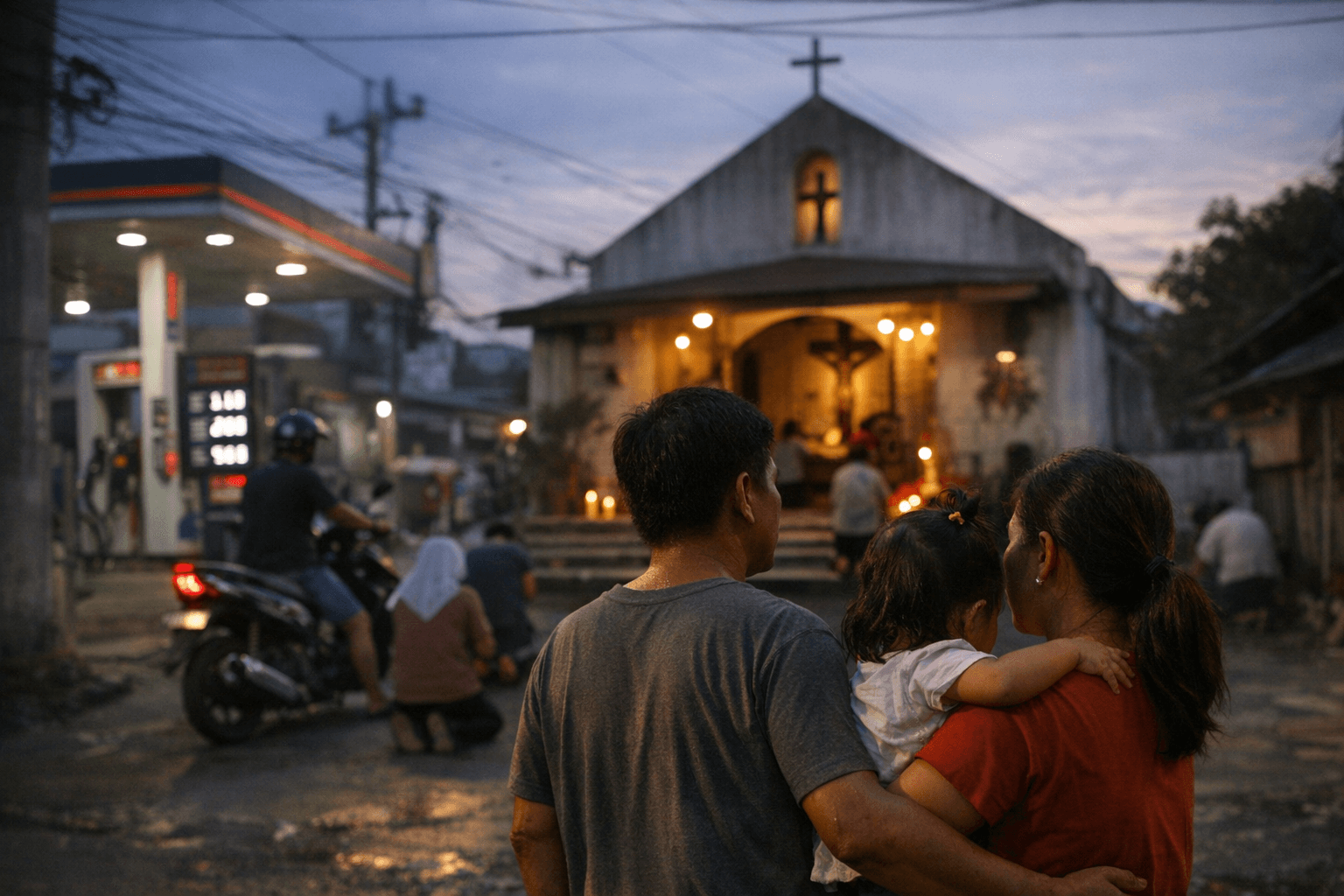
For generations of Filipino Catholics, the Visita Iglesia has meant loading into a car, driving across the city or into the provinces, and stopping at seven churches to pray the Stations of the Cross on Maundy Thursday or Good Friday. This Holy Week, many made a shorter journey, or none at all, as a fuel crisis rooted in the Middle East conflict stripped the pilgrimage of its range.
Oil companies announced diesel price increases of P12.50 to P12.90 per liter at the start of Holy Week, pushing diesel as high as P131.90 per liter in parts of Metro Manila. Gasoline climbed by as much as P2.90 per liter in the same period. The hikes marked the third consecutive week of steep increases since the outbreak of the US-Israel-Iran war on February 28, with some firms implementing single-week diesel hikes of up to P18 per liter. In Isabela province, diesel had already reached at least P121 per liter and gasoline P90, leading some devotees to abandon the cross-regional pilgrimages they had made in years past.
At St. Mary Magdalene Church, worshippers filled the grounds on Maundy Thursday but adjusted their plans. Some opted to remain longer at a single church rather than travel farther, citing the cost of transport. Josie, a 35-year-old who has observed Visita Iglesia for a decade, told reporters her group had scaled back. "We'll just stay here. It's expensive, and gas prices are high," she said. In Isabela, Leandro Martinez, 58, said the full devotion was no longer possible. "Times change. We have to save every penny now because of the Middle East conflict," he said.
In Metro Manila, some devotees shifted to nearby churches and used the opportunity to walk through the Walled City of Intramuros and Rizal Park rather than drive to distant parishes. Ricky Margate, 57, who traveled to San Fernando, Pampanga, for the Good Friday crucifixion reenactment, chose to ride a motorcycle instead of his car because it consumes less fuel.
The Catholic Bishops' Conference of the Philippines acknowledged the strain. Jerome Secillano, executive secretary of the Episcopal Commission on Public Affairs, said via radio that it was understandable for people to save money rather than travel. "We are worried that Filipinos are really affected by the rising prices of oil," Secillano said. Archbishop Romulo Valles of Davao separately urged a simpler Holy Week and clarified that Visita Iglesia is not obligatory, saying the faithful may choose to visit only one or two churches rather than travel extensively.
To provide an alternative, the Church promoted digital options through the FaithWatch mobile app and diocesan platforms, which offer 360-degree virtual tours of churches and online Stations of the Cross observances.
The tradition itself dates to 16th-century Rome, where St. Philip Neri led pilgrims on a Seven Churches Walk. Augustinian missionaries introduced the practice to the Philippines in the 1560s, where it became one of the most defining expressions of Catholic faith in Asia's largest Christian-majority nation. Transportation Secretary Giovanni Lopez had anticipated more than five million people traveling during the Holy Week period despite record fuel prices, though road traffic was notably lighter than previous years, with the burden falling hardest on those who had always measured their faith by the distance they were willing to drive.
This article was produced by Prism’s automated news system from verified source data, official records, and press releases, then run through automated quality and moderation checks before publishing. The system is built and supervised by the people who set the standards it runs under. Read our full AI policy.
Did this article answer your question?


