U.S. Says Congo Government, Rebels Advance Humanitarian Protocol in Talks
Aid convoys and prisoners are now part of Congo peace talks, but the real test is whether civilians in eastern DRC see fewer attacks and faster deliveries.
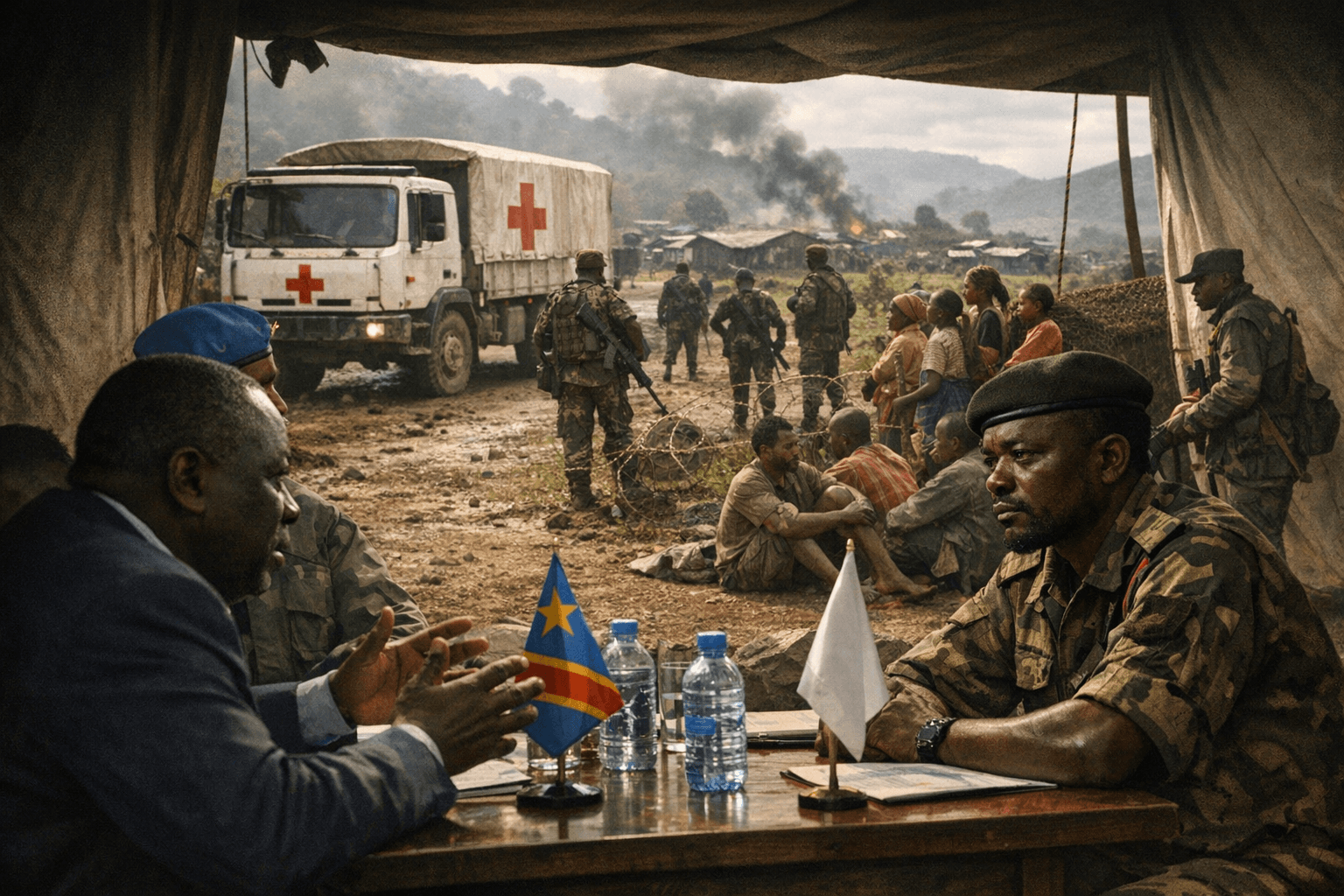
Civilians in eastern Congo stand to gain or lose most from a new diplomatic opening that puts aid access, judicial protection and prisoner releases at the center of talks between the Government of the Democratic Republic of the Congo and AFC/M23. The U.S. said the two sides made substantial progress on a protocol covering humanitarian access and judicial protection, a step that could determine whether food, medicine and relief workers can move more freely through areas still scarred by fighting.
The meetings took place in Montreux, Switzerland, from April 13 to April 17, 2026, under the Doha Framework for a Comprehensive Peace Agreement signed in Doha on November 15, 2025. In their joint statement, the parties said they would comply with obligations under international humanitarian law, international human rights law and international refugee law, and they discussed operationalizing the ceasefire oversight and verification mechanism as well as the release of prisoners. Qatar said the parties would provide proposals for concrete next steps to the facilitation team, while the overall process remains far from a final settlement.
The stakes are severe. OCHA describes the country’s crisis as unprecedented, shaped by armed conflict, massive displacement, climate shocks and epidemics. UNHCR said about 8.2 million people had been displaced by September 2025 and projected that number could reach 9 million by the end of 2026, with 5.8 million internally displaced. IOM’s 2026 overview put internally displaced people in eastern DRC at 3,591,162, including 1,168,413 in North Kivu and 1,232,251 in South Kivu. WFP said funding shortfalls had forced it to cut its assistance in eastern DRC to 600,000 people from a planned 2.3 million, and it said it urgently needed $349 million to sustain emergency operations until April 2026.
The humanitarian gap is already visible on the ground. Human Rights Watch said on April 14 that armed forces and armed groups in the South Kivu highlands were obstructing aid delivery and preventing civilians from fleeing fighting. That makes the new language on access more than a procedural detail: if it is carried out, it could shorten delays for convoys and reduce the risk to aid workers and displaced families trapped near front lines.
The talks are also being tested against a hard record. A joint declaration in Doha in April 2025 called for an immediate cessation of hostilities, but fighting later persisted. An African Union facilitation mission headed by Catherine Samba-Panza and Sahle-Work Zewde is expected to visit Goma next month, another sign that outside mediators are trying to keep the process moving. For now, the protocol marks progress, but the crucial question remains whether it can survive contact with commanders and fighters on the ground.
This article was produced by Prism’s automated news system from verified source data, official records, and press releases, then run through automated quality and moderation checks before publishing. The system is built and supervised by the people who set the standards it runs under. Read our full AI policy.
Did this article answer your question?


