U.S. Treasury selloff deepens as 10-year yield eyes 4.75%
The 10-year Treasury yield hovered near 4.62% as traders eyed 4.75%, a move that is lifting borrowing costs from mortgages to federal debt.

The selloff in U.S. Treasuries tightened again as the benchmark 10-year yield held near 4.62%, with traders now discussing 4.75% as the next technical stop. A level that once drew buyers around 4.5% has lost its power to steady the market, a sign that inflation anxiety is overpowering the old playbook.
That shift matters far beyond bond desks. Higher Treasury yields feed directly into mortgage rates, credit-card pricing, business borrowing and the value of growth stocks, which are more sensitive to the discount rate applied to future earnings. They also raise the government’s financing burden, adding pressure to the federal deficit at a time when Washington is already managing a heavier interest bill.
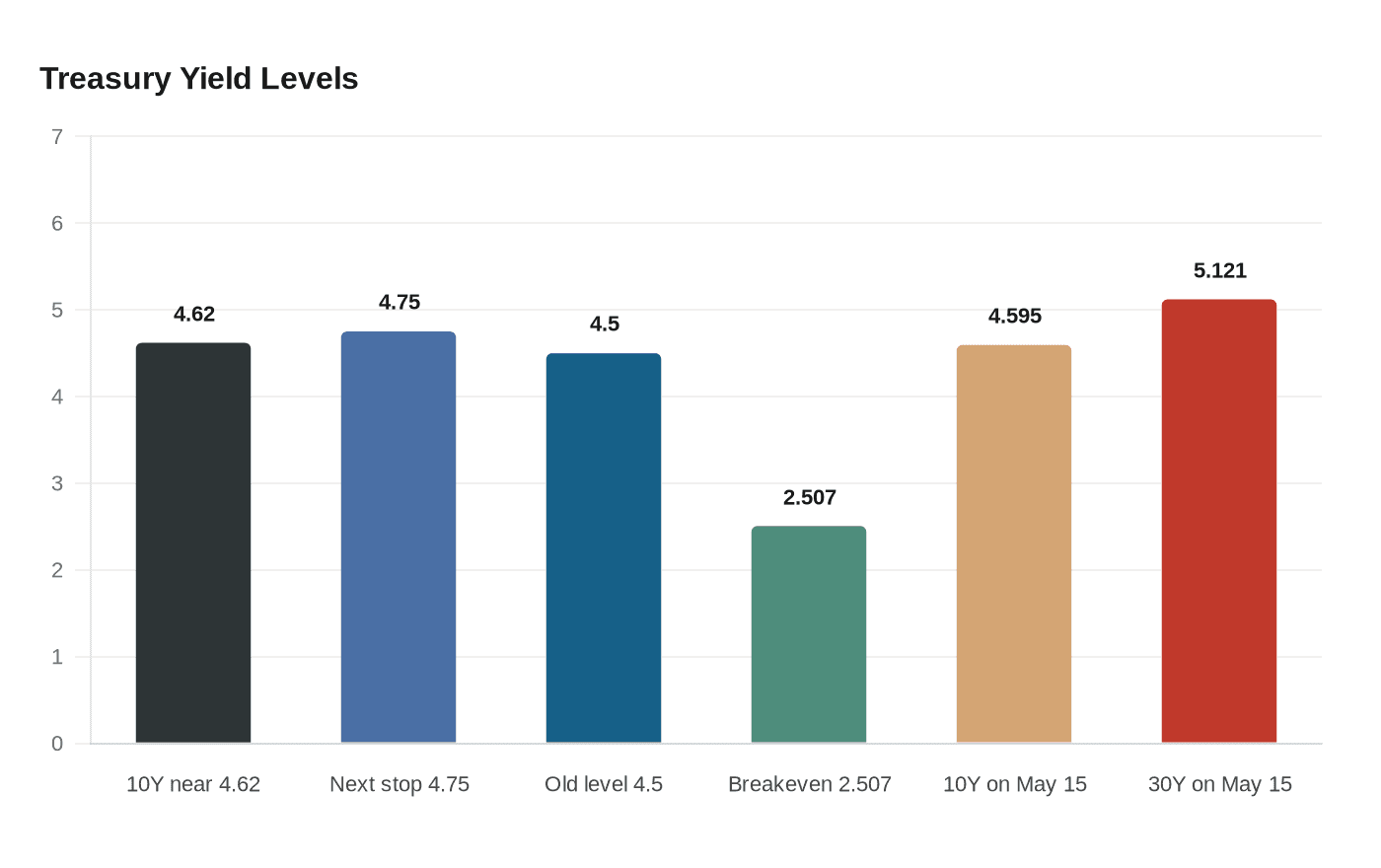
The market’s unease was reinforced by fresh inflation signals. Consumer and producer price readings came in stronger than expected, and the 10-year breakeven inflation rate climbed to 2.507%, close to a three-year high. The St. Louis Fed says that measure is derived from nominal and inflation-indexed Treasury yields and reflects expected inflation over the next decade on average, suggesting investors are not fully convinced price pressures will return to target smoothly.
The move was not confined to the middle of the curve. On May 15, the 10-year Treasury yield reached 4.595%, while the 30-year yield rose to 5.121%, its highest since May 22, 2025 and near its highest level since October 2023. That long-end pressure underscored a broader reassessment of the interest-rate regime, with markets increasingly willing to accept that rate cuts may be pushed farther out.
Investors were also digesting policy uncertainty in Washington and abroad. The U.S. Treasury said on May 6 that it did not expect to raise auction sizes for several more quarters, easing one source of supply pressure but not the deeper concern about demand for government debt. The New York Fed’s April 2026 Survey of Consumer Expectations showed short-term inflation expectations rising while longer-term expectations held steady, a pattern that points to near-term household strain even if confidence in the long run has not broken.
Global spillovers added another layer. Market participants have been watching whether Japan might sell U.S. Treasuries to fund yen purchases, but a senior Japanese Finance Ministry official signaled reluctance, warning that such sales could push U.S. yields higher and weaken the yen. With Kevin Warsh under scrutiny as investors question whether he could help tame inflation amid surging oil prices and prolonged Middle East conflict, the bond market is pricing a more stubborn era of expensive money.
Know something we missed? Have a correction or additional information?
Submit a Tip