U.S.-UAE ties shift beyond oil and security into broader partnership
The old oil-for-security bargain is fading. Washington and Abu Dhabi are now testing whether technology, trade, and defense cooperation can anchor a harder, more strategic partnership.

The end of the old bargain
For years, the U.S.-Gulf relationship was simple to explain: America protected the region, and the region helped stabilize global energy flows. That formula no longer fits the U.S.-UAE relationship, which now reaches far beyond oil and into technology, logistics, defense, and the competition with China. The real policy question in Washington is not whether the relationship matters, but what should replace the old bargain when security is no longer the only currency.
That question matters because the UAE is not a peripheral partner. The United States has had friendly relations with the UAE since 1971, when the federation emerged from the former Trucial Sheikdoms, and formal diplomatic relations were established in 1972. Before that, the emirates of Abu Dhabi, Dubai, Sharjah, Ajman, Umm al-Qaiwain, Fujairah, and Ras al-Khaimah were under British protectorate status. The shift from protectorate politics to sovereign partnership helped create one of the most durable U.S. relationships in the Gulf.
A defense relationship that still does the heavy lifting
Defense remains the deepest pillar of the relationship. U.S.-UAE defense cooperation agreements date to 1987, 2006, and 2019, giving the relationship a legal and operational backbone that has survived regional wars, sanctions, and repeated shifts in U.S. policy. The UAE also hosts major U.S. military assets at Al Dhafra Air Base near Abu Dhabi, where American personnel and aircraft have operated for years.
In September 2024, the two sides issued a joint leaders’ statement reaffirming their strong bilateral security and defense relationship and pledging to expand cooperation through the Department of Defense’s State Partnership Program. That language matters because it shows the relationship is no longer framed only as a wartime necessity. It is being recast as an enduring strategic partnership, with defense still central but no longer sufficient on its own.
The State Department has described the UAE as a key partner and a co-lead in the Global Coalition’s communications and stabilization work, a reminder that the Emiratis are already embedded in U.S.-backed regional security architecture. But the challenge in Washington is to decide whether that architecture should be broadened into something more ambitious, or narrowed to avoid the political risks that come with a more integrated partnership.
The economic relationship is broader than energy
The numbers show how much the relationship has changed. In 2024, U.S. services exports to the UAE were $7.5 billion, while U.S. services imports from the UAE were $6.0 billion, leaving the United States with a $1.5 billion services trade surplus. That is not the profile of a relationship defined only by hydrocarbons. It points to a commercial tie built around finance, logistics, business services, and high-value cross-border activity.
That matters for policy because a real reset with the UAE would need to match the structure of the relationship as it exists now, not as it was in the 20th century. If oil is no longer the central organizing principle, then Washington has to decide what is. In practice, the answer increasingly looks like a mix of advanced technology, digital infrastructure, defense integration, and trade facilitation that keeps the UAE tied to U.S. systems rather than drifting toward alternatives.
Technology, AI, and the new strategic contest
The most important new pillar is technology, especially artificial intelligence and advanced chips. U.S.-UAE cooperation in this area has become central to the relationship, but it has also triggered U.S. national security scrutiny. That tension captures the broader dilemma: Washington wants the UAE as a partner in the next generation of technology, but it also worries about how those technologies could intersect with Chinese influence, military capability, and sensitive supply chains.
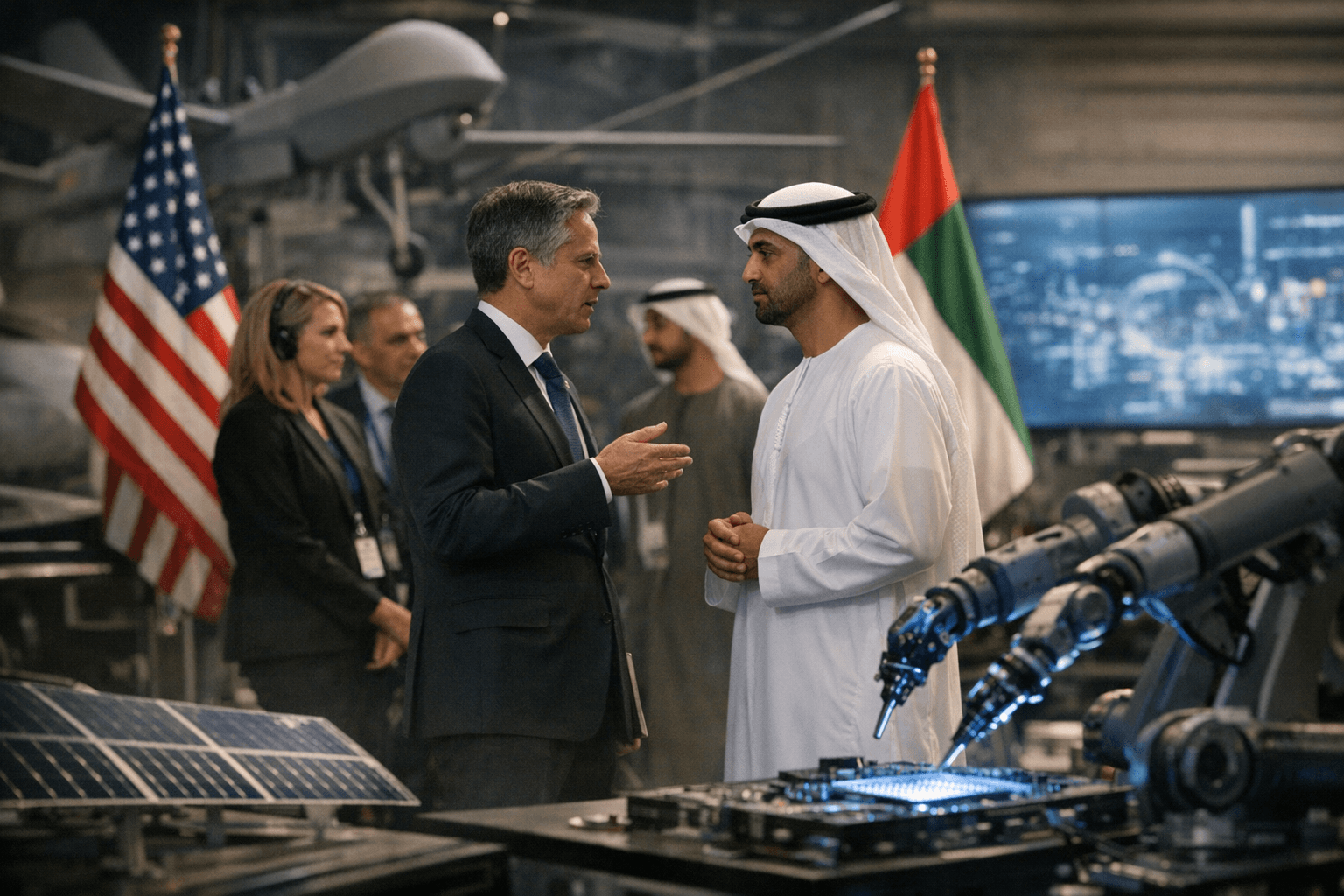
This is where the old oil-for-security bargain breaks down. In the past, the tradeoff was straightforward: energy stability in exchange for military protection. Today, the tradeoff is more complicated. The UAE is trying to balance its long-standing reliance on the United States for security with deepening ties to China and other powers. That means Washington is no longer the UAE’s only strategic reference point, and U.S. policy has to account for competition inside the relationship itself.
A true reset would therefore require clearer American choices. It would mean deciding how much technology transfer, joint development, and infrastructure cooperation Washington is willing to support in exchange for stronger alignment on security and regional strategy. It would also mean accepting that a closer partnership may require more tolerance for Emirati strategic hedging, so long as core U.S. interests are protected.
The Abraham Accords and the region’s new geometry
The UAE’s regional role has also expanded in ways that change the U.S. calculus. On September 15, 2020, the UAE signed the Abraham Accords with Israel, becoming the first Arab state in decades to normalize relations with Israel. The agreement called for diplomatic relations, full normalization, cooperation, and regional stability. That step made the UAE more than a bilateral partner to Washington. It turned Abu Dhabi into a bridge in the region’s emerging diplomatic architecture.
That wider role matters because U.S.-UAE ties now intersect with regional deterrence, Arab-Israeli diplomacy, and crisis management in ways the old model never captured. Leaders in Washington and Abu Dhabi have emphasized a broadening agenda that includes economics, defense, regional stability, and global issues. The relationship is therefore not just about protecting oil flows or basing rights. It is about shaping the region’s political and technological order.
Hormuz, logistics, and the price of instability
The Strait of Hormuz remains one of the clearest reminders that energy and security are still connected, even if the old bargain is obsolete. Emirati officials have warned that access through the waterway must be guaranteed and cannot be weaponized. That concern is not theoretical. The UAE sits at the intersection of energy flows, trade routes, and military access, which means instability in the strait would hit both the Emiratis and the global economy.
This is why logistics belongs in any serious U.S. policy reset. The UAE is a central node for regional trade and military mobility, not just a consumer of security guarantees. For Washington, preserving access, resilience, and interoperability is now as important as preserving barrels of oil. That suggests a broader strategic deal: one built around supply-chain security, port and transit resilience, defense access, and shared crisis management, rather than a narrow promise to police energy markets.
What Washington would have to accept
If the U.S. wants a true reset with the UAE, it would have to accept tradeoffs that the old framework avoided. It would need to treat the relationship as a partnership among equals, not a patron-client arrangement anchored only in oil. It would also need to accept that technology cooperation with Abu Dhabi will require tighter rules, more scrutiny, and clearer limits because of China-related risks and national security concerns.
The payoff is significant. The UAE is still a vital U.S. partner on defense, economic ties, and regional stability, and it remains deeply embedded in the infrastructure of American power in the Gulf. But the future of the relationship will depend on whether Washington can move from an oil-for-security mindset to a broader strategy built on technology, logistics, defense integration, and managed competition with China. That is the new bargain, and it is already being written in Abu Dhabi and Washington, D.C.
This article was produced by Prism’s automated news system from verified source data, official records, and press releases, then run through automated quality and moderation checks before publishing. The system is built and supervised by the people who set the standards it runs under. Read our full AI policy.
Did this article answer your question?


