USNI News Fleet and Marine Tracker Follows U.S. Navy Deployments Worldwide
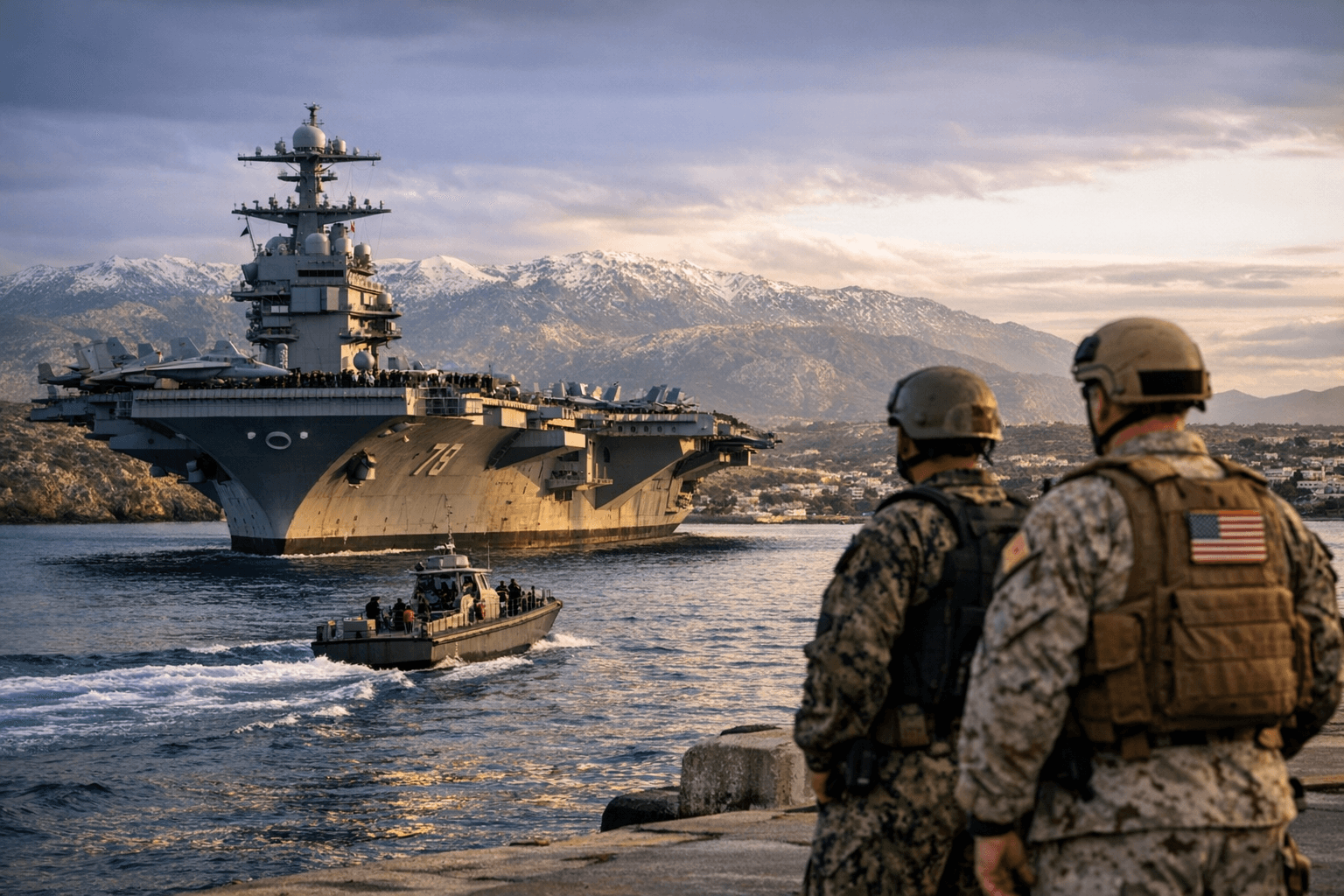
USS Gerald R. Ford pulled into Souda Bay, Greece, while the Boxer ARG left San Diego as the March 23 tracker shows U.S. naval power spread across four fleet areas.
Every week, USNI News compiles the approximate positions of the U.S. Navy's deployed carrier strike groups and amphibious ready groups throughout the world, based on Navy and public data. The March 23, 2026 edition captures a snapshot of American sea power stretched from the Arabian Sea to the Western Pacific, the Eastern Mediterranean to the British Indian Ocean Territory, reflecting a period of notable fleet movement and ongoing combat operations.
What the tracker is and how it works
USNI News describes each entry as "the approximate positions of the U.S. Navy's deployed carrier strike groups and amphibious ready groups throughout the world," noting that in cases where a CSG or ARG is conducting disaggregated operations, the chart reflects the location of the capital ship. The sourcing methodology draws on public statements, imagery, and open data, as well as Navy-provided information. In addition to the major formations tracked, others serving in submarines, individual surface ships, aircraft squadrons, SEALs, Special Purpose Marine Air-Ground Task Forces, Seabees, and EOD Mobile Units are not shown but are operating throughout the globe.
The tracker functions as a running public record, and its archive extends back through late 2025. Entries have appeared on December 29, 2025; January 5 and 12; February 9, 17, and 23; March 2, 9, and 16; and now March 23, 2026, building a detailed chronological record of fleet movements visible to anyone following the publication.
The March 23 snapshot: key movements
On March 23, 2026, USS Gerald R. Ford (CVN-78) pulled into port at Souda Bay, Greece, the Navy announced. That port call represents the latest stop for the Ford Carrier Strike Group, which has been one of the most actively tracked formations in recent weeks. Ford transited the Suez Canal on March 5, 2026, marking a significant geographic shift from her earlier operating area. By March 23, the Ford CSG's carrier air wing remained intact, with squadrons including the "Tomcatters" of Strike Fighter Squadron (VFA) 31, the "Ragin Bulls" of VFA 37, the "Golden Warriors" of VFA 87, and the "Black Lions" of VFA 213, all F/A-18 units homeported at Naval Air Station Oceana, Virginia.
In the Pacific, aircraft carrier USS George Washington (CVN-73) is in port in Yokosuka, Japan. George Washington has been a consistent presence in Yokosuka across multiple tracker editions, appearing in the same homeport as far back as the January 5 and March 2 entries.
The Arabian Sea remains one of the most operationally dense areas in the March 23 tracker. The Abraham Lincoln Carrier Strike Group has maintained a persistent presence there throughout the tracked period. As of early March, the Abraham Lincoln Carrier Strike Group was operating in the Arabian Sea in support of Operation Epic Fury. The Lincoln's air wing includes the "Tophatters" of VFA 14 flying F/A-18Es, the "Black Aces" of VFA 41 flying F/A-18Fs, the "Vigilantes" of VFA 151 flying F/A-18Es, and the "Black Knights" of Marine Fighter Attack Squadron 314 flying F-35Cs from Marine Corps Air Station Miramar.
The Boxer ARG departs; the Tripoli ARG heads for the Middle East
One of the most significant developments in the March 23 tracker is fresh amphibious movement out of the U.S. West Coast. Amphibious assault ship USS Boxer (LHD-4) deployed from San Diego, California, according to ship spotters, and the Boxer Amphibious Ready Group is underway in the U.S. 3rd Fleet area of operations. The Boxer ARG includes Boxer, USS Comstock (LSD-45), USS Portland (LPD-27), and the 11th Marine Expeditionary Unit. Marines with Kilo Company, Battalion Landing Team 3/5, 11th Marine Expeditionary Unit, were conducting amphibious assault training aboard USS Comstock as recently as March 2, 2026, signaling that the unit was preparing for operational deployment.
Meanwhile, the Tripoli ARG has been making a long transit westward. Amphibious assault ship USS Tripoli (LHA-7) is in port in Diego Garcia. The Tripoli Amphibious Ready Group, which includes Tripoli, USS New Orleans (LPD-18), and elements of the 31st Marine Expeditionary Unit, is en route to the Middle East after transiting the Strait of Malacca last week, USNI News reported. That trajectory is a sharp contrast to the formation's earlier positioning: as of early March, Tripoli was operating in the Philippine Sea following a port visit in Okinawa, Japan, with USS San Diego (LPD-22) and USS New Orleans (LPD-18) operating alongside her.
Persistent forces: Bahrain-based Littoral Combat Ships and independent destroyers
A constant feature across the tracker's recent editions has been the Navy's forward-deployed Littoral Combat Ship presence in Bahrain. USS Canberra (LCS-30), USS Tulsa (LCS-16), and USS Santa Barbara (LCS-32) are based in Bahrain with the Navy's first operational mine countermeasure mission packages in U.S. 5th Fleet. This three-ship LCS grouping has appeared consistently across the March 9, March 2, February 23, and January 5 tracker entries, underscoring the enduring importance of mine countermeasure capability in the Persian Gulf region.
Independent destroyer deployments to the Gulf have also been a recurring feature. As of late February, there were two guided-missile destroyers and a Littoral Combat Ship near the Strait of Hormuz, including USS Mitscher (DDG-57), homeported at Naval Station Norfolk, and USS Michael Murphy (DDG-112), homeported at Naval Station Pearl Harbor.
A living document: corrections and real-time updates
The tracker's revision history reveals how seriously USNI News takes positional accuracy. Across the period from December 2025 through March 2026, multiple entries were updated after initial publication. The February 9, 2026 entry carries the most explicit correction note in the archive: "This post has been updated to adjust the position of USS Theodore Roosevelt (CVN-71)," with the update timestamped on February 12, 2026 at 10:14 AM, three days after the original post. The March 2 entry was similarly revised, updated to correct the number of destroyers in the Eastern Mediterranean.
Other entries show same-day revisions: the February 23 post, originally published at 2:34 PM, was updated the same evening at 10:15 PM. The January 5 entry was corrected within 38 minutes of its original noon posting. The December 29, 2025 entry was revised the following morning at 7:52 AM. These update patterns reflect both the speed at which open-source data becomes available and the editorial commitment to correcting the record when new imagery, reports, or official statements sharpen the picture.
Beyond the carriers: what the tracker doesn't show
The tracker explicitly acknowledges its own limits. Every entry notes that submarines, individual surface ships, aircraft squadrons, SEAL teams, Special Purpose Marine Air-Ground Task Forces, Seabees, and EOD Mobile Units are not captured in the published map. As of the February 23 entry, the Navy's total battle force stood at 292 ships (233 USS, 59 USNS), with 101 deployed underway, including 37 forward-deployed naval forces and 64 rotational deployments. That context gives scale to what the tracker's visualized formations represent: only the highest-profile, most strategically significant groupings in a much larger global picture.
For analysts, journalists, and defense watchers, the cumulative record of weekly tracker entries has become a primary open-source tool for following the Navy's strategic posture in real time, from Yokosuka to the Strait of Hormuz to the Eastern Mediterranean and beyond.
This article was produced by Prism’s automated news system from verified source data, official records, and press releases, then run through automated quality and moderation checks before publishing. The system is built and supervised by the people who set the standards it runs under. Read our full AI policy.
Did this article answer your question?


