Vance Heads to Pakistan as Iran Cease-Fire Talks Face Collapse
Iran arrived in Islamabad demanding Lebanon be added to the ceasefire and frozen assets released before talks begin, as Israel's Lebanon strikes keep the Strait of Hormuz closed.

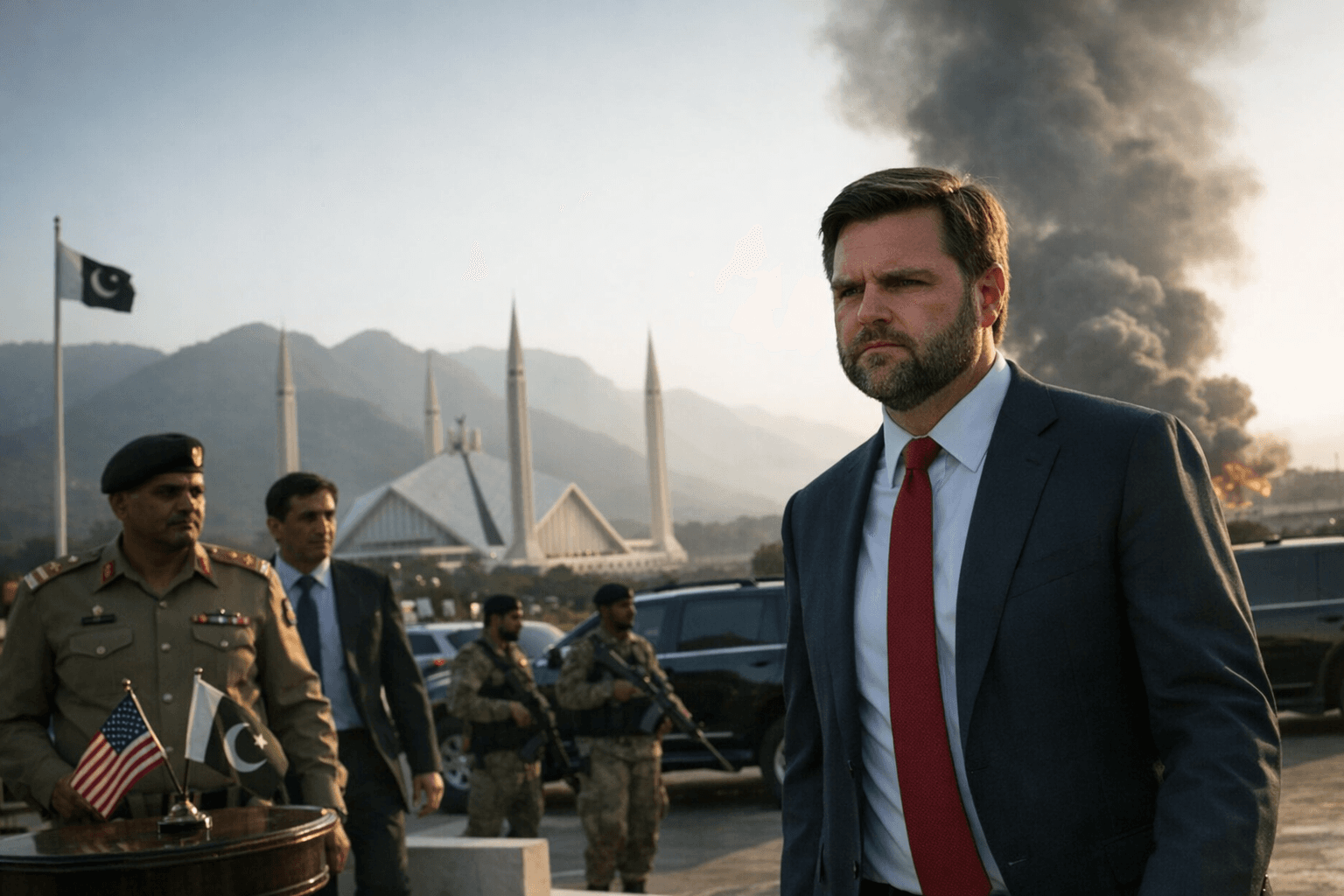
Vice President JD Vance landed in Islamabad on Friday as the two-week U.S.-Iran ceasefire he was sent to formalize teetered on conditions Iran said Washington had not yet met, with Israel's continued bombardment of Lebanon providing the sharpest threat to a deal that financial markets and global shipping have been counting on since President Trump announced it April 7.
The Iranian delegation, led by Parliament Speaker Mohammad Bagher Ghalibaf and Foreign Minister Abbas Araghchi, arrived in the Pakistani capital but stated flatly it would not begin substantive negotiations until two preconditions were satisfied: a ceasefire in Lebanon covering Hezbollah, and the release of Iran's blocked financial assets. "Two of the measures mutually agreed upon between the parties have yet to be implemented: a ceasefire in Lebanon and the release of Iran's blocked assets prior to the commencement of negotiations," Ghalibaf posted on X. He had earlier warned that "time is running out" for the ceasefire to remain viable.
The Strait of Hormuz, whose closure has choked global energy markets since the conflict began, underscored how much hangs on Islamabad. Friday recorded the lowest total number of ship passings through the strait since Trump announced the ceasefire on Tuesday. On Wednesday and Thursday just four ships transited daily, compared with between 130 and 160 ships per day before the war began.
Israel sits at the center of that pressure point. Israel's continued strikes on Hezbollah in Lebanon have shaken the ceasefire deal, and Tehran has made including Lebanon a non-negotiable precondition precisely because the battlefield there is where it retains the most immediate proxy leverage over Washington. Prime Minister Benjamin Netanyahu's office said Lebanon was not covered by the ceasefire agreement, despite Iranian protests, placing the two allies in open public contradiction ahead of the most consequential diplomatic meeting of the conflict. Trump pressured Netanyahu to scale back operations, and Israeli and Lebanese representatives were subsequently scheduled to meet in Washington the following week to discuss ongoing ceasefire negotiations. That concession, however modest, came too late to neutralize Tehran's stated conditions before Vance's arrival.
The leverage map across Islamabad is asymmetric in ways that complicate a fast resolution. Washington's core asks are Hormuz reopening and a nuclear framework; its principal threat remains military. Trump told the New York Post this week, "We're loading up the ship" as he re-upped pressure on Tehran. Iran's ask list is longer: sanctions lifted, U.S. forces withdrawn from regional bases, Lebanon included, and assets unfrozen. Iran claimed it had forced the U.S. to accept its 10-point plan, which includes lifting all sanctions and withdrawing U.S. forces from bases in the region, a framing the White House flatly rejected. Press secretary Karoline Leavitt said Iran's proposal was "literally thrown in the garbage by President Trump."
Gulf states watching from the margins have their own pressure points. Their oil revenues depend on Hormuz, and their quiet endorsement of Pakistan's mediation reflects a calculation that Islamabad is the last viable channel. Pakistani Prime Minister Shehbaz Sharif spoke with eight world leaders, including the emir of Qatar, the presidents of France and Turkey, and the chancellors of Germany and Austria, in a diplomatic sprint to shore up his country's role as honest broker.
Pakistan itself set a modest summit goal: a deal to keep talks going. Vance calibrated his public posture to match. He told reporters ahead of departure: "If the Iranians are willing to negotiate in good faith, we're certainly willing to extend the..." his sentence trailing off into an implied threat that the extension is conditional.
Iran's military joint command warned it had its "fingers on the trigger" due to repeated "breaches of trust" by the U.S. and Israel. With the Lebanese front still live, the Hormuz chokepoint still shut, and both delegations haggling over whether the meeting can even formally begin, the space between the diplomatic clock and the battlefield clock in Islamabad has rarely looked narrower.
This article was produced by Prism’s automated news system from verified source data, official records, and press releases, then run through automated quality and moderation checks before publishing. The system is built and supervised by the people who set the standards it runs under. Read our full AI policy.
Did this article answer your question?


