Viktor Orbán's 16-Year Grip on Hungary Faces Its Biggest Challenge Yet
With Vance in Budapest rallying for him and polls showing him down 19 points, Orbán faces the most dangerous election of his 16-year rule.

Viktor Orbán has rewritten constitutions, remapped electoral districts, and outlasted a generation of European leaders. This week, he needed the American vice president to fly to Budapest and tell Hungarians to keep him in power.
Vice President JD Vance touched down in the Hungarian capital on April 7, addressing a rally billed as a "Day of Friendship" and urging the crowd to "stand with Viktor Orbán." The visit was an extraordinary intervention: a sitting U.S. official openly campaigning for a foreign head of government three days before polling day. It also laid bare how completely Orbán's 16-year grip on Hungary has become fused with the Trump political project, and what that fusion may be costing him domestically.
Hungary votes on April 12 in what analysts across the continent have described as the most consequential parliamentary election in the country's modern history. Independent surveys published this week show Péter Magyar's Tisza party at 56% among decided voters against 37% for Fidesz, a gap of 19 percentage points that would have been unimaginable two years ago. Government-aligned pollsters paint a narrower picture, placing Fidesz at 46% against Tisza's 40%, but even those numbers represent a competitive race that Orbán has never faced since returning to power.
The depth of that shift becomes clearer against his electoral history. Orbán first seized power in April 2010 when Fidesz won a two-thirds parliamentary supermajority, a threshold he used to rewrite the Hungarian constitution, restructure the judiciary, and redesign the electoral map around Fidesz's rural strongholds. He won again in 2014, 2018, and 2022. Freedom House and the V-Dem Institute classified Hungary as an "electoral autocracy" during his tenure, and the European Commission froze billions of euros in cohesion and recovery funds over rule-of-law concerns, triggering Article 7 proceedings in Brussels. None of it produced a credible opposition challenger. Péter Magyar did.
Magyar, a lawyer and former Fidesz insider, emerged in early 2024 after making corruption allegations against the party establishment. His former wife, Judit Varga, had served as Fidesz's Justice Minister, lending his accusations particular force inside Hungary. He founded Tisza, from the Hungarian Tisztelet és Szabadság, meaning Respect and Freedom, and in the June 2024 European Parliament elections the party captured 29.6% of the vote against Fidesz's 44.8%. Magyar won a seat in Brussels. That result showed Hungary's historically fragmented opposition could consolidate behind a single force, and the polls have continued to tighten ever since.
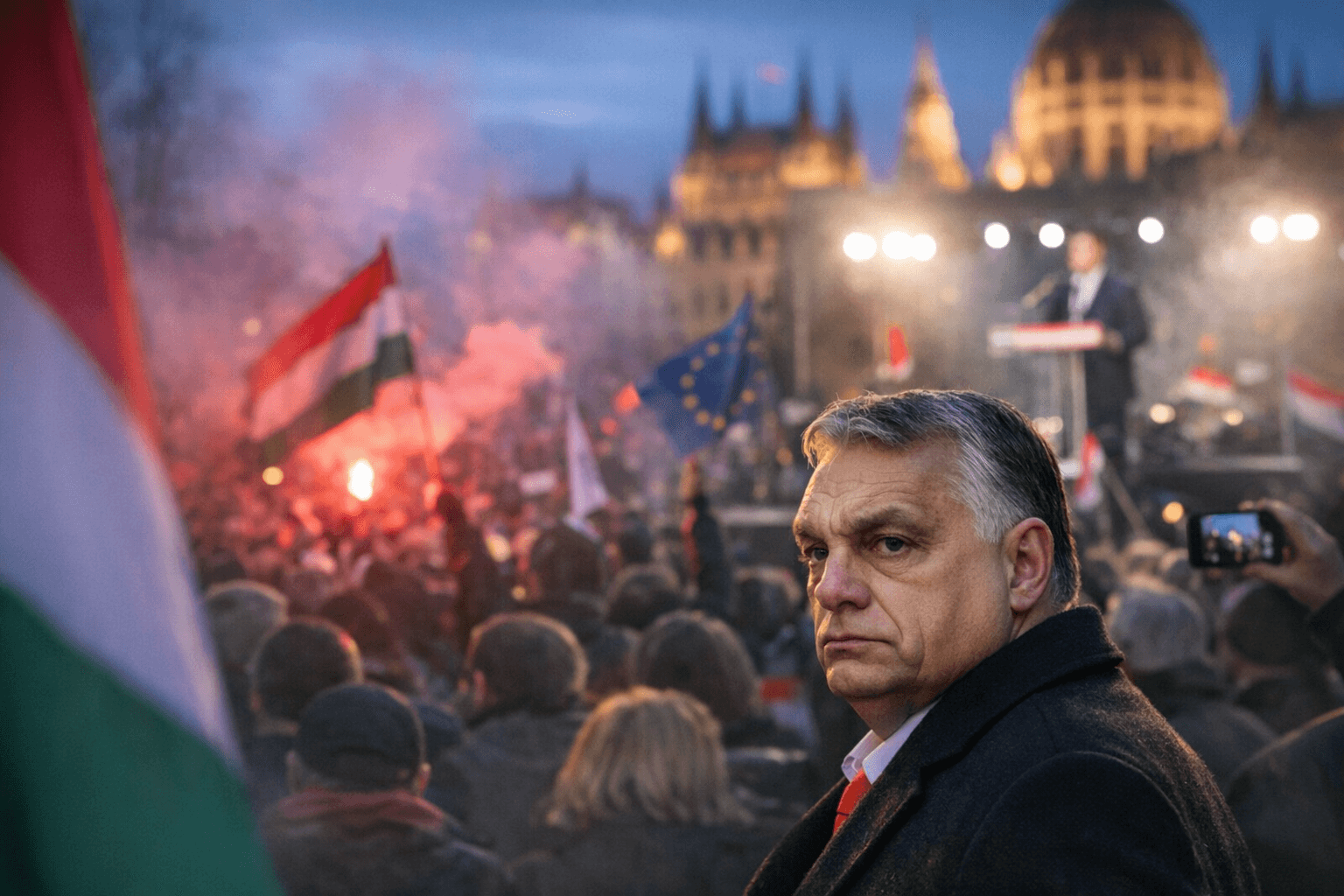
Orbán's alignment with Trump has become a defining fault line of the campaign. He endorsed Trump's 2024 presidential candidacy in person at Mar-a-Lago in March 2024 and was among the first European leaders to return there after Trump's November victory. Trump has called Orbán a "great leader" and held up Hungary as a governing model. Orbán has aligned Hungarian foreign policy with Trump's positions on Ukraine, NATO, and immigration, including Hungary's role in blocking EU military aid packages to Kyiv. Magyar's campaign has framed that record as evidence that Orbán's loyalties run to Washington and Moscow rather than Budapest.
The structural math still favors the incumbent. Fidesz engineered Hungary's current electoral system to amplify its rural support base, and analysts have cautioned that even Tisza's double-digit polling lead may not deliver a parliamentary majority. In Poland, it required an unusually broad multi-party coalition to dislodge a right-wing government with comparable structural advantages. Hungary's system may be harder still to crack.
Orbán coined the phrase "illiberal democracy" to describe what he built here. On April 12, Hungarians will deliver their verdict on whether the model can survive its architect's most dangerous electoral challenge yet.
This article was produced by Prism’s automated news system from verified source data, official records, and press releases, then run through automated quality and moderation checks before publishing. The system is built and supervised by the people who set the standards it runs under. Read our full AI policy.
Did this article answer your question?