Washington Still Struggles to Define What America First Actually Means
America First has driven foreign policy debate for over a decade, yet the Trump administration's 493 military strikes sit uneasily alongside official vows of non-intervention.
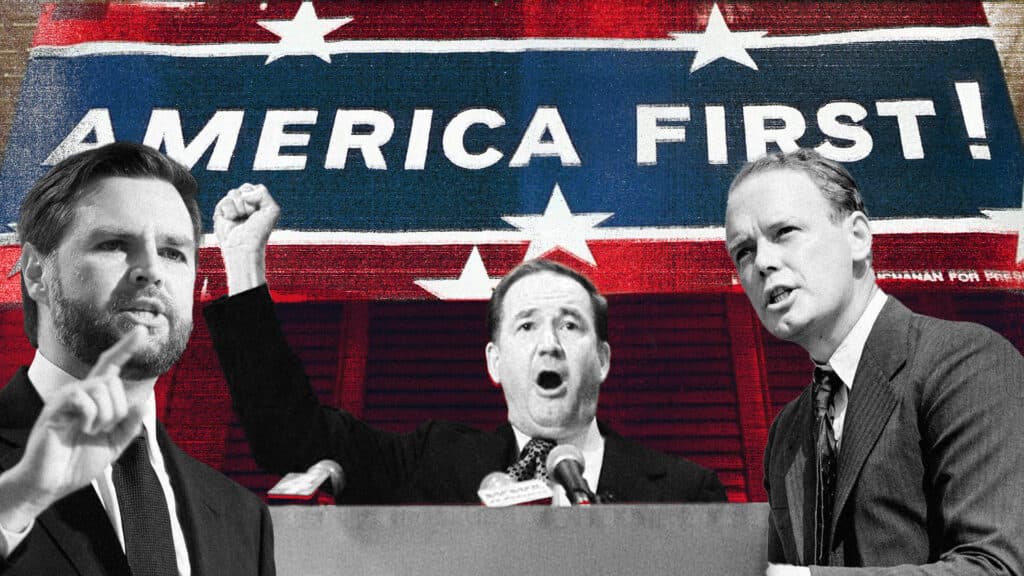
The phrase has outlasted every competing doctrine Washington has produced in a generation. Bill Clinton's "enlargement and engagement," George W. Bush's "freedom agenda," Barack Obama's "renewing American leadership," and Joe Biden's "foreign policy for the middle class" all cycled through and faded. "America First" has prevailed as the paradigm at the center of the foreign policy debate for more than 10 years, according to an analysis by the Chicago Council on Global Affairs, and yet no one in Washington can agree on what it actually requires the United States to do.
The contradictions built into the doctrine have never been sharper. Trump's 2025 National Security Strategy explicitly calls for returning to an earlier era in U.S. foreign policy, endorsing a revival of the Monroe Doctrine, which was promulgated in 1823. The National Defense Strategy of January 2026 goes further, stating "No longer will the Department be distracted by interventionism." Yet in the last 12 months, the U.S. carried out 493 military strikes.
The gap between the written doctrine and the operational record is difficult to ignore. NATO allies agreed to a record increase in defense spending, Iranian nuclear sites came under direct U.S. attack, Gaza acquired a fragile peace plan endorsed by the U.N. Security Council, U.S. tariff rates reached their highest level in a century, a new National Security Strategy warned Europe of "civilizational erasure," and the United States removed Venezuelan President Nicolás Maduro from power all within roughly a year. Charles Kupchan, a senior fellow at the Council on Foreign Relations and a professor at Georgetown University, has argued that Trump's instincts, as well as those of his MAGA base, are neo-isolationist, yet his policies are anything but, with American forces remaining on station across Asia, Europe, and the Middle East.
Not everyone reads the incoherence as a failure of strategy. Benjamin Banta, an associate professor of political science, has pushed back on the flip-flop framing. "It's been mentioned that [Trump] seems to flip-flop between imperialism and isolationism, and I think that's a flawed way of looking at things, and maybe that's the surface level," Banta has said, arguing the administration's approach is more purposeful than it appears.

Public opinion within the Republican coalition adds another layer of complexity to the debate. According to a November 2025 survey, almost 80 percent of MAGA Republicans want the U.S. to play a leading role in global affairs, up from 51 percent in June 2024. More recently, 74 percent of Republicans supported the U.S. military action in Venezuela. That appetite for engagement sits uneasily against the administration's stated preference for restraint.
The Trump administration believes that international pacts, open trade, and foreign assistance are degrading, not amplifying, U.S. power and influence, and Trump has made clear his hostility to multilateralism. But imposing tariffs on the NATO allies whose defense spending he simultaneously demands to increase is the kind of internal tension that analysts say makes "America First" more a political posture than a coherent grand strategy.
The U.S. now asserts its primacy in the Western Hemisphere while pursuing a strategy that also asserts preeminence in Asia, doing so with diminishing credibility by offering rhetorical paeans to "openness, transparency, and trustworthiness" while imposing tariffs on its closest allies, according to an analysis from the Carnegie Endowment for International Peace. After a decade of debate, Washington is no closer to a consensus definition, and the administration shows little interest in providing one.
This article was produced by Prism’s automated news system from verified source data, official records, and press releases, then run through automated quality and moderation checks before publishing. The system is built and supervised by the people who set the standards it runs under. Read our full AI policy.
Did this article answer your question?